Shellfish, crab and lobster

Traceability for shellfish, crab and lobster: from the harvest tag to every customer

Oysters, clams and mussels arrive tagged. Crab and lobster arrive live, by the tote or the crate, and leave graded, cooked, sectioned or picked. LOT AXIS records the harvest data once at receiving, links it to every lot you pack, and prints it on every case, so any container traces back to the harvest in minutes.
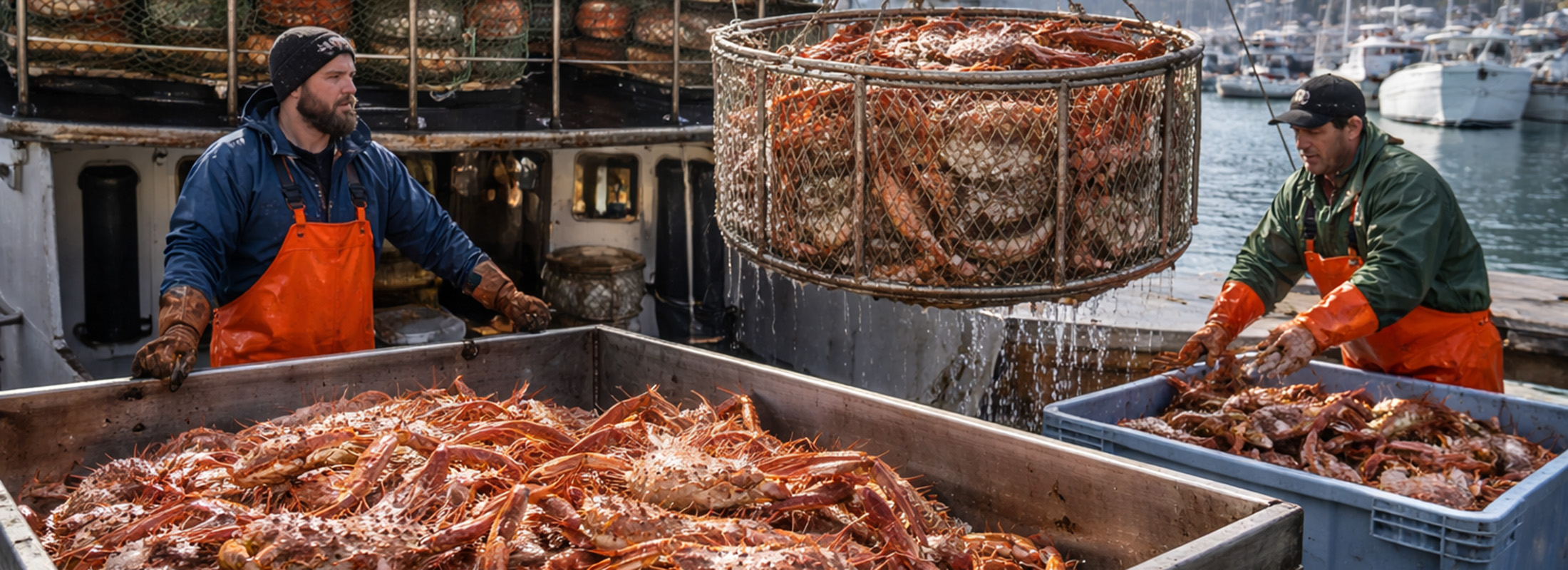
Crab boat in Alaska
What good looks like
Harvest tag or landing record
Graded, cooked or shucked lot, linked
Case label with the lot
Trace any container in minutes
Captured at the station, not typed later
Why it is hard

Live product, fast turns, lots of paperwork

Shellfish plants carry more rules per pound than almost any other seafood.

Harvest data

The tag has to follow the product

Harvest area, harvest date and the harvester or dealer number must stay with every container of oysters, clams and mussels.

Live holding

Tanks, crates and grades

Live crab and lobster are held, graded and re-graded before they ship. Every move between tanks and coolers is a chance to lose the lot.

Conversions

Cooked, sectioned, picked

One delivery becomes whole cooked, sections, claws and picked meat. Each new product needs its own lot, linked back to the delivery.

The rules

What the regulations ask for, and the record behind it

Rules depend on the species and where you ship. Most plants answer to several at once.

Rule
What it asks for
How LOT AXIS covers it
NSSP shellstock tags (US)
Every container of oysters, clams and mussels carries a tag with the harvester or dealer, harvest date, harvest location, and type and quantity of shellfish. Retailers keep tags for 90 days.
Each receiving station is configured to capture the tag data into the receiving lot. Every case and dealer label you print links back to it.
Shucked shellfish labels (US)
Containers of shucked shellfish carry the name, address and certification number of the packer or repacker.
Label formats are set up with your plant name, address and certification number, and print at the station from the lot record.
FSMA 204 (FDA)
Crustaceans, including crab, lobster, shrimp and crayfish, are on the Food Traceability List. Raw oysters, clams and mussels covered by the NSSP are exempt.
Lot codes and key data are captured at receiving, at every conversion and at shipping. The FSMA 204 Chain of Custody report answers a records request in minutes.
SIMP (NOAA, imports)
Imports of red king crab, Atlantic blue crab, shrimp, abalone and sea cucumber need harvest and landing data reported at entry, with records kept.
Import and supplier details stay on the inbound lot, and every downstream lot links back to it.
Country of origin (USDA COOL)
Fish and shellfish sold at retail must show the country of origin and whether it is wild or farm-raised, and suppliers must pass that information on.
Origin and wild or farm-raised can be captured on the receiving lot and printed on the case label, so it follows the product.
Canada: CSSP and SFCR (CFIA)
Harvester tags show the licence holder, harvest location, harvest date and species, and the identity of each shellstock lot must be kept through processing. SFCR asks for traceability one step back and one step forward.
Every processing lot is linked to the receiving lot it came from, and every shipment names the lots and the customer.
Sources: 21 CFR 1240.60; FDA Food Traceability List and 21 CFR 1.1305(f); FDA Food Code 2022; NOAA Seafood Import Monitoring Program; 7 CFR Part 60; CFIA Canadian Shellfish Sanitation Program manual. Checked October 29, 2026. Summaries only, not legal advice.
The questions

Questions to ask any shellfish, crab or lobster traceability vendor

Ask every vendor the same questions. Our answers are in the right-hand column, so you can hold us to them.

What to ask
Why it matters
How LOT AXIS answers
Can it capture harvest tag data at receiving?
Harvest area, date and harvester are hardest to recover later.
Each receiving station is configured to collect the data you need, such as harvest area, harvest date, harvester or dealer, species, truck and invoice.
Does it track live product between tanks and coolers?
Live crab and lobster move several times before they ship.
An Android handheld app covers Load, Unload, Move, Inventory, Palletize and Process Raw Materials, so every move keeps the lot.
Is a new lot created when product is cooked, sectioned or picked?
Each new product needs its own lot, linked to the delivery.
Yes. Every product conversion creates a new lot, linked to the lots that went into it. The lot code is calculated, never typed.
Does it handle catch weight?
Every case weighs something different. If label, inventory and invoice disagree, you give product away or argue with the buyer.
The scale weight goes onto the label, into inventory and onto the shipment. Nobody writes it down or types it twice.
How fast is a trace, really?
FDA can ask for records within 24 hours. Customers often want an answer on the call.
Enter any lot in Traceability View to see every lot back to receiving and forward to every customer, then print or share the FSMA 204 Chain of Custody report.
Does it keep running when the internet drops?
Peak weeks are the worst time for an outage.
LOT AXIS runs on your own server in the plant, so the floor keeps working and the lot history stays in your own database.
See it in the software

What it looks like in a shellfish, crab or lobster plant

Real LOT AXIS screens and reports, shown with sample data.
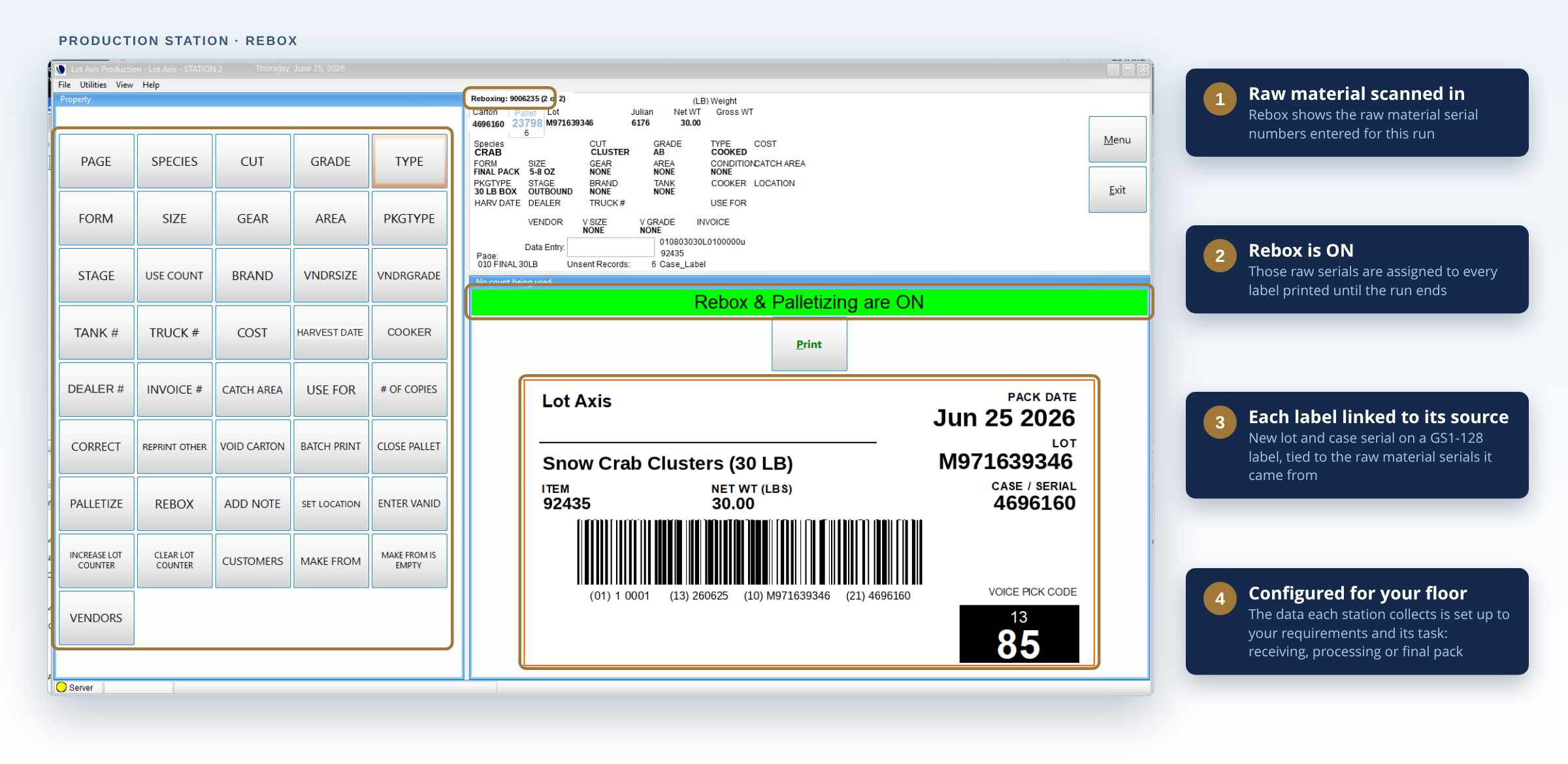
LOT AXIS Production station with Processing (Rebox) on for snow crab clusters: raw material serials linked to every case label printed (sample data)
Click to enlarge

Lots linked at the station

The source units scanned at the station are linked to every label printed from them.
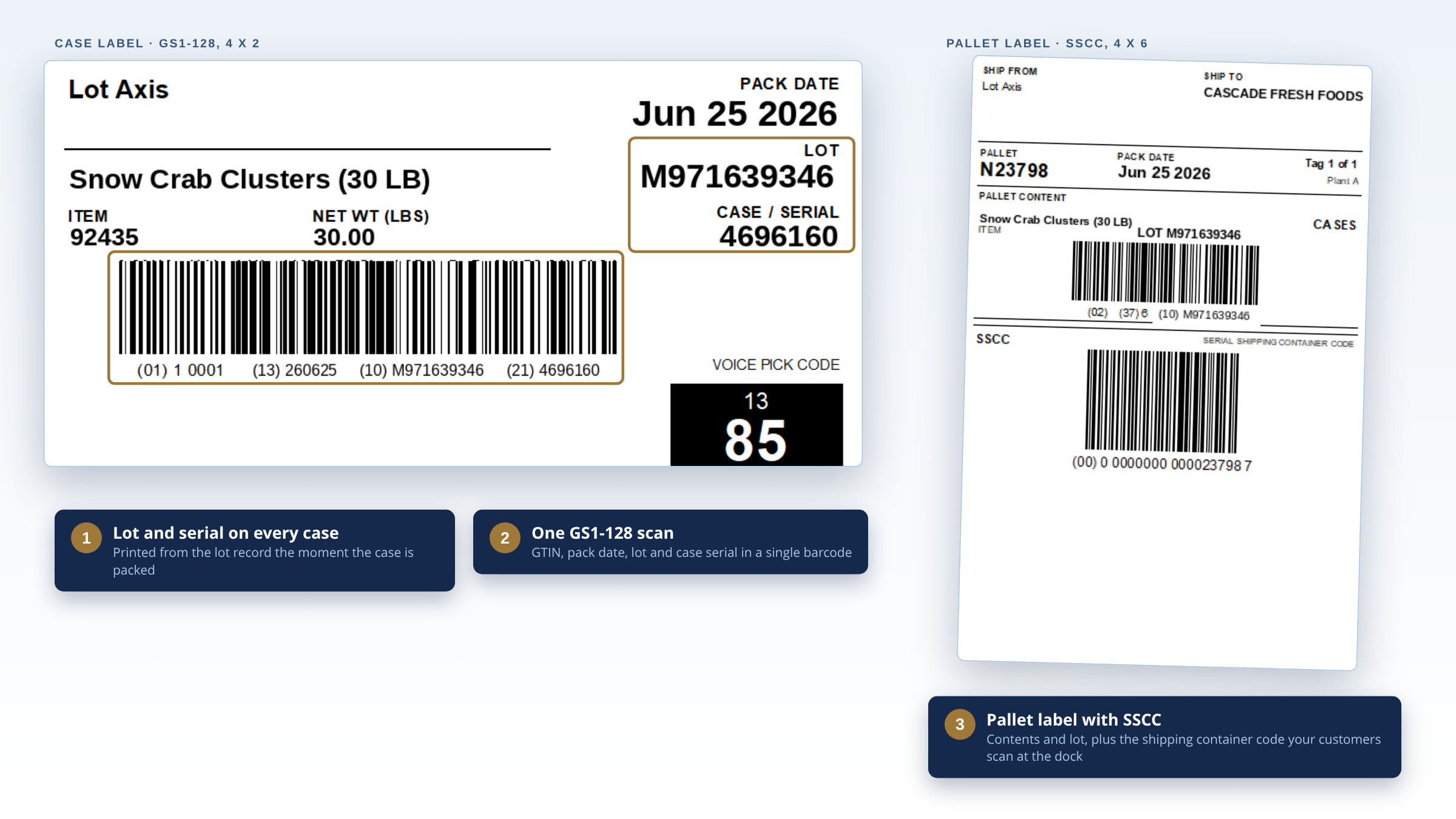
LOT AXIS GS1-128 case label and SSCC pallet label for snow crab clusters, printed from the lot record (sample data)
Click to enlarge

Case and pallet labels from the lot

GS1-128 case label and SSCC pallet label printed from the lot record.
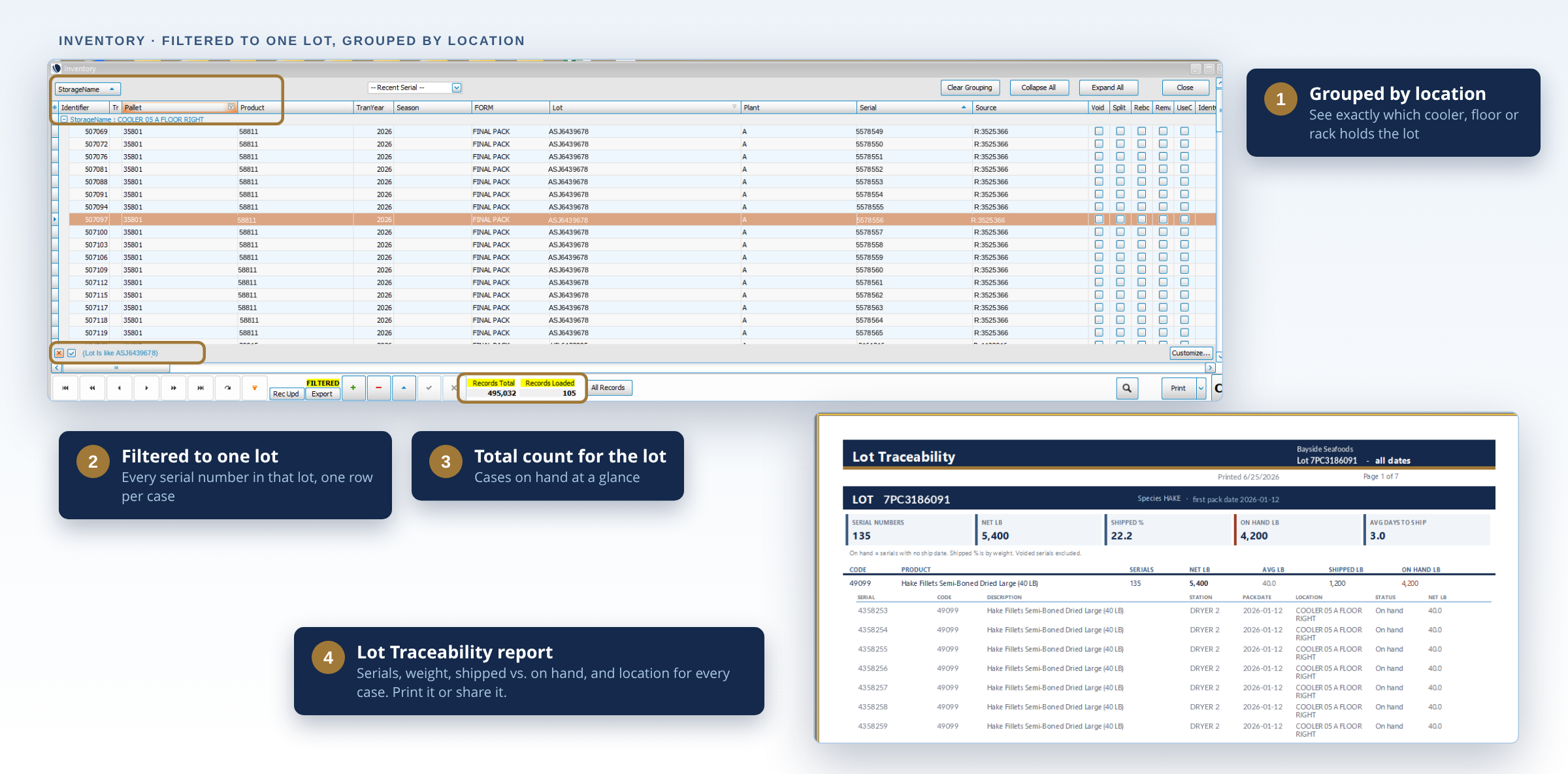
LOT AXIS inventory filtered to one lot, grouped by storage location, with total count and the Lot Traceability report (sample data)
Click to enlarge

Every lot, every location

Inventory filtered to one lot, grouped by storage location.
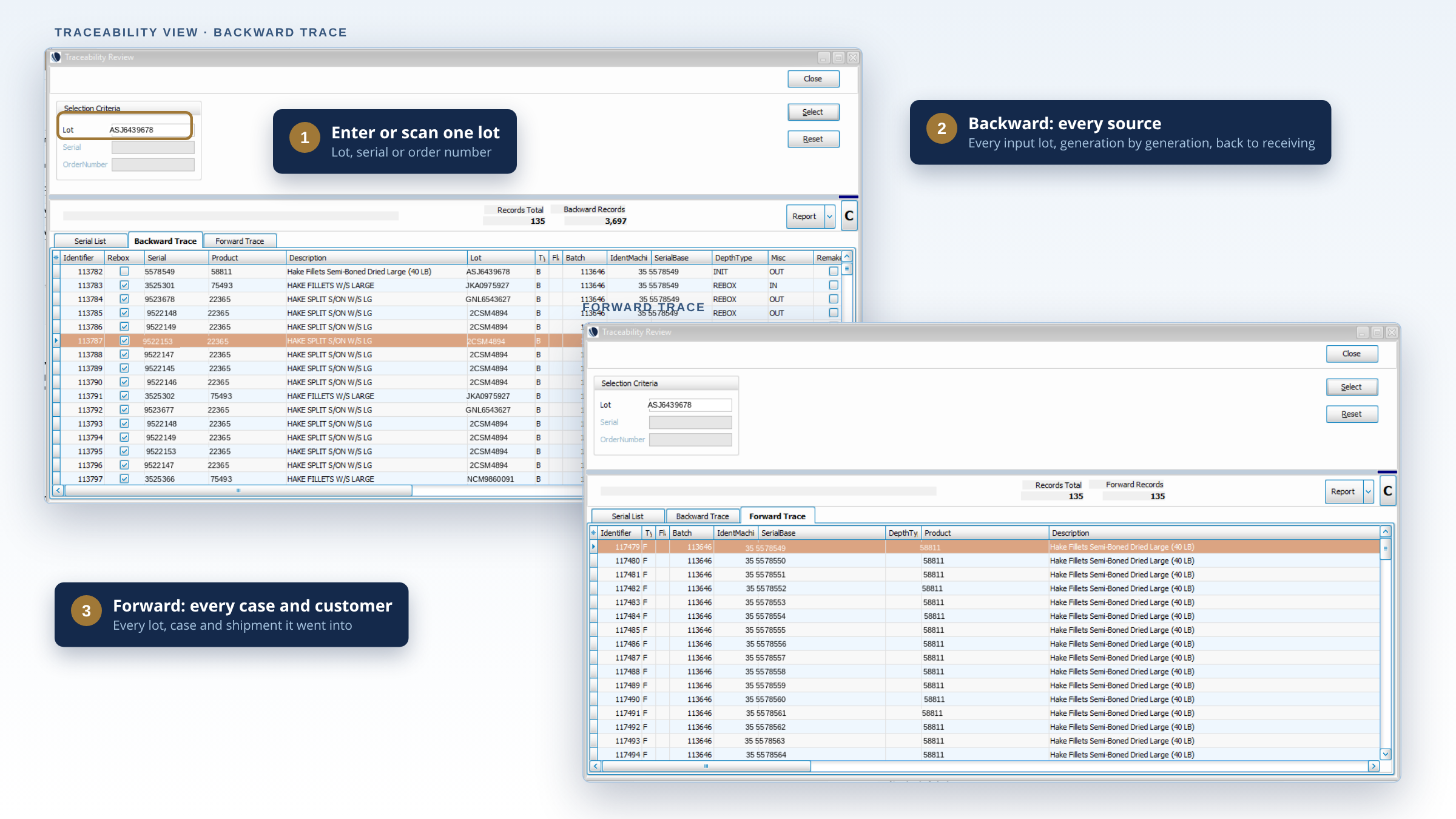
LOT AXIS Traceability View showing backward and forward trace for one lot (sample data)
Click to enlarge

Trace from any lot

Type or scan any lot and see every lot it came from and every lot and shipment it went into.

Questions

Shellfish, crab and lobster questions

Does LOT AXIS replace our shellfish tags?

No. You still tag product as your shellfish program requires. LOT AXIS records the tag data at receiving and links it to every lot you pack and ship.

Does FSMA 204 apply to us?

Crab, lobster, shrimp and crayfish are on the Food Traceability List. Raw oysters, clams and mussels covered by the NSSP are exempt from FSMA 204. FDA cannot enforce the rule before July 20, 2028, but many buyers will ask for the data sooner.

Can it handle size grades?

Yes. Product and grade are part of the lot record, so a trace or an inventory count shows each grade separately.

Will it work with our scales?

LOT AXIS connects to Western Scale Co., Rice Lake and Avery Weigh-Tronix scales and to Bizerba and Marelec graders. Each production station runs up to three label printers and a scale.

How is LOT AXIS priced?

A one-time purchase: from $45,000 per site, with flat-rate add-ons, plus annual support at 20% of the licence. No monthly subscription. Implementation is quoted for your plant. See pricing.

Reading

Go deeper

Plain-English pages on the LOT AXIS site.

Seafood

LOT AXIS for seafood processors

Read
SIMP

SIMP and FSMA 204, from one lot record

Read
FSMA 204

FSMA 204 records, captured as you work

Read

Trace one of your deliveries

Bring one species and one delivery. In a 30-minute demo we follow it from the harvest tag to the truck and show you the trace.

Scroll to Top