
| KEY TAKEAWAYS
• In Food Processing’s 2026 Manufacturing Outlook Survey, 30% of respondents said they were replacing paper records with electronic records, up from 28% a year earlier. One in five is still waiting. [1][11] • Paper is still legal. FDA’s preventive controls rule, the Food Traceability Rule and FSIS HACCP rules all accept paper or electronic records, and the FDA food rules exempt those records from Part 11. [2][3][4] • What paper allows is a record written after the fact. Three recent FDA warning letters describe a form left blank but signed, pre-filled times, records backdated during an inspection, and three years of missing logs. [5][6][9] • FDA’s own traceability exercises found that supply chain coordination, more than any particular technology, drove the best results. Software changes the record. It does not replace the agreement about what goes in it. [7] |
A Blank Form, Signed and Dated
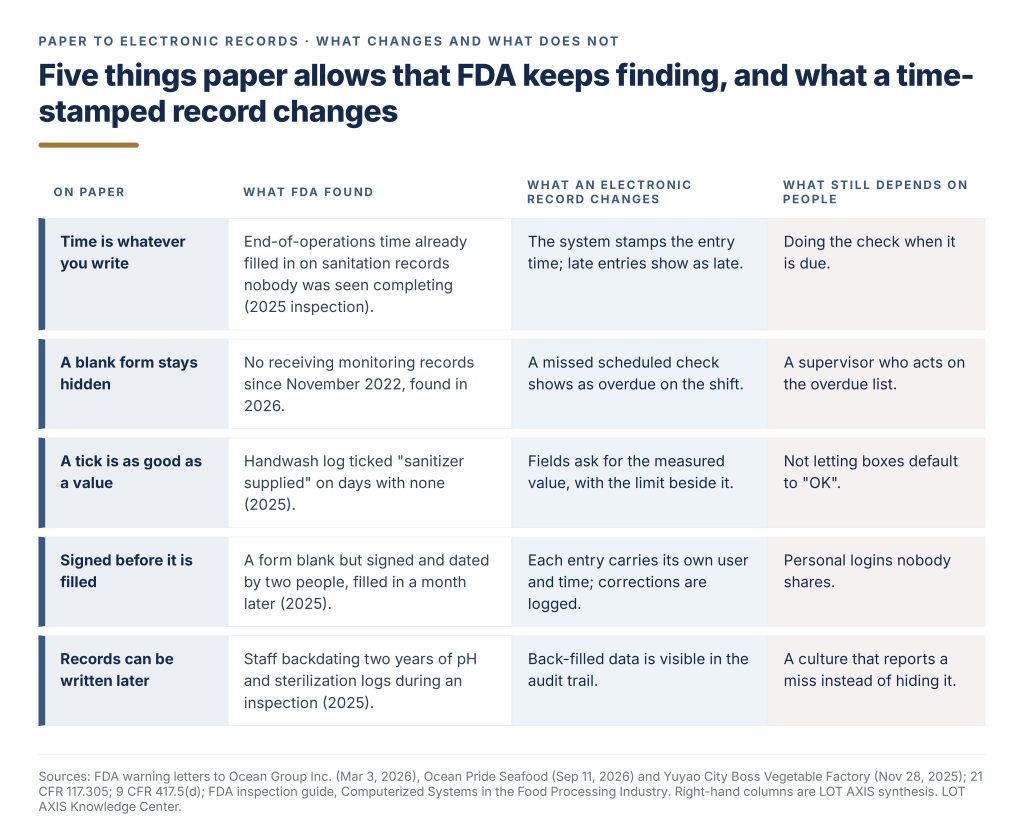
On April 17, 2025, at a seafood processor’s facility in Oceanside, California, someone filled in a sanitation monitoring form. Or rather, two people signed and dated it, the sanitation manager and a HACCP administration associate. The form itself was blank. [5]
FDA’s investigator found it on a later visit. At the same company’s Los Angeles plant in June, the investigator never saw anyone fill in the sanitation record at the times printed on it; the form had “a pre-filled out time for end of operations.” At Oceanside, the handwashing log was check-marked for an adequate supply of sanitizer on days when the station had none. In its response, the company filled in the April 17 form more than a month later. FDA’s warning letter of March 3, 2026 called that inadequate: “such retroactive recording is not a proper corrective action.” [5]
It is not an isolated case. In June 2025 an FDA investigator at a Chinese acidified vegetable plant watched the quality manager and an administrative assistant “creating and backdating multiple records,” including pH results and sterilization monitoring logs, to cover production since 2023. The product went on import alert. [6] In September 2026, FDA wrote to a California seafood processor that had no receiving monitoring records since November 23, 2022. [9]
None of these is a technology story. They are what happens when a record is a sheet of paper that can be filled in at any time, by anyone, with anything.
Who Is Moving, and How Fast
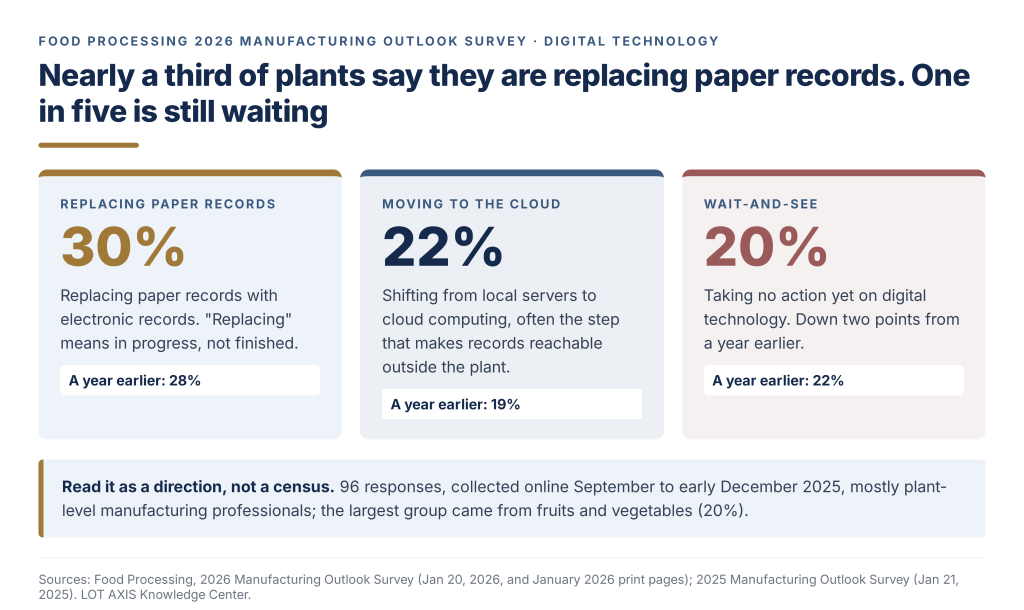
Food Processing magazine’s 25th annual Manufacturing Outlook Survey ran from September to early December 2025. Asked how digital technology was affecting their facility, 30% of respondents said they were replacing paper records with electronic records, up from 28% the year before. Another 22% were shifting from local servers to cloud computing, and 20% were still taking a wait-and-see approach, down from 22%. [1][11]
Two cautions. The survey had 96 responses, so treat it as a direction rather than a census. [10] And “replacing” means in progress. The 30% are not done. They are in the middle, which is where most of the hard lessons are.
The direction is consistent across other surveys. CRB’s 2026 Horizons: Food Safety report, built on more than 300 North American manufacturers, describes the industry “shifting from fragmented, paper-based systems” toward digital traceability, driven largely by FSMA 204. More than 70% plan to invest in automation and control systems in the next three years, yet a growing share expect it to take more than four years to reach their target. [12][13] A 2025 survey of 165 food safety and quality leaders by a software vendor found 69% still relied on manual processes such as spreadsheets, fax and email. [14] Money is following: electronic records already ranked in the top five areas for capital spending in the 2025 outlook survey. [11]
What the Rules Actually Require
No US food safety rule makes you give up paper. Under FDA’s preventive controls rule, records may be originals, true copies or electronic records. They must contain the actual values observed, be “accurate, indelible, and legible,” and be “created concurrently with performance of the activity documented,” with the date, time where appropriate, and the signature or initials of the person who did it. [2] The seafood HACCP rule requires information to be entered on records at the time it is observed, the clause the Oceanside letter cites. [5][17]
FSIS says much the same for meat and poultry. Each HACCP record entry “shall be made at the time the specific event occurs” with date, time and initials, and records kept on computers are acceptable “provided that appropriate controls are implemented to ensure the integrity of the electronic data and signatures.” [4]
Part 11, FDA’s electronic records and signatures rule, worries many plants. For records kept only to meet the preventive controls rule or the Food Traceability Rule, it does not apply: both rules expressly exempt them. [2][3] Records also required under another regulation stay subject to it, and FDA has applied Part 11 narrowly since its 2003 scope guidance. [15]
The Food Traceability Rule is where paper gets expensive. Records can be paper or electronic, but when FDA is dealing with an outbreak or recall it can ask for an electronic sortable spreadsheet of the requested traceability data within 24 hours. Farms with average sales of no more than $250,000, and retailers and other businesses under $1 million, may answer in another form. [3][8] Everyone else has to type their paper into a spreadsheet on the clock. The compliance date is July 20, 2028, as of October 2026. [8]
Five Things That Change on the Floor
Plants that make the move usually describe the same changes, and each one maps to a failure in the letters above.
- The time stamp stops being an opinion. On paper, the time is whatever the person writes. A system records when the entry was made, so a pre-filled end-of-shift time is impossible and a late entry is visible as late. [5]
- A missed check shows up today, not at the audit. A blank paper form is found weeks later, if at all. A scheduled electronic check that has not been done shows as overdue on the shift. Three years without receiving records would have been three years of red flags. [9] Meat and poultry plants already have to review HACCP records for completeness before product ships. [4] On paper, that review is someone leafing through a stack at the end of the day. On screen, it is a list of what is missing.
- The record asks for a value, not a tick. The rules want actual values. [2][4] A field that needs the measured sanitizer concentration or temperature, with the limit beside it, is harder to fake than a check mark, and an out-of-limit entry can prompt the corrective action on the spot.
- Lot codes are scanned, not copied. Every handwritten lot code is a chance for a transposed digit. A scan carries the code from the label to the record unchanged, which is what a traceback depends on.
- Corrections leave a trail. On paper, a correction is a crossed-out line, and backdating can leave no trace at all. FDA’s inspection guide for computerized food systems expects records to be produced in a readable form and electronic signatures to be controlled so that each one belongs to the person who made the entry. [16] A system that logs who changed what, and when, makes the April 17 form a non-event.
What Does Not Change
Software does not fix a culture that fills in forms after the fact. A tablet form whose boxes default to “OK” is the Oceanside check mark in digital form. FSIS ties electronic records to “appropriate controls” for integrity for exactly this reason. [4]
FDA’s 2026 traceability tabletop exercises made a related point. Fifteen companies were asked to produce traceability records in a sortable spreadsheet within 24 hours. Most did, and FDA concluded that “proactive supply chain coordination, more than any particular technology, drove the strongest results.” Participants’ tools ranged from sophisticated systems to printed invoices. [7][19] Where suppliers had not agreed on what data to share, some firms simply left spreadsheet fields blank.
PMMI’s work with manufacturers names the same barriers: the move from manual to automated data capture, training people to capture data accurately, and building a culture that treats data as an asset. [18]
A Sensible Order of Operations
From the plants that have done it, a workable sequence looks like this:
- Start with the records that hurt. CCP monitoring and receiving lot codes come first: they carry the most regulatory risk and feed every traceback.
- Design for values and exceptions. Ask for the measurement, show the limit, and make the deviation path part of the form.
- Run paper and electronic side by side for a fixed, short period, then retire the paper. Two systems that both count as the record are worse than either one.
- Test retrieval, not just entry. Pick one lot and produce the sortable spreadsheet FDA would ask for. Time it.
- Agree data with suppliers and customers. Lot code, format and how it travels: FDA’s exercises show this matters more than the tool. [7]
How Lot Axis Fits
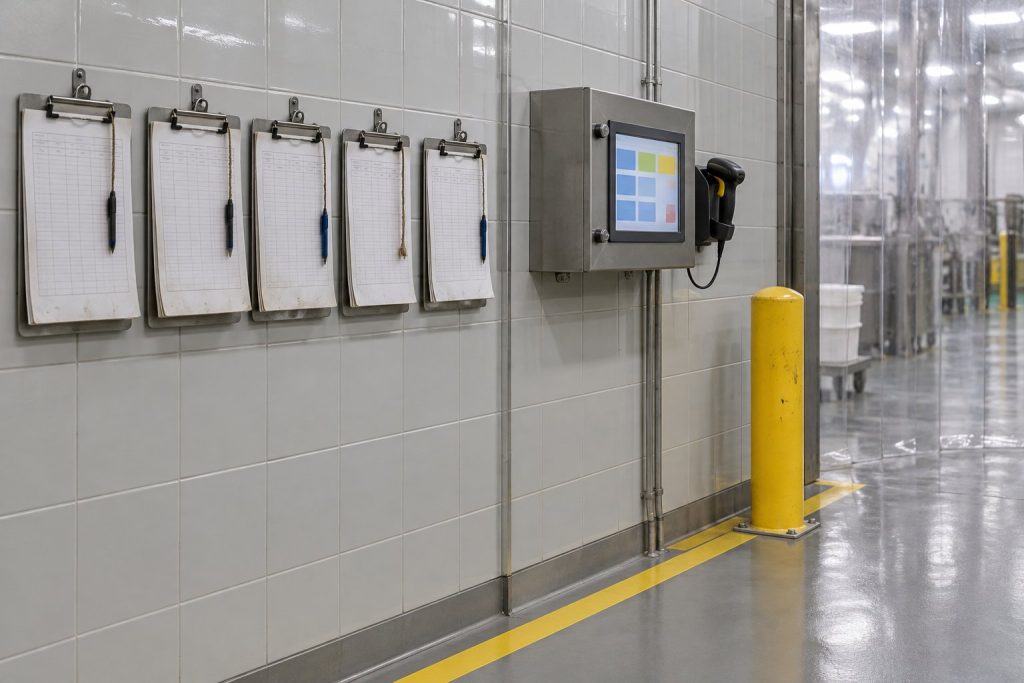
Lot Axis replaces the clipboard with a record made at the moment the work happens. Operators scan lot codes at receiving, production and shipping, enter measured values against limits, and see overdue checks on the shift. Every entry carries its own time stamp and user, and corrections are logged rather than overwritten. Because the same record drives the operation, the 24-hour sortable spreadsheet is a report, not a project. That is what we mean by Lot Intelligence™: one record that runs the floor and answers the inspector.
Want to see what one of your paper logs looks like as a live record? Schedule a Lot Axis demonstration and bring the form you trust least.
This article is general information, not legal advice. Recordkeeping requirements depend on your products and regulator; the FSMA 204 compliance date and survey figures are as of October 19, 2026. Confirm current requirements with FDA, FSIS or your state agency.
Sources
Paste this list at the end of the published post. The full research package below stays internal.
- Food Processing — 2026 Manufacturing Outlook Survey: Will Cost Control Sink Growing Optimism? (January 20, 2026)
https://www.foodprocessing.com/on-the-plant-floor/article/55344696/2026-manufacturing-outlook-survey-will-cost-control-sink-growing-optimism
- eCFR — 21 CFR 117.305, General requirements applying to records
https://www.ecfr.gov/current/title-21/chapter-I/subchapter-B/part-117/subpart-F/section-117.305
- eCFR — 21 CFR Part 1, Subpart S, Additional Traceability Records for Certain Foods (incl. § 1.1455)
https://www.ecfr.gov/current/title-21/chapter-I/subchapter-A/part-1/subpart-S
- eCFR — 9 CFR 417.5, Records (FSIS HACCP)
https://www.ecfr.gov/current/title-9/chapter-III/subchapter-E/part-417/section-417.5
- S. FDA — Warning Letter, Ocean Group Inc., CMS 715467 (March 3, 2026)
https://www.fda.gov/inspections-compliance-enforcement-and-criminal-investigations/warning-letters/ocean-group-inc-715467-03032026
- S. FDA — Warning Letter, Yuyao City Boss Vegetable Factory Co. Ltd., CMS 717174 (November 28, 2025)
https://www.fda.gov/inspections-compliance-enforcement-and-criminal-investigations/warning-letters/yuyao-city-boss-vegetable-factory-co-ltd-717174-11282025
- S. FDA — FDA Releases Report on Traceability Readiness Tabletop Exercises and Updated FAQs (June 2026)
https://www.fda.gov/food/hfp-constituent-updates/fda-releases-report-traceability-readiness-tabletop-exercises-and-updated-faqs
- S. FDA — FSMA Final Rule on Requirements for Additional Traceability Records for Certain Foods
https://www.fda.gov/food/food-safety-modernization-act-fsma/fsma-final-rule-requirements-additional-traceability-records-certain-foods