| KEY TAKEAWAYS
• For fresh produce, the traceability lot code is assigned at initial packing and nowhere else. Distributors and retailers must pass it on unchanged, so a mistake made at the pack travels with the product. [1][3] • Of the fifteen key data elements a produce packer must link to each lot, six have to arrive from someone else: the harvester and, where product is cooled first, the cooler. The rule requires them to send it. [1][4] • In FDA’s 2026 readiness exercises, some firms said in their traceability plan that produce was field packed, then listed a cooling facility as the lot code source in their spreadsheet. Only 27% of participants’ records carried a complete lot code source at every step. [2] • Sprouts carry seven extra seed-supply elements. This autumn’s Salmonella outbreak, traced to a single seed lot, shows why. [1][5] |
The Spreadsheet Said Cooler
Between March 9 and April 1, 2026, FDA asked fifteen companies to do what it will ask during an outbreak: hand over traceability records for one product, over a short date range, in a sortable spreadsheet within 24 hours. Most made the deadline. [2]
The detail that matters for packers sits in one paragraph of the final report. In some exercises, firms wrote in their traceability plan that produce was field packed, correctly naming the farm as the place where the lot code was assigned. Then their spreadsheet listed a cooling facility as the traceability lot code source. FDA’s advice was blunt: initial packers should make sure their records match how they actually operate, so that the lot code source “accurately reflects the physical location where the food was packed.” [2]
That sounds like a clerical slip. It is not. The lot code source is the address FDA goes to when it needs to know where a lot began. Send it to the cooler and the trace starts at a building that never assigned the code. Across all participants, only 27% of records carried a complete lot code source at every step they performed. [2][17]
Why the First Record Is the One That Counts
The Food Traceability Rule allows a traceability lot code to be assigned at only three points: initial packing of a raw agricultural commodity, first land-based receiving of seafood, and transformation. At every other step, including shipping, a firm must not create a new one. [1] FDA’s FAQ puts it plainly: “a distributor should not change the TLC provided to them.” [3][19]
So for a head of lettuce or a case of cucumbers, the lot code assigned on the packing line is the identity the product carries to the store. FDA has said it chose initial packers to assign the code because they are “better suited to assign TLCs than growers,” and that the packer’s records of farm, harvester and cooling are what “shorten the time it takes to perform tracebacks.” [3]
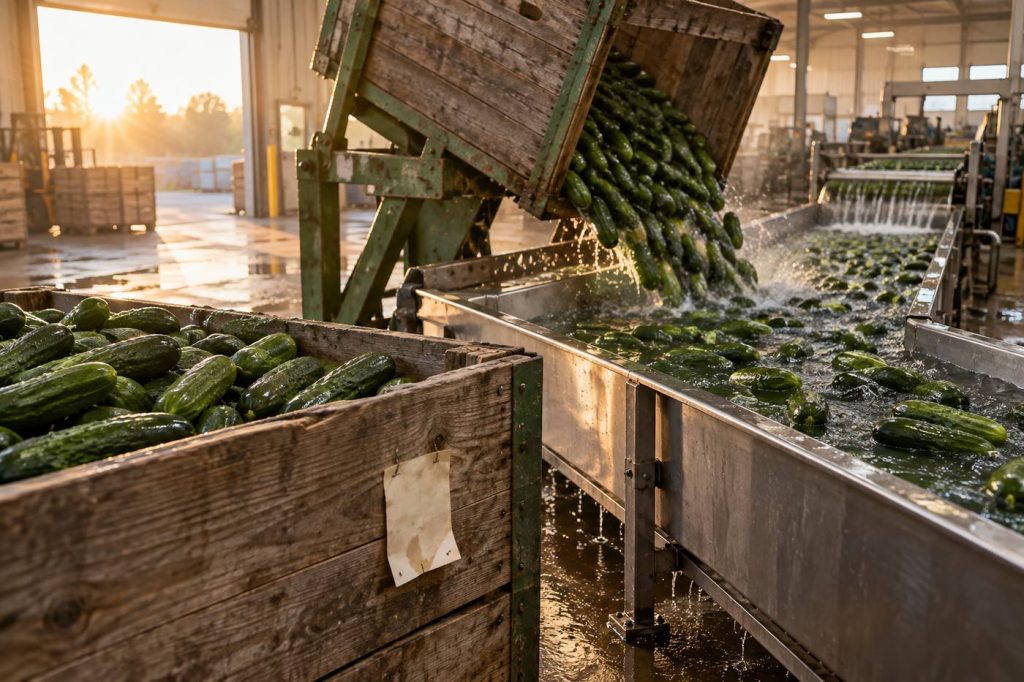
Initial packing means packing a raw agricultural commodity for the first time. [1] Depending on the operation, that happens in very different places. In FDA’s produce example, a contract harvester picks cucumbers, an off-site cooler cools them and a packinghouse packs them, so the packinghouse is the initial packer. If a farm packs in the field, the farm is. [10] And if a packer later repacks someone else’s product, that is not initial packing at all: FDA treats repacking as transformation, with its own records. [3]
The lot code source follows the food, not the org chart. FDA’s FAQ addressed companies whose lot codes are set at headquarters: the decision may be made there, but “the TLC source will always be a place where the food was physically handled.” [3]
Fifteen Elements, Three Sources
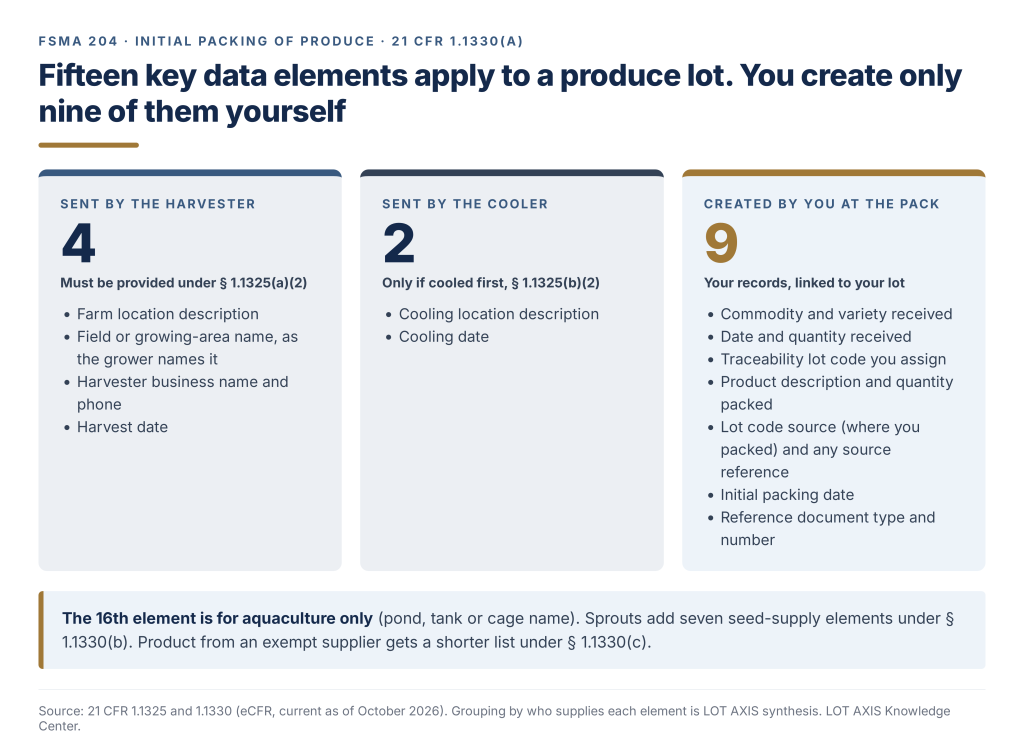
Under 21 CFR 1.1330(a), the initial packer must keep sixteen key data elements and link each one to the traceability lot. One applies only to aquaculture, which leaves fifteen for produce. [1]
The useful way to read them is by who knows each fact. Four come from the harvester: the farm’s location description, the field or growing-area name, the harvester’s business name and phone number, and the harvest date. Two come from the cooler, if the product was cooled before packing: the cooling location and the cooling date. The packer creates the other nine: commodity and variety received, date and quantity received, the lot code, the product description, the quantity packed, the lot code source and any source reference, the packing date and the reference document. [1][4][9]
The rule does not leave the first six to chance. Section 1.1325 requires anyone who harvests or cools a listed food to send that information to the initial packer, “either directly or through the supply chain.” [1] FDA’s fact sheet for produce farms lists exactly what goes forward. [4] In practice, it rides on a bin ticket, a harvest log or a grower portal, and that is where it gets lost.
Two details are easy to miss. The field name “must correspond to the name used by the grower.” [1] And the farm’s location description is business name, phone and address, not GPS coordinates for every block; the field name carries the precision. [3]
Five Ways the First Record Goes Wrong
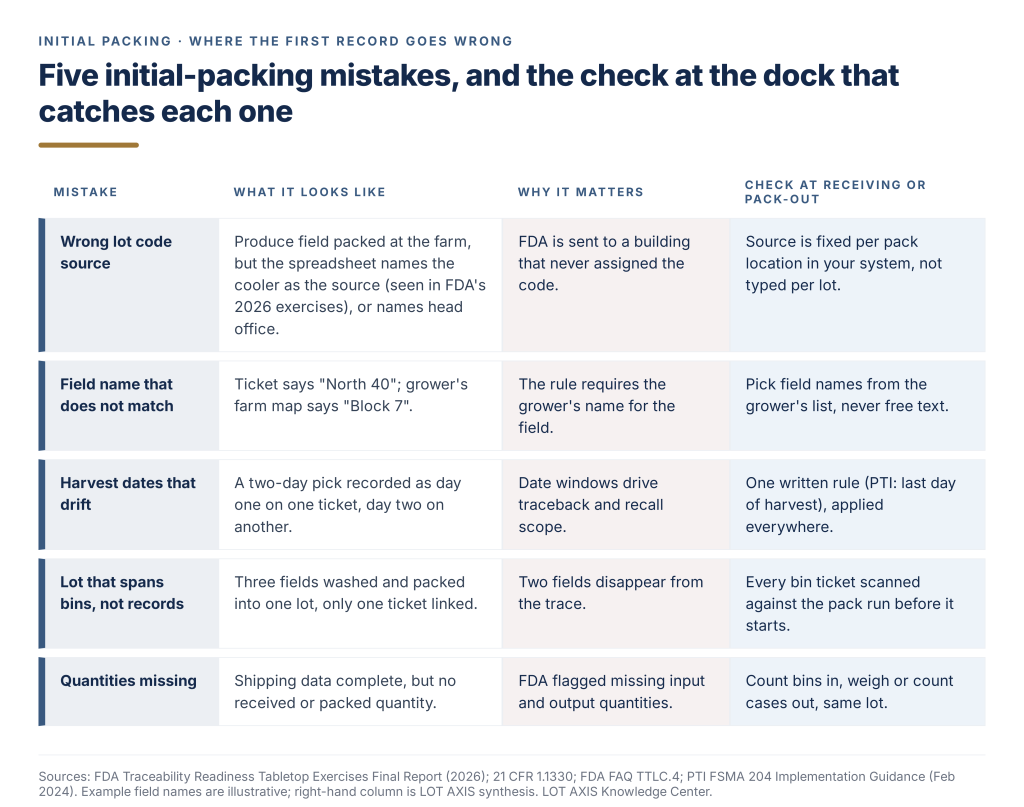
FDA’s report and the rule’s own wording point to the same handful of failures.
The wrong lot code source. A cooler, a sales office or headquarters listed instead of the place where the product was packed. [2][3] The fix is to set the source once per packing location in the system, not type it per lot.
A field name that does not match. The crew calls it “North 40”; the grower’s farm map says “Block 7.” The rule wants the grower’s name. [1] Field names should be picked from the grower’s list, never typed freehand.
Harvest dates that drift. A pick that runs over two days gets recorded as day one on one ticket and day two on another. The rule does not define which date to use; the Produce Traceability Initiative’s guidance says to list the end date of harvest, and the last day of cooling. [6] Pick one rule, write it in the traceability plan and apply it everywhere.
A lot that spans bins but not records. Many crops are washed, graded and packed together from several fields. PTI notes “there may be more than one batch or lot listed for a single Traceability Lot Code,” which is common with tomatoes. [6] That is workable only if every bin’s harvest record is linked to the lot. Link one ticket and the other fields disappear from any trace.
Quantities left out. FDA found firms that sent complete shipping data but no initial packing records, or that left out input and output quantities. [2] Bins in and cases out, against the same lot, are what let an investigator check that the story adds up.
There is one legitimate shortcut. If you pack product from a supplier the rule does not apply to, such as a produce farm with average annual produce sales of $25,000 or less, Section 1.1330(c) asks for a shorter list: the supplier’s location description takes the place of the farm, field, harvester and harvest date details. [1][7] You still assign the lot code.
Sprouts: The Packer Holds the Seed Record
Sprouts get their own paragraph in the rule. A sprouter who packs sprouts must also keep seven seed-supply elements: the seed grower and harvest date if available, the conditioner and seed lot code, the seed packinghouse and any repacking, the seed supplier with master lot and sub-lot codes, the seed description and any treatment, the date of receipt, and the reference document. [1] Seeds are not on the Food Traceability List, so FDA’s own example spells it out: as the initial packer, “the sprouter must maintain certain KDEs related to the growing, conditioning, packing and supplying of the seeds.” [11]
This autumn showed why. A Salmonella Bovismorbificans outbreak linked to broccoli sprouts from an Idaho grower reached 32 illnesses in six states, with three hospitalizations, as of October 7, 2026. [5][12][15][16] The grower recalled 215 cases on September 10. [13] FDA then sampled seed from the supplier, matched it to the outbreak strain by whole genome sequencing and traced the illnesses to “a contaminated seed lot.” Recalls of home-sprouting seed followed, identified by lot, including supplier lot W4105. [5][14]
The seed lot is the link between a sick person and a bag of seed. At the sprout grower, it exists only if someone wrote it down when the seed arrived and tied it to every production lot that followed.
Getting It Right at the Dock
None of this needs new information. It needs the information to be captured once, at the right moment, and linked.
- Agree the data with harvesters and coolers before the season. FDA found supply chain alignment “mattered more than technology”; where partners agreed upfront, data was notably stronger, and where firms waited, some left fields blank. [2]
- Check bin tickets at receiving, not at month end. Missing harvester phone, unknown field name or no harvest date: send it back while the truck is still there.
- Fix the lot code source per location. One packinghouse, one source description, chosen from a list. If you use a source reference, test that it resolves. [6][18]
- Close every pack run with quantities. Bins in, cases out, same lot.
- Write it down in the traceability plan. FDA found the few plans submitted “very useful” in reading the data. [2]
On timing: the compliance date is July 20, 2028. FDA is still working on flexibilities for lot-level tracking and holds a public meeting on November 6, 2026; speakers must register by October 26. [8] Flexibilities may change the details. They will not change where the lot code is born.
How Lot Axis Fits
Lot Axis captures the initial packing record where it happens. Receiving scans each bin and checks its ticket against the grower’s farm and field list. The pack run links every bin to the lot it feeds, with quantities in and out. The lot code source comes from the packing location, not a keyboard. When FDA asks, the sortable spreadsheet is a report, not a reconstruction. That is what we mean by Lot Intelligence™: a first record that is right because it was never retyped.
Want to see how your bin tickets would look as linked lot records? Schedule a Lot Axis demonstration and bring last week’s pack sheet.
This article is general information, not legal advice. Requirements depend on your products, your role in the supply chain and any exemptions that apply; the FSMA 204 compliance date, meeting dates and outbreak figures are as of October 21, 2026. Confirm current requirements with FDA.
Sources
Paste this list at the end of the published post. The full research package below stays internal.
- eCFR — 21 CFR Part 1, Subpart S, Additional Traceability Records for Certain Foods (incl. §§ 1.1310, 1.1320, 1.1325, 1.1330)
https://www.ecfr.gov/current/title-21/chapter-I/subchapter-A/part-1/subpart-S
- S. FDA — Traceability Readiness Tabletop Exercises Final Report (June 2026)
https://www.fda.gov/media/192993/download
- S. FDA — Frequently Asked Questions: FSMA Food Traceability Rule
https://www.fda.gov/food/food-safety-modernization-act-fsma/frequently-asked-questions-fsma-food-traceability-rule
- S. FDA — What You Need to Know About the Food Traceability Rule: Recordkeeping Information for Produce Farms (June 2023)
https://www.fda.gov/media/169510/download
- S. FDA — Outbreak Investigation of Salmonella: Sprouts (September 2026)
https://www.fda.gov/food/outbreaks-foodborne-illness/outbreak-investigation-salmonella-sprouts-september-2026
- Produce Traceability Initiative — FSMA 204 Implementation Guidance (February 12, 2024)
https://producetraceability.org/wp-content/uploads/2024/02/PTI-FSMA-204-Implementation-Guidance-FINAL-2.12.24-1.pdf
- S. FDA — Exemptions Relevant to Produce Farms Under the Produce Safety Rule and the Food Traceability Rule
https://www.fda.gov/food/food-safety-modernization-act-fsma/exemptions-relevant-produce-farms-under-produce-safety-rule-and-food-traceability-rule
- S. FDA — Food Traceability: FDA Issues Draft Enforcement Discretion Policy for Certain Small Retailers and Restaurants and Announces Public Meeting (October 8, 2026)
https://www.fda.gov/food/hfp-constituent-updates/food-traceability-fda-issues-draft-enforcement-discretion-policy-certain-small-retailers-and