| KEY TAKEAWAYS
• FDA does not require any particular traceability software. It does hold you responsible for producing records within 24 hours, even when a vendor keeps them for you. [1][2] • In FDA’s 2026 readiness exercises, coordination mattered more than technology, and only 27% of participants had a complete lot code source at every step. [3][11] • The best test of a vendor is a demo on your own product and FDA’s sortable spreadsheet, not a sample company. [4] • Ask about cost, data ownership and go-live as hard as you ask about features. |
What Traceability Software Cannot Do for You
Most traceability software demos look good. The sample lot traces cleanly and the report prints in seconds. The hard part is knowing which questions to ask a vendor before you sign, because the problems show up later: on a wet floor at 5 a.m., during an audit, or when FDA calls.
Start with what the law asks for. FDA’s Food Traceability Rule “does not prescribe specific technologies for the maintenance of records.” Paper is allowed. [2] What the rule requires is an answer: records within 24 hours of a request and, for foods on the Food Traceability List, an electronic sortable spreadsheet when FDA is working an outbreak or recall. [1] If a vendor keeps those records for you, “you are responsible for ensuring that such records can be retrieved and provided onsite within 24 hours.” [1]
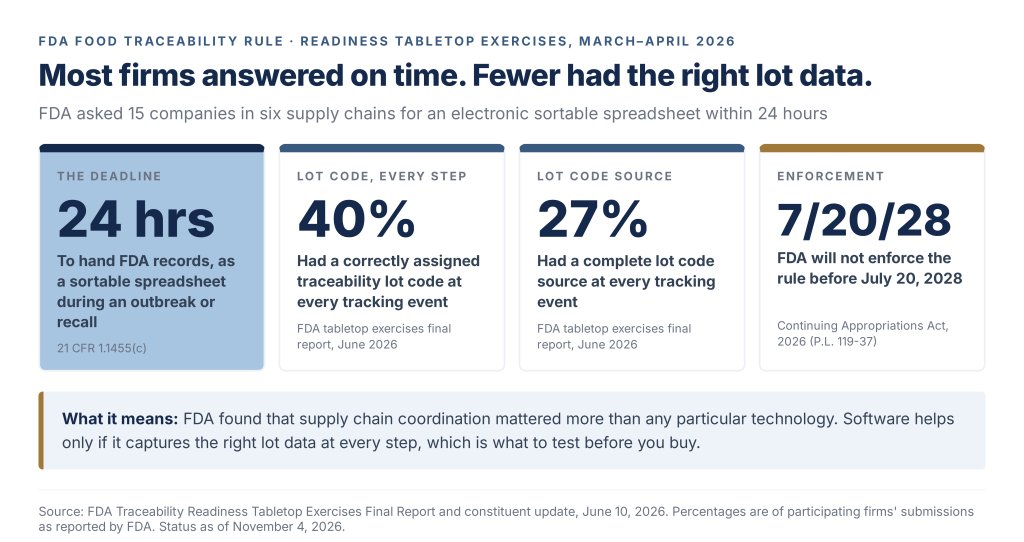
FDA tested this in March 2026 with 15 companies. Most answered within 24 hours, and FDA concluded that “proactive supply chain coordination—more than any particular technology—drove the strongest results.” [11] Yet only 40% had a correctly assigned traceability lot code at every step, and 27% a complete lot code source. [3] Software did not fix that on its own. The right questions tell you whether a system will.
Enforcement starts July 20, 2028, and FDA holds a public meeting on November 6 on possible lot-level flexibilities, with comments open until December 6. [7][19] Buy for the rule as it stands, and ask how the vendor handles change.
Traceability Software Questions About the Data It Captures
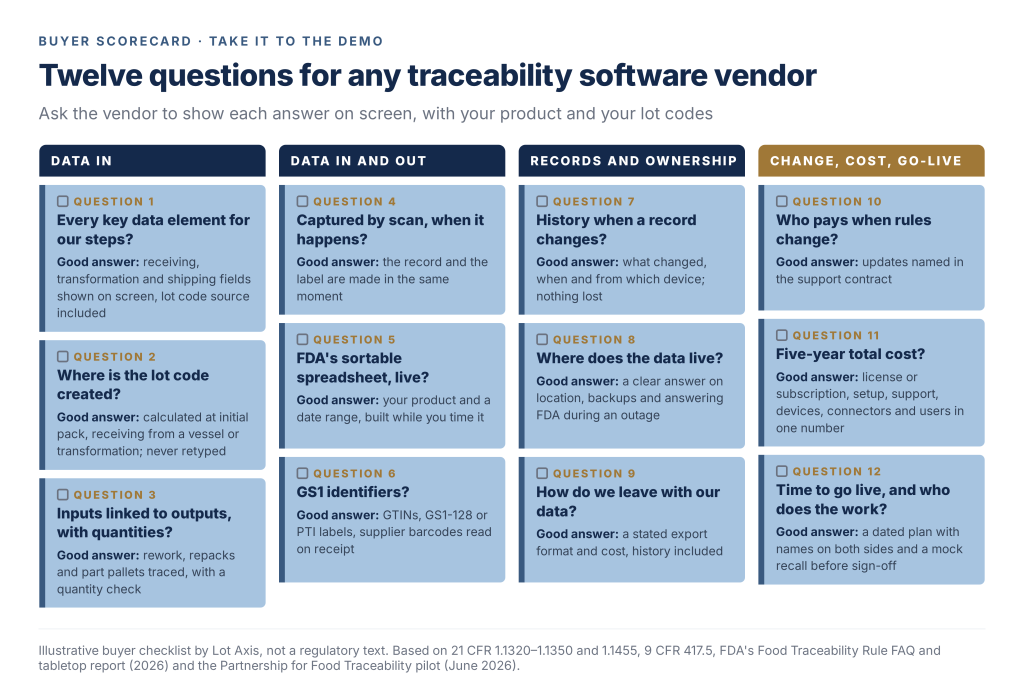
- Will it capture every key data element for the steps we actually do? List your critical tracking events, usually receiving, transformation and shipping, and ask to see each required field on screen. [10] Watch the lot code source, the element FDA found incomplete most often. [3] How Lot Axis answers: receiving is scanned on the handheld, production is recorded at the station, and every unit is scanned onto the load with a unit-level manifest. In the demo we walk through your steps, not ours.
- Where is the lot code created, and can anyone type it? A new traceability lot code may be assigned only at initial packing, first land-based receiving or transformation. [10] A code retyped at shipping breaks the chain. In a 2026 interoperability pilot, the hardest work included “deciding when and where traceability lot codes are created.” [6] How Lot Axis answers: the lot code is calculated when the label prints, using PTI for produce, GS1 for meat and seafood, or your own prefix-and-date format. Nobody types it.
- How does it link inputs to outputs, with quantities? Transformation records must tie each input lot to the new lot. [10] Grinders must record every supplier lot number for each lot of raw ground beef. [12] BRCGS expects a full trace test with a quantity check within 4 hours. [17] Ask to see rework, a repack and a part pallet, not only a clean batch. How Lot Axis answers: raw materials are scanned into production by work order, by box or by full pallet, and every label printed is linked to them. Rebox links each source unit to each new unit.
- Is data captured by scan, when it happens? FSIS requires HACCP record entries to be made “at the time the specific event occurs.” [5] In March, FDA cited a firm whose monitoring form was signed while blank and filled in five weeks later. [13] Typing fails more quietly: in one hospital study, bar-code scanning cut transcription errors from 6.1% to zero. [14] How Lot Axis answers: labels print from the scan at the station or handheld, so the record and the label are made in the same moment.
Questions About Getting Data Out
- Can you produce FDA’s sortable spreadsheet, live, from our data? FDA publishes a free template with a tab for each tracking event and a column for each data element. [4] You do not have to use it, but it is the clearest test. The pilot found that operational data has to be “flattened” into rows for FDA, a step it called “not complicated, but it is essential.” [6] Give the vendor a product and a date range, and time it. How Lot Axis answers: Back Trace and Forward Trace run from any unit, pallet, lot or load, and screen views export to Excel or CSV.
- Does it use GS1 identifiers? FDA does not endorse any standard, but it notes that many firms use GS1, and its own Product Tracing System converts incoming data to GS1’s EPCIS format. [2][9] Ask about GTINs, GLNs, GS1-128 labels and how the system reads a supplier’s barcode. [20] How Lot Axis answers: it prints GS1-128 and PTI case labels and looks up a supplier’s GTIN barcode at Unload.
- What happens when someone changes a record? FSIS accepts computer records “provided that appropriate controls are implemented to ensure the integrity of the electronic data and signatures.” [5] Ask to see the history of a corrected entry: what changed, when, and from which device. How Lot Axis answers: every transaction is date- and time-stamped, and every change is kept in history with the machine it came from. Nothing is lost.
Want to put these seven questions to us with your own product? Book a Demo and bring one lot from last month.
Questions About Risk and Ownership
- Where does our data live, and what happens if we cannot reach it? On June 5, 2025, grocery distributor UNFI took systems offline after a cyberattack, which “temporarily impacted the Company’s ability to fulfill and distribute customer orders.” [15] The FBI has warned that ransomware attacks on the food sector “disrupt operations.” [16] Ask where the database sits, who backs it up, and how you would answer FDA during an outage. How Lot Axis answers: it runs on premise. The database sits on your server, on your network.
- If we leave, how do we take our records with us? You must keep traceability records for two years. [1] Ask what format an export comes in, whether history comes with it, and what it costs. How Lot Axis answers: the database is on your server, so the records stay with you.
- What happens when the rules change? SQF Edition 10 audits are expected from January 2, 2027, and FDA may add lot-level flexibilities. [18][7] Ask whether updates are included or quoted separately. How Lot Axis answers: annual support covers updates, patches, bug fixes and unlimited technical support.
Questions About Cost and Go-Live
- What will it cost over five years? Add license or subscription, implementation, support, devices, label printers, ERP connectors and per-user fees. Researchers studying seafood traceability found integration costs “can be prohibitively high,” especially for custom ERP and legacy systems. [8] How Lot Axis answers: a one-time purchase plus annual support, quoted per plant, with no monthly subscription. It connects to QuickBooks, NetSuite, NetYield and custom AS/400 systems, and to Rice Lake, Avery Weigh-Tronix and Western Scale Co. scales.
- How long to go live, and who does the work? Get a schedule with names on both sides. The pilot recommended structured onboarding “before relying on these connections during an actual recall.” [6] Run a mock recall on your own lots before you call the project done. How Lot Axis answers: order to go-live is typically about three months. Ask us for the plan.
The Answer That Matters Most
Most traceability software vendors will say yes to most of these questions. The difference is whether they can show you, on your product, during the demo.
That is how we sell Lot Axis. Bring one lot from last month and we will follow it from receiving through production to the truck, then show you the trace, the labels and the history behind them. That is Lot Intelligence™: the record is made where the work happens, so the answer is ready when someone asks.
There is one catch we tell every buyer. Software only links what gets scanned. If product moves without a scan, no system can trace it. That is why Lot Axis prints the label from the scan: the step nobody can skip is the step that makes the record.
Ready to ask us all twelve? Book a Demo. Or see how it works for seafood, meat and poultry, produce and cannabis.
This article is general information, not legal advice. Requirements depend on your products, your regulator and your food safety plan. Dates and meeting details are as of November 4, 2026; FDA cannot enforce the Food Traceability Rule before July 20, 2028. Confirm current requirements with FDA, FSIS or your state agency.
Sources
Paste this list at the end of the published post. The full research package below stays internal.
- eCFR — 21 CFR 1.1455, How must records required by this subpart be maintained and made available?
https://www.ecfr.gov/current/title-21/section-1.1455
- FDA — Frequently Asked Questions: FSMA Food Traceability Rule
https://www.fda.gov/food/food-safety-modernization-act-fsma/frequently-asked-questions-fsma-food-traceability-rule
- FDA — Traceability Readiness Tabletop Exercises Final Report (June 2026)
https://www.fda.gov/media/192993/download
- FDA — Food Traceability Rule: downloadable, electronic, sortable spreadsheet template
https://www.fda.gov/media/179616/download
- eCFR — 9 CFR 417.5, Records (HACCP)
https://www.ecfr.gov/current/title-9/chapter-III/subchapter-E/part-417/section-417.5
- Partnership for Food Traceability — Interoperable FSMA 204 Traceability: Lessons from the PFT Cucumber Pilot (June 2026)
https://pftraceability.org/wp-content/uploads/2026/07/PFT-Interoperability-Cucumber-Pilot-Whitepaper-June-2026.pdf
- FDA — Public Meeting: Challenges and Solutions in Lot-Level Food Traceability (November 6, 2026)
https://www.fda.gov/food/workshops-meetings-webinars-food-and-dietary-supplements/fda-public-meeting-challenges-and-solutions-lot-level-food-traceability-11062026
- Hardt, Flett and Howell — Current Barriers to Large-scale Interoperability of Traceability Technology in the Seafood Sector, Journal of Food Science (2017)
https://pmc.ncbi.nlm.nih.gov/articles/PMC6282720/