| KEY TAKEAWAYS
• FDA is collecting comments until December 6, 2026 on ways to loosen the Food Traceability Rule’s lot-level tracking, led by a “reasonable range” of lot codes and “inferred” lot codes for distribution centers shipping to stores. Nothing has been adopted. [1][2] • The ideas are aimed at distributors, not at the plant that assigns the lot code. A processor’s duties to assign a traceability lot code and pass it on are unchanged. [2][4] • A range is only as narrow as the lots and data that go into it. Mixed pallets, unreadable labels and ship notices that don’t match the truck all make the range wider. [7] • Wider ranges mean wider recalls. Some commenters told FDA exactly that. [1] |
What FDA Put on the Table
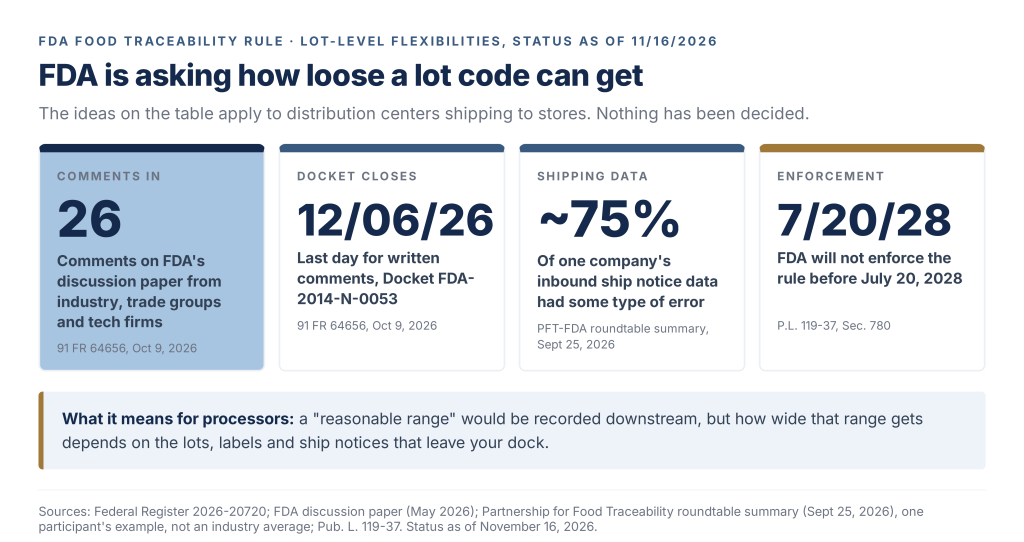
Should a distribution center be allowed to ship a reasonable range of lot codes instead of the exact ones? That is the lead question FDA is now asking. On October 9, it announced a second public meeting on “Challenges and Solutions in Lot-Level Food Traceability,” held virtually on November 6. Written comments are open until December 6, 2026, in Docket FDA-2014-N-0053. [1] The meeting is part of a series Congress ordered in Section 780 of the 2026 appropriations law, which also told FDA not to enforce the rule before July 20, 2028, and to “identify and implement, as appropriate, additional flexibilities” for lot-level tracking. [1][3]
The starting point is a discussion paper FDA released in May. It is explicit that it “does not represent draft or final guidance.” [2] It lists eight topics, and two of them go to the heart of the rule.
The first is a reasonable range of traceability lot codes. Some distribution centers told FDA they would have to scan every case to know which lots went to which store, because product arrives on mixed-lot pallets and gets mixed again in pick slots. Their proposal: record and send “a range of all possible TLCs that could reasonably be associated with a shipping event,” with the method described in the traceability plan. [2]
The second is inferred lot codes. Many warehouses already calculate which lots shipped, based on receiving dates, pick-slot placement and first-expired, first-out picking, instead of scanning. FDA’s example: send the inferred codes (10 boxes each of lots 5, 6 and 7) plus a statement of others that might have been in the load (lots 4 and 8). [2]
The other topics are “eaches” from broken cases, returns and reclamations, food waste recovery, intracompany shipments, retail kitchens that ship to sister stores, and data standards. [2]
FDA received 26 comments on the paper. Its summary says “many commenters supported” ranges or inferred codes from distribution to retail, with guardrails such as documented practices, validation exercises and limiting the range “to the fewest TLCs possible.” It also records the other side: “some commenters expressed concern that a flexibility for TLCs could reduce product-specific traceability and unnecessarily broaden the scope of a recall.” [1]
Why Distribution Centers Asked for It
The argument is older than the 2028 delay. The FSMA statute itself says the traceability rule may not require “product tracking to the case level.” [6] When FDA finalized the rule in 2022, many commenters said lot-specific shipping records would force case-level tracking anyway. FDA disagreed. A firm “could define a lot as a case, a pallet, a day’s production, or some other amount of product,” and combining several small lots in one shipment means records “specific to each traceability lot,” not to each case. [5]
The grocery industry kept pressing. In October 2024, FMI proposed letting retail stores and distribution centers keep “a reasonable range of all possible traceability lot codes” whenever they “cannot practicably provide” lot-specific data. Its example was a truck of tomatoes carrying three lots, moved into one pick slot without sorting cases by lot, then shipped to stores with all three codes. [10]
At FDA’s June meeting, a produce distributor put the case this way: “A defensible range, documented and bounded by clear operational parameters, is more honest and more useful to an investigation than a single forced lot code on co-mingled product.” [9]
The Trade-Off: Practical Picking vs. Narrow Recalls
Both sides have a point, and a small example shows why.
Picture that tomato pick slot holding lots A, B and C, and four stores receiving product from it. With exact records, lot B went to stores 2 and 3. If lot B is recalled, two stores pull product. With a range, every store’s record says “A, B or C,” so all four stores pull product, and lots A and C come off shelves too.
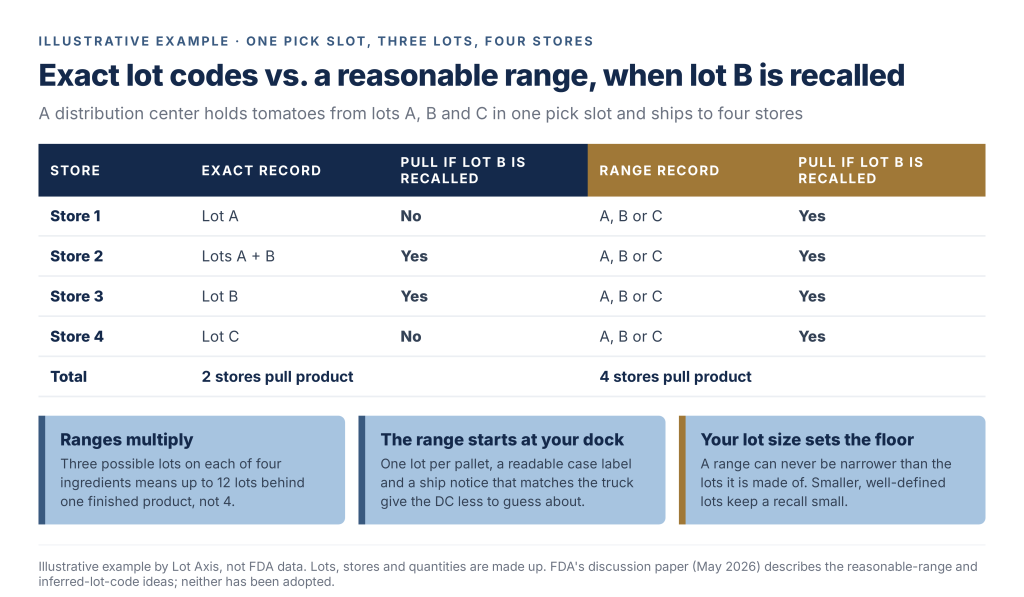
That is the concern FDA wrote down. It is also why another June speaker, whose company builds lot records from existing supply chain data, drew a hard line: “Probabilistic models or inference models guess at what was shipped. In an investigation or a recall, a guess means either contaminated product stays on shelves or safe product gets destroyed.” [9]
The effect compounds. At a September roundtable between FDA and the Partnership for Food Traceability, participants warned that if suppliers send several possible lot codes and each trading partner adds its own inference, “the number of potential lots could expand as a product moves through the supply chain.” [7] The same summary describes a suggested definition worth remembering: the reasonable range as “the narrowest range a company can reliably identify.” [7]
What It Would Change for Processors
For a plant that packs, cooks, smokes, cuts or blends food on the Food Traceability List, the short answer is: not your obligations, but very possibly your recalls.
Every idea in FDA’s paper is framed around distribution centers shipping to retailers. [2] The rule as written still says you assign a traceability lot code when you initially pack a raw agricultural commodity, first receive seafood from a vessel, or transform food, and that you do not create a new one for other activities such as shipping. [15] When you ship, you still keep eight data elements, starting with the traceability lot code and the quantity, and send the first seven to your customer. [4]
What changes is what happens to your lot code after it leaves. If your customer’s distribution center records a range, your clean lot can end up in a recall next to someone else’s, or next to your own lot from the day before.
The roundtable made clear how much of the problem starts upstream. One distributor contacted about 1,600 manufacturers about FSMA 204 and heard back from fewer than 20 percent of those with listed foods. In another example, only about 23 percent of manufacturers sending advance ship notices were rated “trusted,” and about 75 percent of the data had some type of error. Participants described ship notices that arrived after the truck, barcodes that would not scan, and records that did not match the labels. [7] FDA’s own readiness exercises earlier this year found that only 40 percent of participants had a correctly assigned traceability lot code at every tracking event. [13]
A distribution center needs a range when it cannot tell what it received. Every pallet that arrives with one lot, a readable case label and a ship notice that matches the truck is one less reason to guess.
Five Things to Do Before December 6
- Read the discussion paper and decide whether to comment. Processors are part of this record. If ranges would widen recalls of your product, or if you already ship clean lot data, FDA should hear it. Comments go to Docket FDA-2014-N-0053. [1]
- Keep lots on separate pallets where you can. FDA asked how many lots end up on one pallet and in one pick slot. [2] The fewer you send, the narrower any range downstream.
- Make the label and the ship notice agree. GS1 US recommends recording the traceability lot code as the GTIN plus batch or lot number, with quantity per lot, in the advance ship notice. [14] Check yours against the cases on the truck.
- Look hard at your lot size. A range can never be narrower than the lots in it. A lot defined as a shift or a production run keeps a recall smaller than a lot defined as a week.
- Run a trace with a customer. Pick one shipped lot, ask your largest customer to show where it went, and compare their records with yours.
Dates to Watch
- November 23, 2026: comments close on FDA’s draft policy not to enforce the rule against retail food establishments and restaurants with average annual food sales between $250,000 and $1 million. [8][17]
- December 6, 2026: comments close on lot-level flexibilities. [1]
- December 11, 2026: the current stopgap funding law expires. [11] Food safety attorney Bill Marler argues that the next funding bill decides whether Section 780 carries into 2027. [16]
- July 20, 2028: the earliest date FDA will enforce the rule. [1][12]
How Lot Axis Fits
Lot Axis is built so a range is never needed for your own product. The lot code is calculated by the system when the label prints, and printed on GS1-128 case labels, so nobody types it. Pallets are built by scan, and every unit is scanned onto the load with a bill of lading and a unit-level manifest, so the record of what shipped comes from what was actually on the truck. Back Trace runs from a finished case to the raw materials in it, and Forward Trace runs from a lot to every customer that received it. That is Lot Intelligence™: an exact answer, not a reasonable range.
Want to see an exact shipment record from your own product? Book a Demo and bring one bill of lading.
This article is general information, not legal advice. FDA has not adopted any of the flexibilities described, and dates are as of November 16, 2026. Confirm current requirements with FDA before changing your traceability plan.
Sources
Paste this list at the end of the published post. The full research package below stays internal.
- Federal Register — Challenges and Solutions in Lot-Level Food Traceability; Public Meeting (FDA, October 9, 2026, 91 FR 64656)
https://www.federalregister.gov/documents/2026/10/09/2026-20720/challenges-and-solutions-in-lot-level-food-traceability-public-meeting
- FDA — Discussion Paper: Identifying Additional Flexibilities for Satisfying the Food Traceability Rule’s Lot-Level Tracking Requirement (May 2026)
https://www.fda.gov/media/192696/download
- FDA — Public Meeting: Challenges and Solutions in Lot-Level Food Traceability, November 6, 2026
https://www.fda.gov/food/workshops-meetings-webinars-food-and-dietary-supplements/fda-public-meeting-challenges-and-solutions-lot-level-food-traceability-11062026
- eCFR — 21 CFR 1.1340, What records must I keep and provide when I ship a food on the Food Traceability List?
https://www.ecfr.gov/current/title-21/section-1.1340
- Federal Register — Requirements for Additional Traceability Records for Certain Foods, final rule (FDA, November 21, 2022, 87 FR 70910)
https://www.federalregister.gov/documents/2022/11/21/2022-24417/requirements-for-additional-traceability-records-for-certain-foods
- 21 U.S.C. 2223 — Enhancing tracking and tracing of food and recordkeeping (FSMA section 204), Legal Information Institute
https://www.law.cornell.edu/uscode/text/21/2223
- Partnership for Food Traceability — PFT-FDA Joint Q&A Roundtable: Food Traceability Rule Lot-Level Tracking Requirements, September 25, 2026
https://pftraceability.org/wp-content/uploads/2026/10/PFT-FDA-Roundtable-Summary-September-25-2026.pdf
- Federal Register — Enforcement Policy for Certain Retail Food Establishments and Restaurants; Draft Guidance for Industry (FDA, October 9, 2026, 91 FR 64629)
https://www.federalregister.gov/documents/2026/10/09/2026-20721/requirements-for-additional-traceability-records-for-certain-foods-enforcement-policy-for-certain