
| KEY TAKEAWAYS
• In a seafood plant, a new traceability lot code is created at transformation: cooking, smoking, filleting, portioning, repacking, mixing. The record must link every input lot, with the quantity used, to the lot that comes out. [1] • A documented kill step can take cooked crab, shrimp or clams out of the rule. Cooking tuna, mahi and other histamine or ciguatoxin species does not count. [2][4] • Smoked finfish stays on the list whether it is hot or cold smoked. FDA says hot smoking “cannot be considered a kill step,” because the risk comes after the smoker, at slicing and packing. [2][3] • In FDA’s 2026 readiness exercises, some firms left out input and output quantities, and only 40% of records carried the right lot code at every step. [6] |
One Lot Code, Three Fish
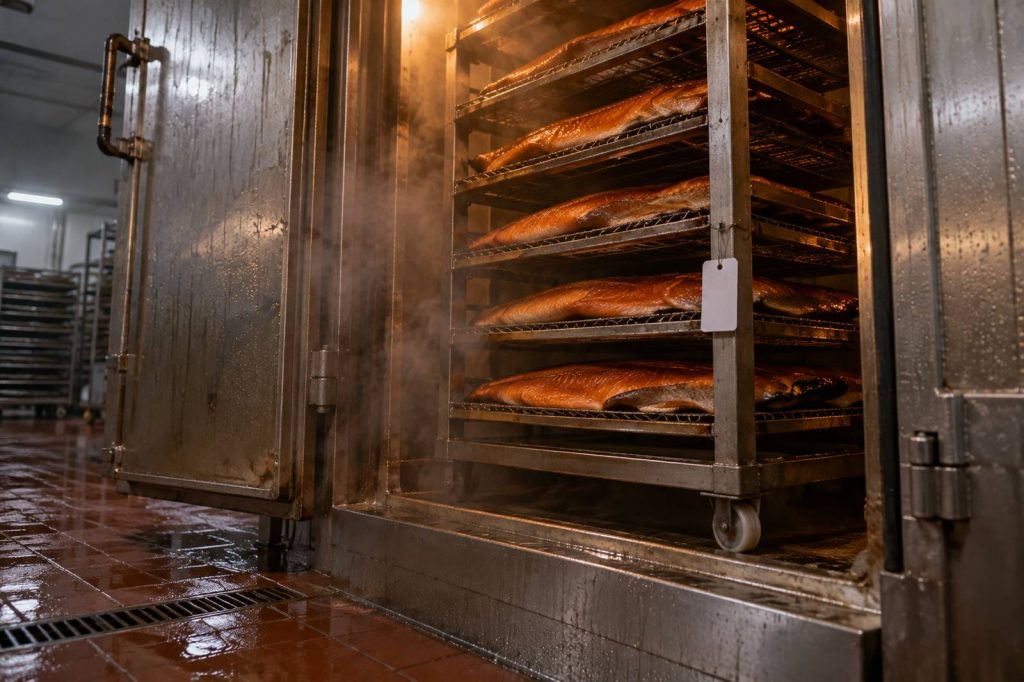
On October 1, New York’s agriculture department announced a recall of a cold smoked “Seafood Trio” of salmon, halibut and trout, after state inspectors found Listeria monocytogenes in packages from one lot. Two weeks later FDA posted a second recall from the same Brooklyn distributor, for sliced cold smoked salmon, also traced to a single lot number found by New York sampling. The distributor said it did not make the product. [7][9]
No illnesses were reported. But look at the first product from the processor’s side. One lot code on the pack stands for at least three species, probably several raw lots of each, a brine, a smoke run, a slicing line and a packing shift. When a regulator calls with that lot code, the answer depends on whether someone wrote down which raw lots went into it, and how much of each.
That is the transformation record. In seafood, it is where traceability most often comes apart.
Where the Lot Code Changes
Under FSMA 204, a traceability lot code can be assigned at only three points: initial packing of a raw agricultural commodity, first land-based receiving of seafood from a fishing vessel, and transformation. [1] For most seafood processors, the third is the one that matters every day.
The rule defines transformation as manufacturing or processing a food, or changing it or its packaging, “e.g., by commingling, repacking, or relabeling,” when the output is still on the Food Traceability List. [1] FDA’s own tabletop report gives “processing raw finfish into packaged fillets” as the example of a processor’s work. [6]
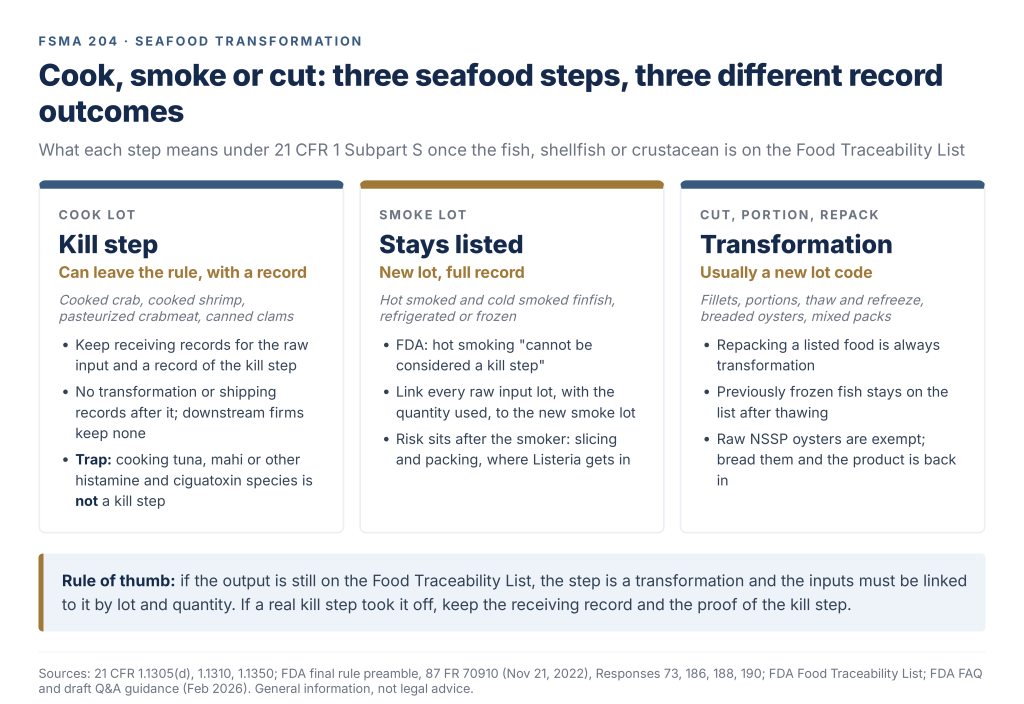
For each new lot made that way, 21 CFR 1.1350 asks for two sets of facts. For every listed food used: its lot code, its description and “the quantity and unit of measure of the food used from that lot.” For the output: the new lot code, where it was made (the lot code source), the date transformation was completed, the product description, the quantity, and the reference document. [1]
Those quantities are the part plants skip. In FDA’s readiness exercises this spring, some firms sent complete shipping data but left out “input and output quantities where required.” Only 40% of participants’ records captured the properly assigned lot code across every step they performed. [6]
Three Steps, Three Different Answers
Seafood is unusual because the same building can do three things that the rule treats very differently.
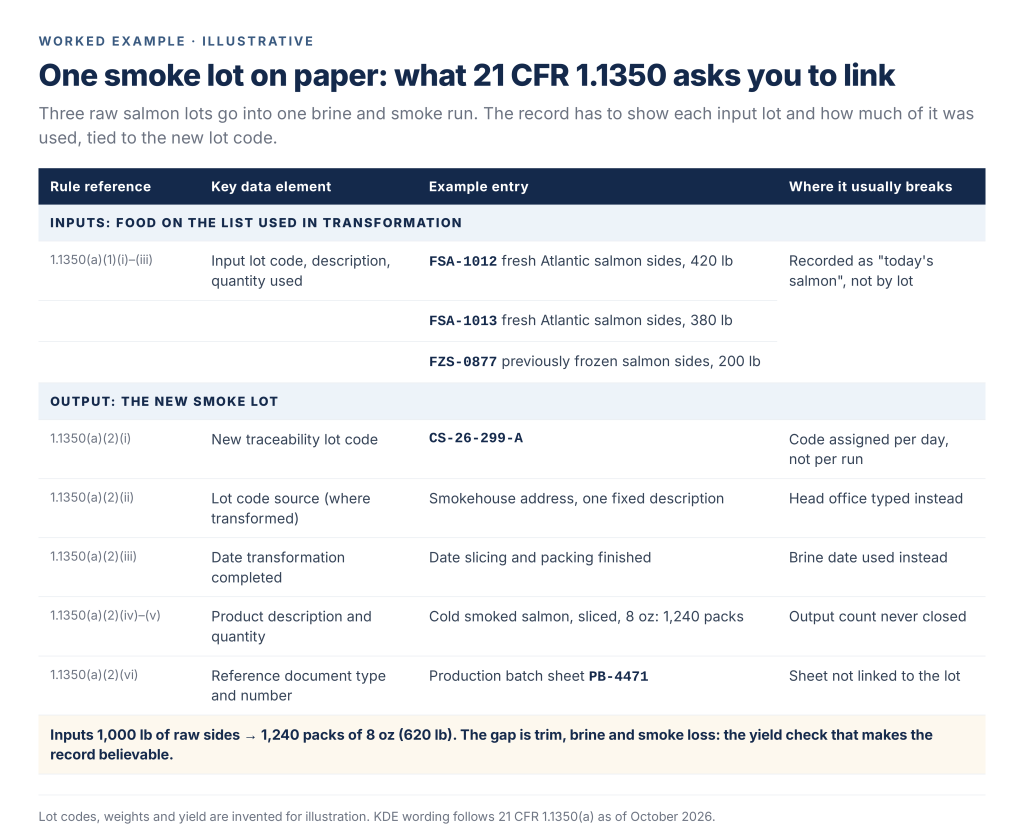
Cook lots can leave the rule. A kill step is “lethality processing that significantly minimizes pathogens.” [1] If you apply one to a listed food and keep a record of it, you keep receiving records for what came in, but no transformation or shipping records afterwards, and nobody downstream keeps any. [1][4] FDA said in the final rule that cooking or pasteurizing crabmeat meets that definition when done properly. [2] Its February 2026 draft guidance walks through canned clams: once cooked and canned, the only record the manufacturer needs is the record of the kill step, “which they are probably already required to maintain under another regulation.” [5] FDA’s FAQ points to existing preventive-control and thermal-process records for exactly that. [4]
There is a trap. Histamine and ciguatoxin are toxins, not pathogens, and cooking does not remove them. FDA was explicit that for histamine-producing finfish such as tuna, mahi and mackerel, and ciguatoxin species such as grouper and snapper, “cooking or other thermal processing of these commodities does not constitute a kill step.” [2][3] A cooked tuna loin does not get the exemption.
Smoke lots stay on the list. The Food Traceability List names smoked finfish, refrigerated, frozen and previously frozen, “including cold smoked finfish and hot smoked finfish.” [3] Some commenters argued hot smoking should count as a kill step. FDA disagreed: “hot smoked finfish is covered by the subpart S requirements, and the hot smoking itself cannot be considered a kill step.” [2] Smokehouses already control the botulinum hazard in their HACCP plans [10][11]; traceability is a separate record. FDA’s reason for keeping smoked fish on the list is the one every smoked fish plant knows. Hot smoking “typically is not applied to the finished product,” so it does nothing about contamination “introduced after smoking when the finfish is sliced and otherwise handled before packaging.” [2]
Cutting, portioning and repacking are transformation. FDA’s FAQ says repacking a listed food is “always a transformation event” and often needs a new lot code. [4] Thawing does not take fish off the list: previously frozen seafood is covered. [4] And an exemption can end mid-process. Raw oysters under the National Shellfish Sanitation Program are exempt, but FDA’s draft guidance says that once a processor breads them, transformation records are required. [5]
One Smoke Lot, Written Down
A typical cold smoked salmon run shows where the gaps open. Several raw lots go into the same brine. The sides are smoked together, then sliced and packed over a shift, sometimes the next day. Each step is a chance to lose the link between what went in and what came out.
The weak points are predictable:
- Inputs recorded by day, not by lot. “Tuesday’s salmon” is not a lot code. If three lots were in the brine, all three belong on the record, each with the quantity used.
- One lot code per day instead of per run. If two smoke runs share a code, a problem in one recalls both.
- The wrong lot code source. The source is the smokehouse where the product was made, not the head office that issues codes. [1][6]
- The wrong date. The rule asks for the date transformation was completed. For sliced product, that is when packing finished, not when the fish went into the brine.
- No output count. Without packs out against pounds in, nobody can check that the story adds up. Smoked fish loses weight to trim, brine and smoke, so a believable record shows the yield, not just the start.
The industry standard for seafood data, GDST, puts the principle in one line: “Traceability should lean more toward overinclusion of inputs rather than under inclusion.” [12] If you are not sure whether a lot touched the run, list it. A wider trace is slower. A missing input is a trace that ends.
Why the Slicing Room Matters
FDA’s focus on what happens after the smoker is not theoretical. When the agency inspected 15 cold smoked salmon plants, two had numerous Listeria monocytogenes positives, and in one, cross-contamination from a resident strain had reached finished product. [13] Europe has tracked a smoked salmon Listeria cluster since 2019, with 20 cases. [16]
A resident strain does not respect lot boundaries. If an investigation points to a slicer, the question becomes which lots went across it, and over what dates. That is answerable only if each sliced lot is tied to its smoke run and each run to its raw inputs.
One more detail catches seafood plants. Seafood HACCP records for refrigerated products must be kept for at least one year. [10] FSMA 204 records must be kept for two. [1] The smoked salmon run that passed its HACCP record review last autumn still needs its traceability record next autumn.
For contrast, the raw oyster outbreak in Virginia this month was traced through NSSP harvest records to one river and one dealer. [14] Raw shellstock carries its harvest area and date on a tag. A smoked salmon pack carries only what the plant chose to link to its lot code.
Getting It Right on the Floor
- Decide, product by product, which outcome applies. Cooked crab with a validated cook: keep the kill-step record. Smoked fish, tuna, fillets, mixed packs: full transformation records.
- Assign the new lot code at the run, not the calendar. One brine and smoke run, or one slicing run, equals one code.
- Scan inputs as they are consumed. Every raw lot that enters the brine or the cutting table gets recorded with its weight at that moment, not reconstructed at month end.
- Close every run with quantities. Pounds in, packs out, same lot. Unexplained yield is the first sign an input is missing.
- Fix the lot code source per location and keep traceability records for two years, regardless of the HACCP retention period.
On timing: compliance is due July 20, 2028. [17] FDA holds a virtual public meeting on lot-level tracking on November 6, 2026, with comments open until December 6. [8][15] Flexibilities may change some details. They are unlikely to change what a smoke lot record has to show.
How Lot Axis Fits
Lot Axis records transformation where it happens. Process Raw Materials consumes input lots by scan, with their weights, into the output lot the run produces. The new lot code comes from the run, the lot code source from the location. Yield by lot falls out of the same record, so a run that does not add up shows up the same day. That is Lot Intelligence™: a smoke lot whose inputs were captured once, at the brine tank, and never retyped.
Want to see your last smoke run as a linked lot record? Schedule a Lot Axis demonstration and bring one batch sheet.
This article is general information, not legal advice. Whether a step is a kill step depends on your product, hazards and validated process; requirements depend on your role in the supply chain and any exemptions that apply. The compliance date, meeting dates and recall details are as of October 26, 2026. Confirm current requirements with FDA.
Sources
Paste this list at the end of the published post. The full research package below stays internal.
- eCFR — 21 CFR Part 1, Subpart S, Additional Traceability Records for Certain Foods (incl. §§ 1.1305, 1.1310, 1.1320, 1.1350, 1.1455)
https://www.ecfr.gov/current/title-21/chapter-I/subchapter-A/part-1/subpart-S
- Federal Register — Requirements for Additional Traceability Records for Certain Foods, Final Rule, 87 FR 70910 (November 21, 2022)
https://www.federalregister.gov/documents/2022/11/21/2022-24417/requirements-for-additional-traceability-records-for-certain-foods
- S. FDA — Food Traceability List
https://www.fda.gov/food/food-safety-modernization-act-fsma/food-traceability-list
- S. FDA — Frequently Asked Questions: FSMA Food Traceability Rule
https://www.fda.gov/food/food-safety-modernization-act-fsma/frequently-asked-questions-fsma-food-traceability-rule
- S. FDA — Questions and Answers About Requirements for Additional Traceability Records for Certain Foods: Draft Guidance for Industry (February 2026)
https://www.fda.gov/media/191182/download
- S. FDA — Traceability Readiness Tabletop Exercises Final Report (June 2026)
https://www.fda.gov/media/192993/download
- S. FDA — Krasnyi Oktyabr Inc. Recalls Starfish Seafood Premium Cold Smoked Norwegian Salmon Sliced (October 2026)
https://www.fda.gov/safety/recalls-market-withdrawals-safety-alerts/krasnyi-oktyabr-inc-recalls-starfish-seafood-premium-cold-smoked-norwegian-salmon-sliced-227g8oz
- S. FDA — Public Meeting: Challenges and Solutions in Lot-Level Food Traceability (November 6, 2026)
https://www.fda.gov/food/workshops-meetings-webinars-food-and-dietary-supplements/fda-public-meeting-challenges-and-solutions-lot-level-food-traceability-11062026