| KEY TAKEAWAYS
• FDA’s traceback converged on one supplier, but the recall issued on July 17, 2026 covered all iceberg lettuce sourced from central Mexico by Taylor Farms de Mexico — a region and a supplier, not a lot or a field.[1][4] • By FDA’s August 20 update the outbreak stood at 10,930 illnesses in 17 states, with two deaths in Michigan, and most illnesses began before the recall.[1] • CDC’s national health advisory came on July 14, roughly ten weeks after the first reported illnesses of the season, because Cyclospora cannot be cultured or matched by whole-genome sequencing the way Salmonella and E. coli can.[3][14] • FSMA 204 was not in force: Congress has barred FDA from spending funds to enforce the Food Traceability Rule before July 20, 2028, and fresh and fresh-cut leafy greens are on the Food Traceability List.[5][10] • The gap this exposed is not exotic. It is invoices without lot codes, commingled product and records that take days to assemble.[12][13] |
What Actually Happened, in Dates
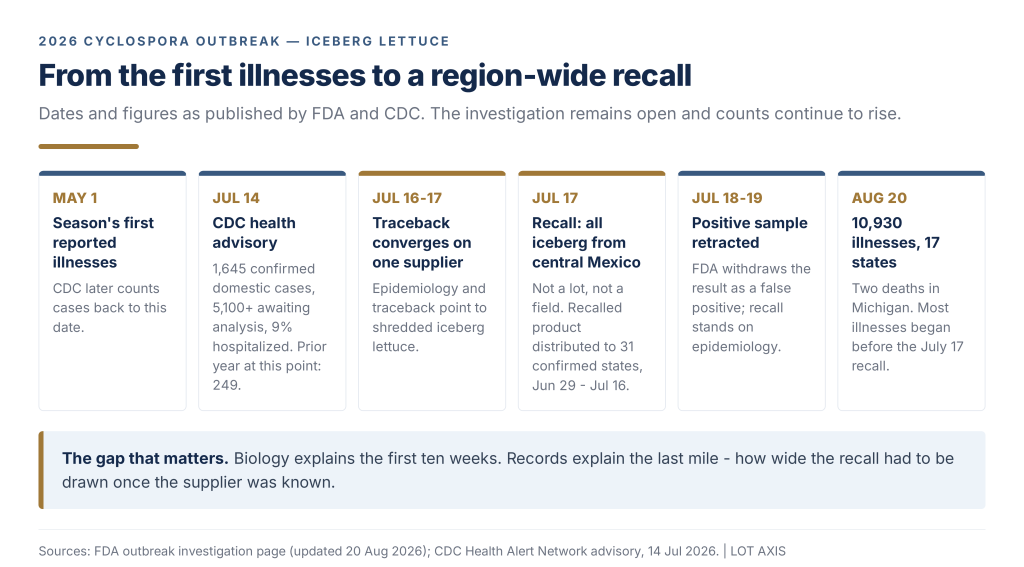
On July 14, 2026, CDC issued a Health Alert Network advisory: since May 1 it had received 1,645 confirmed reports of domestically acquired cyclosporiasis, plus more than 5,100 additional cases awaiting analysis, against 249 reported nationally by the same point the previous year. Nine percent of the confirmed patients had been hospitalized.[3]
Two days later, epidemiology and traceback pointed at shredded iceberg lettuce. On July 17, Taylor Farms de Mexico announced it was removing all iceberg lettuce sourced from central Mexico from the U.S. market and initiated a recall covering retail product sold under the Marketside brand at Walmart along with a list of foodservice items.[1][4] FDA later confirmed distribution of recalled product from June 29 through July 16 in 31 states, with further distribution possible in nine more plus Puerto Rico and the District of Columbia.[1]
Then a complication that is worth remembering the next time a test result makes the news. On July 18 FDA announced a lettuce sample had tested positive for Cyclospora; on July 19 it withdrew the result as a false positive that did not represent true amplification.[14] The recall stood anyway, because it had never rested on a laboratory match — it rested on epidemiology and traceback.
The case count kept climbing as interviews caught up: 6,358 illnesses in 15 states on August 5, 9,481 in 17 states on August 13, and 10,930 in 17 states by August 20, with at least 278 hospitalizations reported as of the August 13 update and two deaths in Michigan. Most of those illnesses began before the July 17 recall.[1][2] For scale, CDC’s national cyclosporiasis tally across seven separate outbreaks reached 17,180 patients by August 24, with thousands more suspected but unconfirmed — a reminder that this lettuce outbreak sits inside a much larger season and that the two figures should not be mixed.[19]
The Recall Was Drawn by Region, Not by Lot
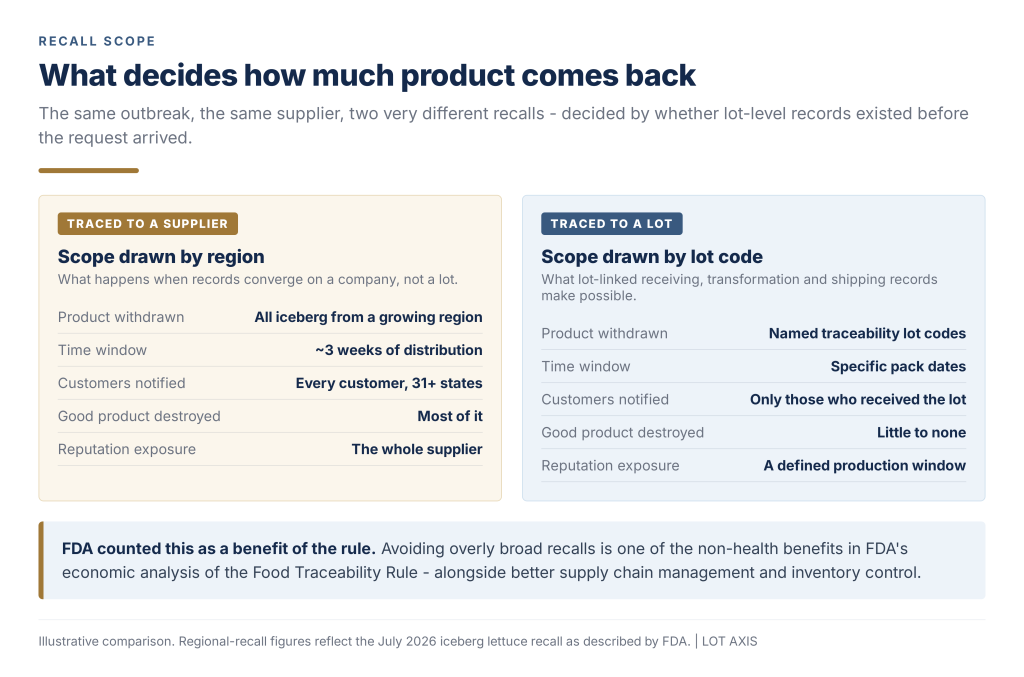
This is the sentence a processor should sit with: the recall removed all iceberg lettuce from one growing region, over roughly three weeks of distribution, across 31 confirmed states.
That is not a criticism of the company that issued it. When you cannot say with confidence which lots are implicated, the only responsible move is to draw the circle wide. It is also what the rules leave you: FDA’s traceback converged on a common supplier, not on a field, a harvest day or a wash line.
The cost of a wide circle is carried by everyone in the chain. Good product is destroyed. Customers who received unaffected lots pull them anyway. And the reputational damage is applied to the whole supplier rather than to a defined production window. FDA’s own economic analysis of the Food Traceability Rule counted avoiding overly broad recalls as a benefit worth money, separate from the public health case.[11]
The opposite outcome — a recall that names a traceability lot code, a pack date and a customer list — is only available if the data existed before anyone asked for it.
This is also not new. In 2018, the traceback behind 240 E. coli O157 illnesses across 37 states identified numerous romaine distributors and growers and resolved only to a growing region — Yuma — rather than to a farm.[20] FDA has treated end-to-end leafy greens traceability as a priority since publishing its Leafy Greens STEC Action Plan in 2020, and industry-run traceability pilots the same year found that the pivot point of a produce traceback is identifying the specific shipment and lot code, which is often not what firms keep.[16][17]
Why Produce Traceback Is Slow
Cyclospora makes an investigation harder than most. The parasite cannot be grown in culture, so investigators cannot use whole-genome sequencing to link patients to a sample the way they do with bacterial outbreaks; they work from partial genotyping and, mostly, from interviews with sick people. Symptoms appear about a week after exposure and can relapse, which stretches the recall window at every point of service.[14][15]
But the record-keeping side is the part processors control, and the independent review of FDA’s outbreak response processes described it plainly: tracebacks are “time and labor intensive and frequently limited by inadequate records and comingling of product in distribution.” Document requests routinely cover two to three weeks at each point of service, and often up to a month; many small firms have no electronic record system that can produce shipment records, invoices and bills of lading, so discrepancies send investigators back for original paper documents.[12]
FDA’s former food policy lead put a number on it during this outbreak: under the current system it can take several days to a week just for FDA to collect and assess supply-chain records for one leg of a traceback.[13] Multiply that by each distributor, each processor and each grower behind each restaurant, and weeks disappear while product is still moving.
What FSMA 204 Would Have Changed — and What It Would Not
Iceberg lettuce is squarely covered by the Food Traceability Rule: fresh leafy greens and fresh-cut leafy greens are on the Food Traceability List.[10] Under the rule, the processor assigns a traceability lot code at initial packing or at transformation, carries it through shipping and receiving records, and must be able to hand FDA an electronic sortable spreadsheet within 24 hours of a request during an outbreak.[7][8][9]
None of that was in force this summer. FDA moved the compliance date from January 20, 2026 to July 20, 2028, and the FY2026 appropriations act then barred the agency from using funds to administer or enforce the rule before that date.[5][6] Former senior FDA officials said publicly that having the rule in effect would have made it materially faster to trace suspect product back to the field and forward to recipients; the produce industry’s trade association argued the delay did not reduce the ability to trace during this event, while agreeing the rule will make future tracebacks more precise.[13][18]
Both can be true. Lot-level records would not have shortened the incubation period, fixed the diagnostic limits of a parasite, or replaced the interviews that identified lettuce in the first place. What they change is the last mile of the investigation — the part where an agency asks who received a specific lot and how long the answer takes. That is exactly the mile where this outbreak lost weeks and where the recall lost precision.
Five Gaps a Processor Can Close This Quarter
- Lot codes on the paperwork, not just the pallet. If your invoices and bills of lading show item and quantity but not the lot, an investigator cannot narrow anything from your records. Put the lot on the shipping document.
- Commingling discipline. Mixed pallets and blended totes are where traceback dies. Record each lot on a mixed load separately, and decide deliberately how large a lot is allowed to get — lot size sets recall scope.
- Input-to-output links at transformation. Shredding, coring, washing and repacking create a new lot. Unless the record links every input lot code to that new code with quantities, forward and backward traces stop at the wash line.
- A 24-hour drill, on the clock. Pick a lot you shipped last month and rebuild it end to end in a day: every input, every date, every customer. Log what was missing. FDA’s spring 2026 readiness exercises found that supply-chain coordination, not technology choice, separated the firms that could produce records from those that could not.[11]
- Know which customers received it, in minutes. The trace-forward list is what lets you narrow the recall to the customers who actually got the lot instead of every customer you serve.
How Lot Axis Fits
Lot Axis was built for lot-controlled food processing: barcode-driven receiving, production and shipping that keep one current record of every lot from receiving through transformation to the customer. When the traceability lot code follows product through every scan, the trace-back and trace-forward lists are already assembled before anyone requests them — and the same records tell a plant manager which lots are oldest, which are on hold and which customers received a specific run. That is what we mean by Lot Intelligence™: traceability data used every day, not only during an outbreak.
The processors who come out of the next investigation with a narrow, defensible recall will be the ones who could answer in hours what took weeks this summer.
Want to see what a 24-hour traceability request looks like when the data is already there? Schedule a Lot Axis demonstration and we will walk one of your product flows — receiving, transformation, shipping — end to end.
This article is general information about a federal regulation and an ongoing public health investigation, not legal advice. Case counts change; confirm current figures against FDA and CDC outbreak pages and your obligations against 21 CFR part 1, subpart S.
Sources (publish this block with the article)
Paste this list at the end of the published post. Keep it to 6–8 authoritative links. The full research package below stays internal.
- FDA — Investigation of Multistate Outbreak of Cyclospora Illnesses: Iceberg Lettuce (July 2026)
https://www.fda.gov/food/outbreaks-foodborne-illness/investigation-multistate-outbreak-cyclospora-illnesses-iceberg-lettuce-july-2026
- Congressional Research Service — The FDA’s Food Traceability Rule: Overview and Issues for Congress (R48925, April 29, 2026)
https://www.everycrsreport.com/reports/R48925.html
- Federal Register — Requirements for Additional Traceability Records for Certain Foods: Compliance Date Extension (August 7, 2025)
https://www.govinfo.gov/content/pkg/FR-2025-08-07/pdf/2025-14967.pdf
- FDA — Food Traceability List
https://www.fda.gov/food/food-safety-modernization-act-fsma/food-traceability-list
- 21 CFR 1.1320 — When traceability lot codes must be assigned
https://www.law.cornell.edu/cfr/text/21/1.1320
- 21 CFR 1.1350 — Records required when transforming a listed food
https://www.law.cornell.edu/cfr/text/21/1.1350
- 21 CFR 1.1455 — How records must be maintained and made available (24-hour rule)
https://www.law.cornell.edu/cfr/text/21/1.1455
- FDA — Leafy Greens STEC Action Plan
https://www.fda.gov/food/foodborne-pathogens/leafy-greens-stec-action-plan