
| KEY TAKEAWAYS
• The two largest US cold storage operators reported storage revenue of about $21 per pallet a month in Q2 2026 ($64.61 a quarter at Americold, $63.06 at Lineage). That is a blended average, not a quote, but it is a fair floor for the rent a pallet pays. [1][2] • In the same quarter, customers had committed to roughly 1.07 million pallet positions at those two companies that were not physically filled. [1][2] • 46.1% of Lineage’s storage revenue was under minimum storage guarantees at the end of 2025, paid “regardless of whether the underlying pallet positions are occupied.” [3] • In an illustrative case, 40 held pallets for three months cost about $10,920 before any write-off. Rent is the smallest line; the money tied up in the product is the largest. |
The Pallet That Stays
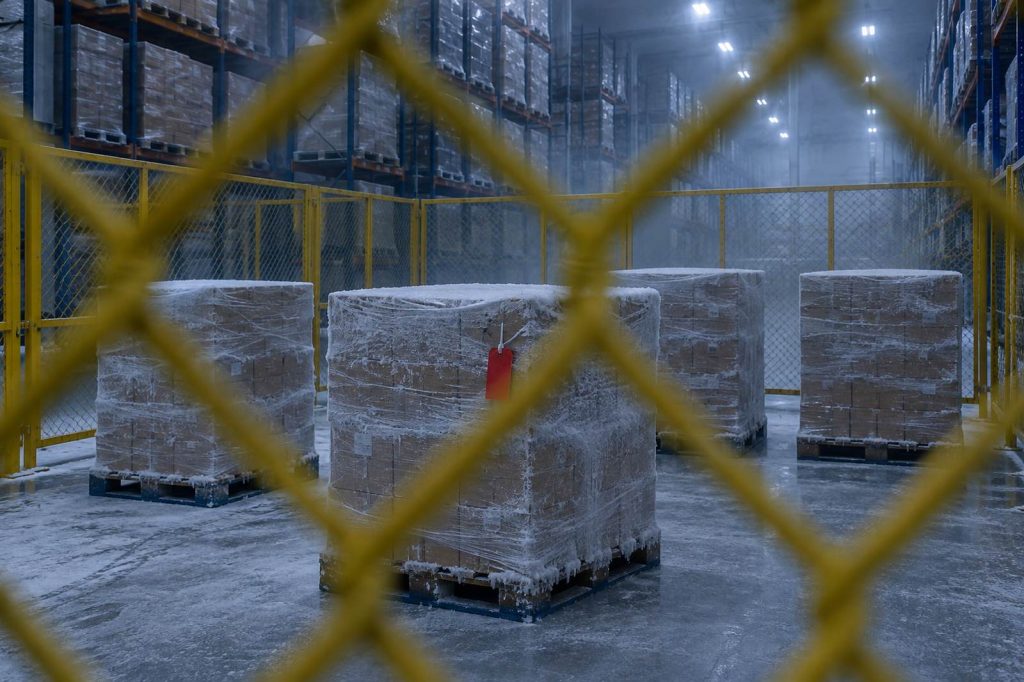
Walk the back of almost any public freezer and you will find them: pallets that came in months ago and have not moved. Some are on hold waiting for a test result. Some are past the shelf-life a customer will accept. Some nobody can quite place, so nobody wants to ship them.
Each one pays rent every month. Most processors know their storage invoice in total. Far fewer can say how much of it pays for product they cannot sell.
There is a lot of space to fill. On October 1, 2025, the United States had 3.99 billion gross cubic feet of refrigerated warehouse capacity across 931 warehouses, according to USDA’s biennial survey. Usable space was 3.25 billion cubic feet, 79% of it freezer, and public warehouses held 62% of gross capacity. [4] On August 31, 2026, those freezers held 862.1 million pounds of red meat, up 8% from a year earlier, and 1.15 billion pounds of poultry. [5][17]
What a Pallet-Month Really Costs
Rate cards vary by market, temperature and contract, and most are private. The most reliable public reference is what the two largest operators actually collect.
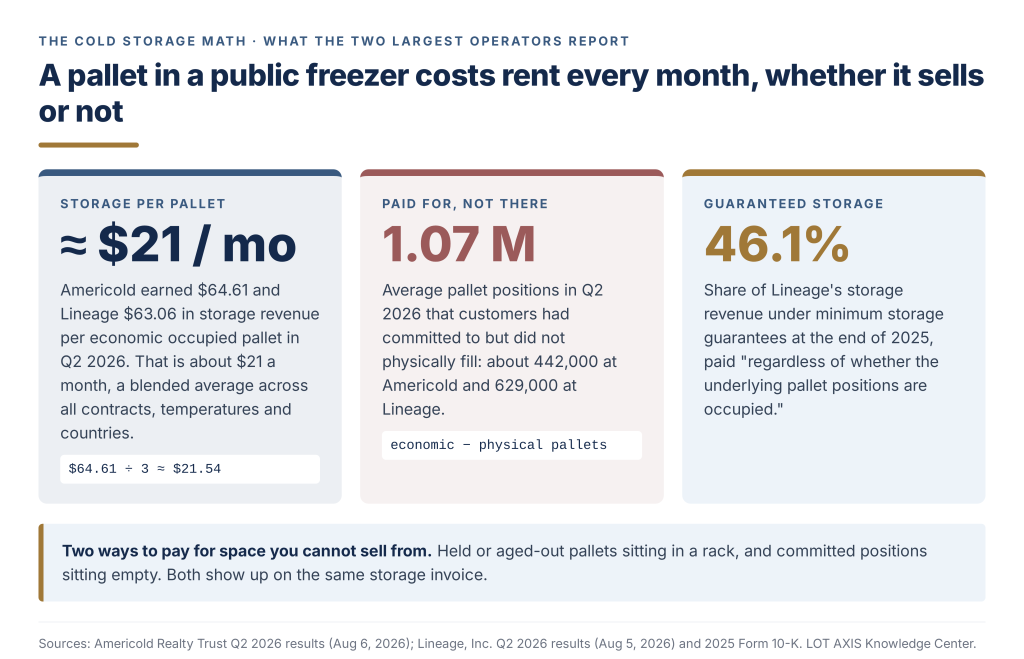
In the second quarter of 2026, Americold reported total rent and storage revenue of $64.61 per average economic occupied pallet, and Lineage reported storage revenue of $63.06. [1][2] Divide by three and a pallet paid about $21 a month for storage alone. That figure blends every contract type, temperature zone and country the two companies serve, so treat it as a reference point. Many frozen spot rates are higher.
Moving the pallet costs extra. Warehouse services revenue per throughput pallet, which covers receiving, putaway, picking and shipping, was $39.20 at Americold and $32.21 at Lineage. [1][2] A pallet that is pulled for re-inspection, re-labelled or sorted pays that again.
Then there is the money. Product sitting in a freezer is cash that is not working. The bank prime loan rate was 7.00% at the start of October 2026. [10][12] At that rate, a pallet of product worth $8,000 costs about $47 a month just to finance, more than twice the storage rent.
If you run your own cold rooms, you do not get an invoice, but you pay in electricity. In the federal survey of commercial buildings, refrigerated warehouses used about 29.6 kilowatt-hours of electricity per square foot a year, against 5.3 for non-refrigerated warehouses. [11] A held pallet in your own freezer still uses space you are paying to keep cold.
Paying for Pallets That Are Not There
Cold storage operators report two kinds of occupancy. Physical occupancy counts pallets in the racks. Economic occupancy adds positions that customers have committed to pay for whether or not they fill them. Americold defines economic occupied pallets as “the sum of the average number of physically occupied pallets and otherwise contractually committed pallets.” [1]
The gap between the two is space that customers are paying for and not using. In Q2 2026 it averaged about 442,000 pallet positions at Americold (3.93 million economic against 3.48 million physical) and about 629,000 at Lineage (8.15 million against 7.52 million). [1][2]
That is not an accident of the market. Lineage describes minimum storage guarantees that “generate minimum or fixed storage revenues regardless of whether the underlying pallet positions are occupied,” and says it is moving more customers onto them. At the end of 2025, 46.1% of its storage revenue was under such guarantees, up from 44.0% a year earlier. [3]
A guarantee can be a sensible trade: certainty of space in peak season in exchange for paying through the quiet months. But it changes the math on held product. If your committed positions are full of pallets you cannot ship, the space you reserved for saleable product is gone, and the overflow goes onto the invoice at the full rate.
Why Cheaper Space Is Not Coming to the Rescue
On paper the market has softened. Newmark Research reported that US cold storage vacancy rose to 7.7% in the first half of 2026, with the first negative first-half net absorption since 2007: about 56 million cubic feet of move-outs against 41 million cubic feet of new deliveries. [6][15][16]
The vacancy sits mostly in old buildings. Newmark found that legacy facilities hold 68% of all vacant cubic feet, while facilities built since 2020 have captured nearly all recent demand. [6] Prices have not collapsed either. Americold’s rent and storage revenue per economic occupied pallet was up 2.1% from a year earlier; Lineage’s was down 1.7%. [1][2] Lineage’s chief executive described inventory levels as having “further normalized” and the industry as “stabilizing.” [2]
So the opportunity is not a cheaper warehouse. It is fewer pallets that do not need to be there.
Where Unsellable Pallets Come From
Held inventory usually falls into a few groups, and each has a different fix.
Product held for a test result. Since February 8, 2013, FSIS has withheld its determination that meat and poultry are not adulterated until its own test results come back, so tested product must stay under the establishment’s control. [7][13][14] When industry raised the cost, FSIS answered: “FSIS is aware of the impact of establishment verification testing on resources, particularly related to storage and handling and product shelf-life.” It still expected plants to design around it, and anticipated that some would adjust lot size “to accommodate necessary storage capacity.” [7] FSIS said most negative results would be available in one to two days. [7] A lot defined as a whole shift’s production holds a whole shift’s pallets.
Product past the customer’s limit. US retailers commonly require at least 70% of shelf life remaining when fresh product arrives. [8] A lot that misses that window has not spoiled, but it can no longer go to that customer. It waits for a discount buyer or the dumpster.
Product nobody can identify. A pallet without a readable lot code, or with records nobody can find, is hard to release with confidence. Under FSMA 204, covered firms must produce traceability records within 24 hours of an FDA request. [9] If you cannot isolate the affected lots that fast, you tend to hold everything that might be involved.
Product that was simply forgotten. Overbuilt seasonal packs, customer returns and remnant cases with no buyer. These rarely show up in a report unless someone asks for inventory by age.
A Worked Example: 40 Pallets, Three Months
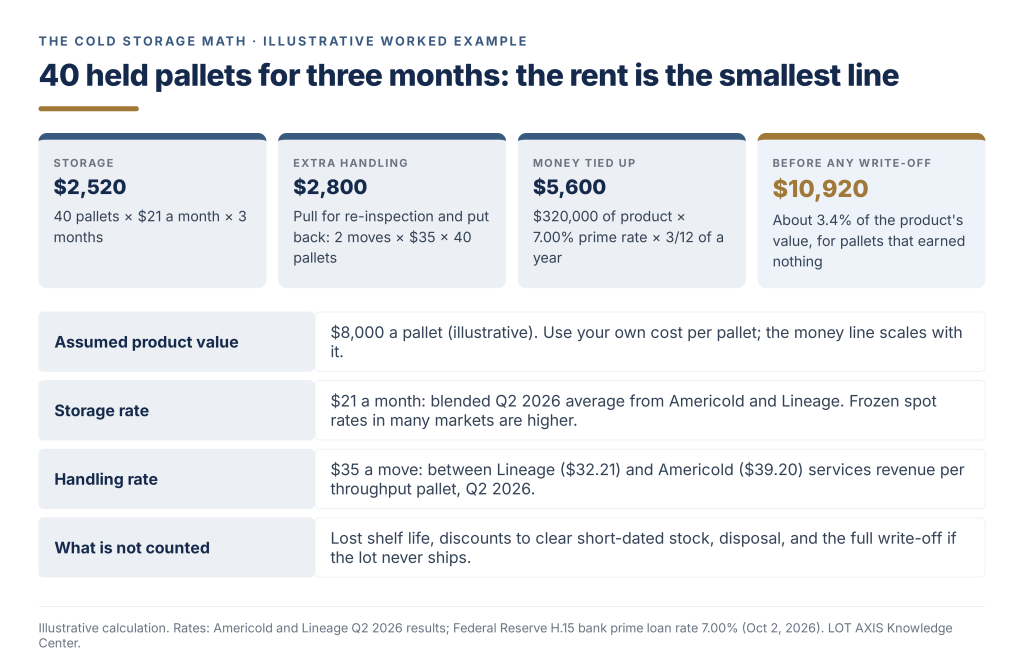
Take 40 pallets, each worth $8,000 at cost, held for three months. The numbers are illustrative; swap in your own.
| Cost line | Calculation | Amount |
| Storage | 40 pallets × $21 a month × 3 months | $2,520 |
| Extra handling | 2 moves × $35 × 40 pallets | $2,800 |
| Money tied up | $320,000 × 7.00% × 3/12 | $5,600 |
| Total before any write-off | $10,920 |
That is about 3.4% of the product’s value, spent on pallets that earned nothing. It does not count lost shelf life, discounts to clear short-dated product, disposal, or the full write-off if the lot never ships. For fresh product with a 70% rule, three months on hold usually means the last line is the one that matters.
Five Numbers to Pull This Month
- Pallets by status. Released, on hold, short-dated, unidentified. If your system cannot split them, that is the first gap.
- Age of every held lot. Days since the hold was placed, with a reason and an owner. A hold with no owner tends to last.
- Committed versus used positions. Compare your minimum storage commitment to what you actually fill, month by month.
- Days of shelf life left on held lots, against each customer’s acceptance rule, so you can ship by expiry while there is still time.
- Monthly cost of held inventory. Storage, handling and financing, using the arithmetic above. Put it on the operations report.
How Lot Axis Fits
Lot Axis tracks inventory by lot, location and status, so held, quarantined and released stock are separate in the system rather than in someone’s memory. Every lot carries its dates, its location and its full history from receipt or production, by barcode scan. That makes the five numbers above a report rather than a project, and it means a hold can be placed on exactly the lots affected rather than on everything nearby. When a test comes back clear, the release is a scan, and the pallet is available to ship that day. That is what we mean by Lot Intelligence™: the record you use to run the warehouse is the same one that tells you what your inventory is costing you.
Want to know how many of your pallets are paying rent for nothing? Schedule a Lot Axis demonstration and we will walk through your own inventory by status and age.
This article is general information, not financial, legal or regulatory advice. Storage rates and contract terms vary by provider and market; the figures here are published averages and an illustrative example. Confirm test-and-hold obligations against current FSIS policy and your HACCP plan.
Sources
Paste this list at the end of the published post. The full research package below stays internal.
- Americold Realty Trust — Americold Announces Second Quarter 2026 Results (August 6, 2026)
https://ir.americold.com/press-releases/news-details/2026/Americold-Announces-Second-Quarter-2026-Results/default.aspx
- Lineage, Inc. — Lineage, Inc. Reports Second-Quarter 2026 Financial Results (August 5, 2026)
https://ir.onelineage.com/press-releases/news-details/2026/Lineage-Inc–Reports-Second-Quarter-2026-Financial-Results/default.aspx
- Lineage, Inc. — Annual Report on Form 10-K for 2025 (SEC)
https://www.sec.gov/Archives/edgar/data/1868159/000186815926000012/line-20251231.htm
- USDA National Agricultural Statistics Service — Capacity of Refrigerated Warehouses, 2025 Summary (February 2026)
https://release.nass.usda.gov/reports/rfwh0126.pdf
- USDA National Agricultural Statistics Service — Cold Storage (September 25, 2026)
https://esmis.nal.usda.gov/sites/default/release-files/796075/cost0926.pdf
- Newmark Research — 1H 2026 U.S. Cold Storage Market Overview (August 27, 2026)
https://www.nmrk.com/insights/market-report/1h-2026-u-s-cold-storage-market-overview
- Federal Register — FSIS, Not Applying the Mark of Inspection Pending Certain Test Results, final policy (December 10, 2012)
https://www.govinfo.gov/content/pkg/FR-2012-12-10/html/2012-29516.htm
- Akkaş, A. and Honhon, D. — Determining maximum shipping age requirements for shelf life and food waste management, Production and Operations Management (2023)
https://ideas.repec.org/a/bla/popmgt/v32y2023i7p2173-2188.html