| KEY TAKEAWAYS
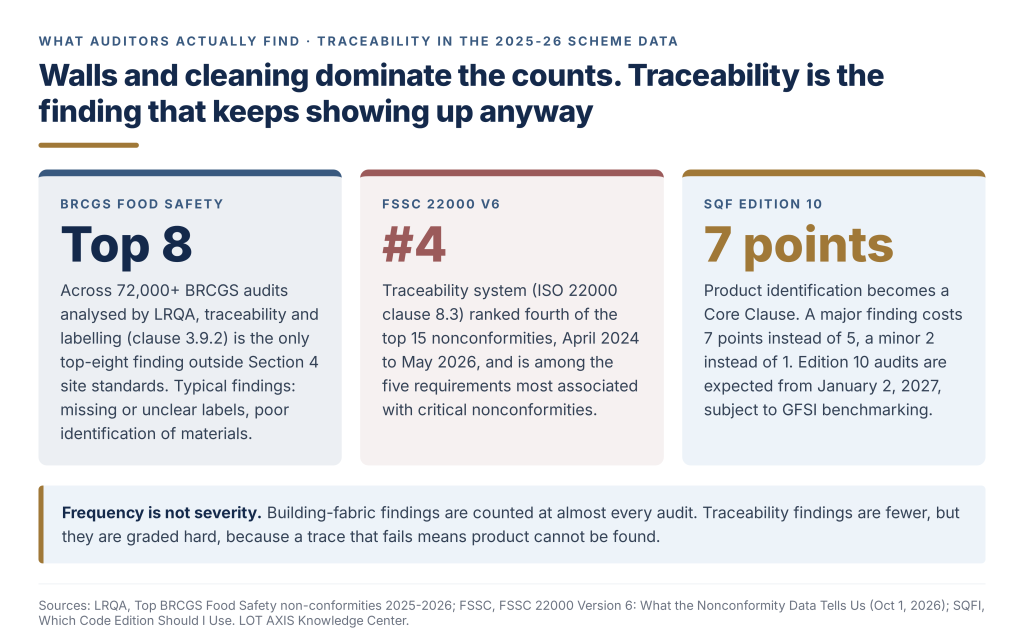
• Most audit findings are about the building: cleaning, walls, doors, chemicals. Across 72,000+ BRCGS audits, seven of the eight most common non-conformities sat in Section 4, site standards. The eighth was traceability and labelling. [1] • In FSSC 22000 Version 6 audits from April 2024 to May 2026, the traceability system ranked fourth of all nonconformities and was among the five requirements most often behind a critical finding. [3] • SQF Edition 10, expected from January 2, 2027, makes product identification a Core Clause: a major finding costs 7 points instead of 5. [4] • The findings describe practice, not paperwork: decanted ingredients nobody can trace, tests that skip inputs, records that cannot be found quickly. [1][3] |
A 96 Percent Superior Rating
On July 25, 2011, a third-party auditor spent about four hours at a cantaloupe packing shed in Colorado and gave it 96 percent, a “superior” rating. [5] Within weeks, cantaloupes from that shed were linked to a Listeria outbreak that, by the time a congressional committee reported in January 2012, had made 146 people ill and killed 30. [5][16] The auditor had noted major deficiencies, but the scoring only deducted points for departures from regulation, not from FDA guidance. [5]
The lesson most people take is that audits miss things. A team of food safety researchers put it more precisely: an audit is “a snapshot in time.” [6] The score tells you how a site looked on one day against one checklist. Other research on BRC audit grades in the United States found that grades are lower the first time a site certifies, lower at small manufacturers than at multi-site companies, and higher where certification bodies compete harder for business. [17] A grade measures more than food safety.
So the better use of audit data is not the grade. It is the pattern of findings across tens of thousands of audits, which the schemes and certification bodies now publish every year.
What the Lists Say
The certification bodies and scheme owners publish their most common findings. Read side by side, they tell the same story.
BRCGS Food Safety. LRQA, one of the largest certification bodies, analysed more than 72,000 BRCGS audits for 2025-26. The most common finding was hygiene, clause 4.11.1, “premises and equipment not consistently clean.” Chemical control drew more than 10,000 findings. Seven of the top eight sat in Section 4, site standards. The one that did not was traceability and labelling, clause 3.9.2, with “missing or unclear labels” and “poor identification of materials.” LRQA’s verdict: “Traceability fails in practice, not policy.” [1] The BRCGS Technical Advisory Committee’s overall top ten, reported by Campden BRI in January 2026, has the same shape: nine Section 4 clauses and traceability and labelling in seventh place. [2]
FSSC 22000. On October 1, 2026, FSSC published its analysis of Version 6 nonconformities from April 2024 to May 2026. Physical contamination ranked first, maintenance second, quality control third. The traceability system, ISO 22000 clause 8.3, ranked fourth. [3] FSSC’s first-year data was sharper: traceability was the second most common major nonconformity, behind internal audits, and one of four requirements most often graded critical. [9] The 2026 analysis again lists traceability among the five requirements most associated with critical findings. [3]
SQF. SQFI’s own review of Edition 9 named pest prevention as the leading non-conformance, followed by the food safety plan and cleaning and sanitation. [10] One U.S. certification body’s 2025 list of the ten most common SQF findings is led by cleaning, walls and chemicals, with records maintenance fourth and document control tenth. [11] Traceability does not appear by name, but it relies on those records.
Why do site standards dominate? LRQA’s explanation is that these are “controls carried out continuously, across shifts, by different people, under time pressure.” Its insight on hygiene: “Not a system failure – a consistency failure.” [1] The same is true of traceability. The procedure exists. What slips is the label on a part-used pallet at 3 a.m.
Frequency Is Not Severity
If you read the lists by count alone, the advice writes itself: fix the doors and the cleaning schedule. That is worth doing. But the counts measure how easy a finding is to see, not how much it matters.
A scuffed wall is visible to every auditor on every walk. A broken trace is only visible when someone tests it, and auditors test it on a sample of products. When the test fails, the grade reflects what it means: the site cannot say where its product went. That is why traceability sits fourth by frequency in FSSC data but second among majors and in the critical list. [3][9]
The grades matter. LRQA describes a major as “a significant failure that could impact product safety or legality if not addressed,” and a critical as “a breakdown that presents a direct risk to consumer safety or product integrity, often leading to immediate certification consequences.” [1] A site can carry a dozen minors on building fabric and keep its certificate. One critical on traceability can cost it.
Records sit behind the traceability ranking too. FSSC’s eleventh most common finding, documented information, includes “records that were not readily retrievable” and “insufficient control or protection of electronic records.” [3] A trace is only as fast as the slowest record it needs.
It is also why the schemes keep raising the bar. BRCGS Issue 9 requires a traceability test at least once a year, including a quantity check, that “should be achievable within 4 hours.” [15] SQF requires an annual trace exercise and notification to the certification body and SQFI within 24 hours of a Class I or II recall. [13] Under SQF Edition 10, product identification becomes one of the Core Clauses, scored at 2 points for a minor and 7 for a major instead of 1 and 5. Edition 10 audits are expected to begin January 2, 2027, subject to GFSI benchmarking, which SQFI says could push the date later. [4][12] FSSC 22000 Version 7 was released May 1, 2026, and Version 6 audits end on April 30, 2027. [14]
For U.S. processors, certification is rarely optional. Walmart, for one, requires suppliers to make “products, facilities, and records available for audits, inspections, and tests.” [19]
What the Traceability Findings Actually Describe
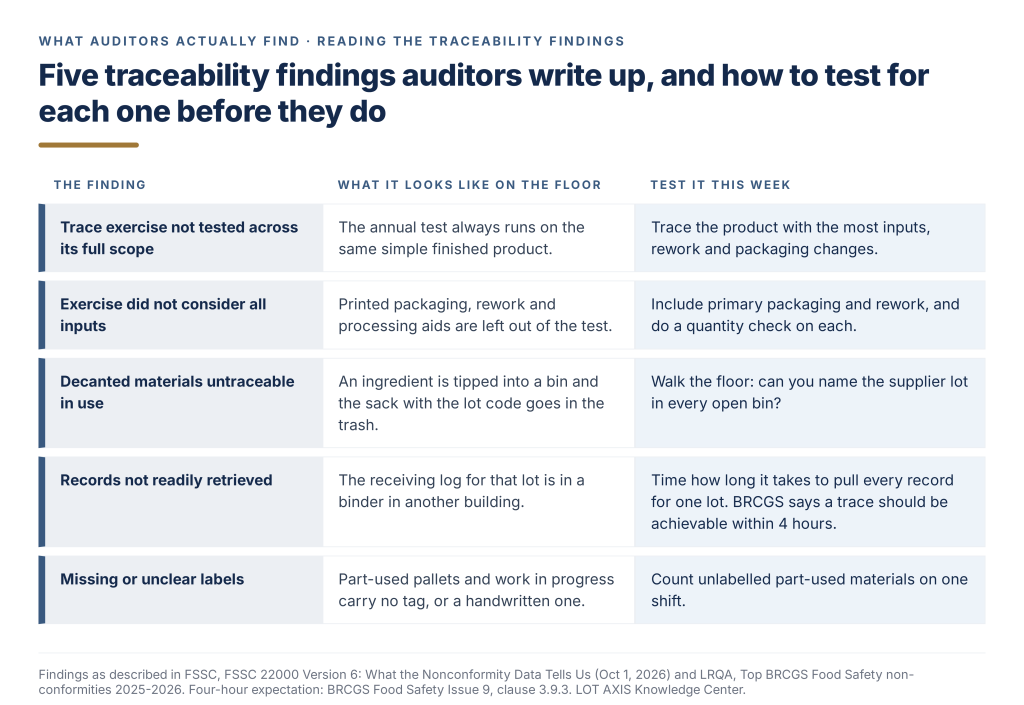
The useful part of the FSSC analysis is its description of what auditors wrote up. Common findings included trace exercises “not being completed in accordance with established procedures,” “inadequate testing of system effectiveness,” and exercises “that did not consider all relevant inputs and products.” Other findings: “decanted materials that could not be traced while in use and traceability records that could not be readily retrieved during the audit.” [3]
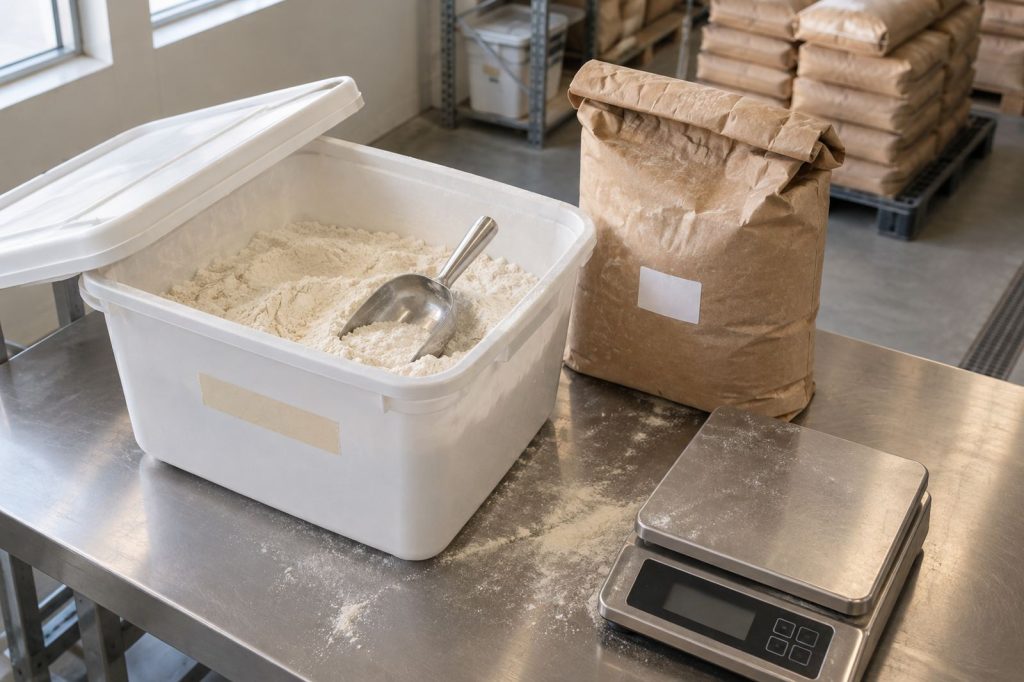
None of that is a missing procedure. Each is a moment on the floor. An operator tips a bag of flour into a bin and the bag with the supplier lot goes in the trash. A trace test runs on the same simple product every year and never touches rework or printed packaging. The receiving log for one lot is in a binder in the other building.
FDA saw the same thing from the regulatory side. In its spring 2026 traceability tabletop exercises with 15 companies, traceability lot codes were present in most records, but only 40% of participants had properly assigned them across each step in the chain, and only 27% had a complete lot code source. [7] The regulator is still working on it: on October 9, 2026, FDA announced a public meeting for November 6 on “challenges and solutions in lot-level food traceability” and proposed enforcement discretion for some small retailers and restaurants. [18][8] Neither changes what a processor must record.
Five Tests to Run Before the Auditor Does
- Trace your hardest product, not your easiest. Pick the one with the most ingredients, rework and packaging changes, and run it forward and back.
- Include every input. Primary and printed packaging, rework and processing aids. Do a quantity check: how much was received, used, shipped and still on hand.
- Walk the open bins. For every decanted ingredient on the floor, can someone name the supplier lot right now?
- Time the record pull. Start a clock, pull every record for one lot, and compare it with the four-hour expectation.
- Read your last three audit reports together. Group findings by clause family. A minor that repeats is a pattern, and the schemes now say so. [1][3]
How Lot Axis Fits
Lot Axis records each lot at the moment it moves, by barcode scan: receipt, decanting, production, rework, packing and shipping. When an ingredient is tipped into a bin, the bin carries the supplier lot forward, so the trace does not depend on a sack someone kept. A forward or backward trace with quantities becomes a search rather than a binder hunt, and the same records answer an auditor, a customer or FDA. That is what we mean by Lot Intelligence™: the record you use to run production is the record that proves where every lot went.
Want to see how long your hardest trace takes? Schedule a Lot Axis demonstration and we will run one with your own products.
This article is general information, not legal or certification advice. Scheme requirements, dates and scoring are as of October 12, 2026; confirm current requirements with your certification body and the scheme owner.
Sources
Paste this list at the end of the published post. The full research package below stays internal.
- LRQA — Top BRCGS Food Safety Non-Conformities 2025-2026 (datasheet, 2026)
https://assets.lrqa.com/m/16a77aca45cb1eb7/original/BRCGS-Food-Safety-non-conformities-Datasheet-Global-26.pdf
- Campden BRI — Top BRCGS and FSSC non-conformances: what can we learn? (January 12, 2026)
https://www.campdenbri.co.uk/blogs/brcgs-fssc-non-conformances.php
- FSSC — FSSC 22000 Version 6: What the Nonconformity Data Tells Us (October 1, 2026)
- SQFI — Which Code Edition Should I Use (Edition 10 scoring and Core Clauses)
https://www.sqfi.com/the-sqf-code/comply-with-the-code/which-code-edition-should-i-use
- S. House Committee on Energy and Commerce — Report of the Investigation of the Outbreak of Listeria monocytogenes in Cantaloupe at Jensen Farms (January 2012)
https://foodpoisoningbulletin.com/wp-content/uploads/CongressReportJensenFarmsOutbreak.pdf
- Powell, D.A. et al. — Audits and inspections are never enough: A critique to enhance food safety, Food Control 30(2), 2013
https://doi.org/10.1016/j.foodcont.2012.07.044
- S. Food and Drug Administration — Traceability Readiness Tabletop Exercises, Final Report (June 2026)
https://www.fda.gov/media/192993/download
- Federal Register — FDA, Challenges and Solutions in Lot-Level Food Traceability; Public Meeting (October 9, 2026)
https://www.federalregister.gov/documents/2026/10/09/2026-20720/challenges-and-solutions-in-lot-level-food-traceability-public-meeting