| KEY TAKEAWAYS
• NOAA’s Seafood Import Monitoring Program (SIMP) covers imports of 13 species groups — more than 1,100 species — and traces them from the harvest event to the point of entry into U.S. commerce. Its purpose is to keep illegally caught and misrepresented seafood out of the market. • FDA’s Food Traceability Rule (FSMA 204) covers listed foods, including most finfish, smoked finfish, crustaceans and molluscan shellfish, and follows them through the domestic supply chain. Its purpose is faster outbreak response. Enforcement is set for July 20, 2028. • The two programs share almost no data. SIMP records live with the importer of record — the International Fisheries Trade Permit holder — and are produced for an audit in days. FSMA 204 records live with everyone who handles the food and must reach FDA in 24 hours as an electronic sortable spreadsheet. • The seam is at the dock. Imported seafood usually arrives with no traceability lot code on it, and the first covered U.S. receiver has to assign one. |

Ask a seafood plant manager what “traceability” means and you will get an answer that depends on which auditor called last. If it was NOAA, traceability means harvest documents, vessel names and gear types. If it was a customer’s food safety team, traceability means lot codes, ship dates and a mock recall. Both answers are right, because two separate federal regimes are operating on the same fish, written by different agencies for different reasons, and they meet at the dock without shaking hands.
Understanding where each one starts and stops is the difference between keeping two sets of records twice and keeping one set of records once.
One Fish, Two Regimes, One Seam
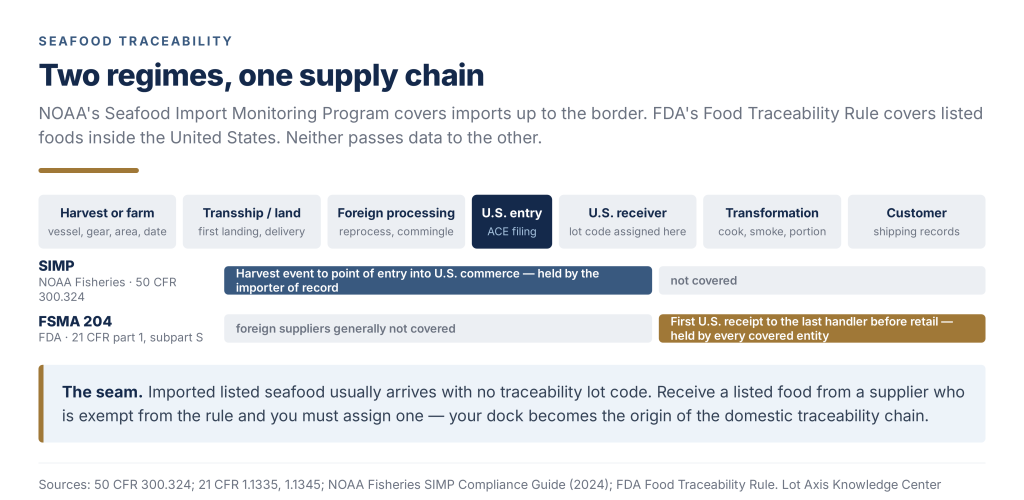
SIMP is a border program. NOAA Fisheries published the rule establishing the Seafood Import Monitoring Program on December 9, 2016, with mandatory compliance beginning January 1, 2018 for most species and December 31, 2018 for shrimp and abalone.[5][7] It applies to imports of 13 species groups — abalone, Atlantic cod, Atlantic blue crab, red king crab, Pacific cod, dolphinfish (mahi mahi), grouper, red snapper, sea cucumber, sharks, shrimp, swordfish and the tunas — covering more than 1,100 unique species.[6][8] Its job is to deter illegal, unreported and unregulated (IUU) fishing and seafood fraud, and its coverage runs from the harvest or aquaculture event to the point of entry into U.S. commerce. After that point, SIMP stops.[6]
FSMA 204 is a domestic food safety program. FDA’s Food Traceability Rule, at 21 CFR part 1, subpart S, applies to anyone who manufactures, processes, packs or holds a food on the Food Traceability List — which includes finfish (fresh and frozen), smoked finfish, crustaceans and bivalve molluscan shellfish.[19] It does not care where the fish came from or whether it was caught legally. It cares whether you can reconstruct, quickly, everywhere a lot went. Its coverage runs from the first covered handler in the United States to the last one before retail. Enforcement is set for July 20, 2028.[20]
Draw those two coverage bands on the same supply chain and the picture is clear: SIMP ends where FSMA 204 begins, and neither one hands the other any data.
What Each Regime Actually Asks You to Keep
The obligations are not similar, and that is the point.
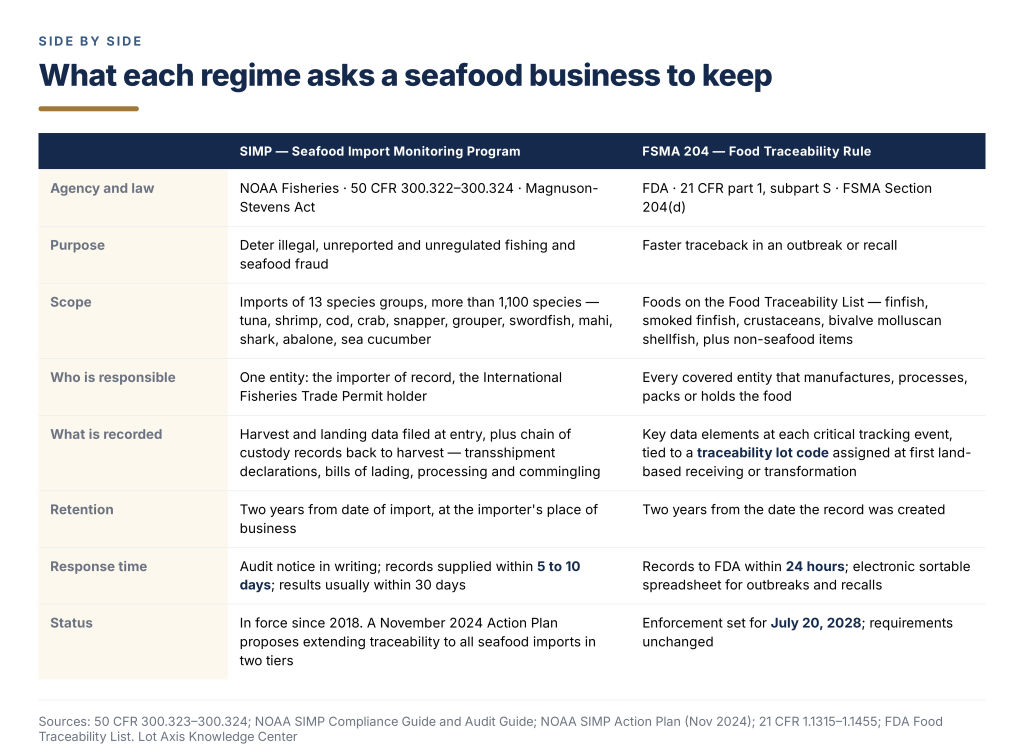
Under SIMP, the responsible party is one entity: the importer of record, which NOAA defines as the holder of the International Fisheries Trade Permit (IFTP).[1] That entity reports a defined harvest and landing data set through the Automated Commercial Environment at the time of entry — species, harvest area and gear, vessel or aquaculture facility, points and dates of first landing, the entity to which the fish was landed or delivered, and the IFTP number.[3] Separately, the importer must retain chain of custody records sufficient to trace the product from the point of entry back to the point of harvest, including transshipment declarations and bills of lading, and records of processing, reprocessing and commingling. Those records live at the importer’s place of business for two years from the date of import.[3][4]
Audits are the enforcement mechanism. When NOAA selects an entry, the importer is notified in writing and asked to supply supporting records within 5 to 10 days, with results typically returned within 30 days along with any nonconformities and corrective actions.[2] Importers with a clean record — three consecutive audits with no findings of noncompliance in the preceding 365 days — can be listed on the SIMP-Compliant Importers List, which reduces audit frequency at no cost.[9]
Under FSMA 204, the responsibility is distributed. Every covered entity keeps its own key data elements at each critical tracking event it performs. For seafood the pivotal one is first land-based receiving: the first person taking possession of the food on land directly from a fishing vessel assigns the traceability lot code and records the species or product description, quantity, the harvest date range and locations, the location description of the first land-based receiver, the landing date, and the reference document.[13] From then on the code travels with the product until a transformation — cutting, cooking, smoking, blending or repacking — creates a new lot code that must be linked to every input lot and quantity.[15] Records go to FDA within 24 hours of a request, as an electronic sortable spreadsheet when an outbreak or recall is involved.[16]
Two different clocks, two different custodians, two different definitions of “the record.”
The Seam at the Dock
Here is the practical problem for an importer or a processor that buys imported raw material.
SIMP’s data set is confidential, held by NOAA and the importer, and is not a labeling program — nothing on the carton tells your production supervisor anything.[7] Meanwhile, the FSMA 204 chain for that fish has to start somewhere in the United States, and a foreign supplier is generally not a covered entity assigning traceability lot codes. The rule handles this directly: when you receive a listed food from a person who is exempt from the rule, and no traceability lot code has been assigned, you must assign one.[14]
That single sentence is where a lot of seafood programs will succeed or fail. It means the U.S. receiver becomes the origin of the domestic traceability chain, and every downstream customer’s ability to trace the product depends on whether that assignment happened cleanly, on the pallet, at receipt — or was reconstructed later from an invoice.
It also means the two record sets are describing the same physical fish with entirely different vocabularies. The SIMP file says “yellowfin tuna, FAO Area 77, purse seine, landed 3 March.” The FSMA file says “TLC 26-0942, 1,180 kg, received 22 April, transformed into loins 24 April.” Nothing links them unless you deliberately link them.
Why Linking Them Is Worth Doing Anyway
Neither agency requires you to keep one combined record. Both make it easier if you do.
When a NOAA auditor asks for chain of custody on a specific entry, the answer sits in shipping documents. When a customer or FDA asks which finished lots contain that entry’s fish, the answer sits in production records. If the import entry number, the supplier lot and the traceability lot code are all attributes of the same lot record in one system, both questions are lookups. If they are not, both questions are projects.
The regulatory direction of travel also favors the operators who already keep clean lot-level data. NOAA’s November 2024 SIMP Action Plan proposes a two-tiered system that would extend traceability requirements to all U.S. seafood imports, with the full key data element set for higher-risk species and a smaller subset for everything else, plus pre-entry screening of SIMP data, after NOAA withdrew an earlier expansion proposal in November 2023.[10][11] Congress directed NMFS to move forward with implementing that Action Plan in FY2026.[12] Outside pressure is pushing the same way: a May 2026 policy brief from the U.S. IUU Fishing and Labor Rights Coalition argued that the majority of seafood entering the country still arrives without basic catch documentation and called for full implementation of the Action Plan.[17]
And the enforcement is not theoretical. In March 2026 NOAA closed two multi-year investigations into improperly labeled “dolphin safe” tuna, issuing civil penalties and stopping product at the border — one importer had brought in 74 shipments totaling 2.2 million pounds over an 11-month period, and a nationwide retailer another 29 shipments totaling 1.2 million pounds.[18] Those cases were labeling and documentation failures, not fishing failures. Documentation is the thing that gets audited.
A Sensible Way to Run Both
- Decide who owns each regime. SIMP compliance belongs to whoever holds the IFTP. FSMA 204 belongs to operations. Write both names down.
- Carry the import entry on the lot. Record the entry number and supplier lot as fields on the receiving record, not in a separate spreadsheet.
- Assign the traceability lot code at receipt. Imported listed seafood usually arrives without one, and you are the source of it. Print it, scan it, and stop treating the supplier’s carton marking as your lot identity.
- Instrument transformation. Cook lots, smoke lots, portioning and repack are where the seafood chain most often breaks. Input lots and quantities must link to the output lot.
- Keep everything two years and test the retrieval. Both regimes require two-year retention. Only one of them gives you 24 hours.
How Lot Axis Fits
Lot Axis was built for lot-controlled processing: barcode-driven receiving, production and shipping that keep one record per lot from the dock through transformation to the customer. The import entry, the supplier lot, the traceability lot code, the yield and the customer shipments are attributes of the same record — so a NOAA chain of custody request and an FDA traceability request are answered from the same data, without a special project for either. That is what we mean by Lot Intelligence™: the compliance record and the operating record are the same record.
Handling imported seafood and unsure where your SIMP file ends and your FSMA 204 file begins? Schedule a Lot Axis demonstration and we will walk one imported lot end to end — entry, receipt, transformation, shipment.
This article is general information about federal regulations, not legal advice. Confirm your obligations against the current text of 50 CFR part 300 subpart Q, 21 CFR part 1 subpart S, and NOAA’s and FDA’s current species and food lists.
Sources
Paste this list at the end of the published post. Keep it to 6–8 authoritative links — primary law, agency pages, standards bodies, and one current-status report. The full research package below stays internal.
- NOAA Fisheries — Seafood Import Monitoring Program
https://www.fisheries.noaa.gov/international/international-affairs/seafood-import-monitoring-program
- NOAA Fisheries — Compliance Guide for the U.S. Seafood Import Monitoring Program (revised January 2024)
https://www.fisheries.noaa.gov/s3/2024-01/SIMP-Compliance-Guide-JAN.2024.revision-508.pdf
- NOAA Fisheries — Guide to Audit Requirements for the Seafood Import Monitoring Program
https://media.fisheries.noaa.gov/2020-12/SIMP%20Audit%20Guidance%202020.pdf
- 50 CFR 300.324 — Seafood Traceability Program (reporting, recordkeeping, audits, chain of custody)
https://www.law.cornell.edu/cfr/text/50/300.324
- 21 CFR 1.1335 — Records for the first land-based receiver of food obtained from a fishing vessel
https://www.law.cornell.edu/cfr/text/21/1.1335
- FDA — Food Traceability List
https://www.fda.gov/food/food-safety-modernization-act-fsma/food-traceability-list
- FDA — FSMA Final Rule on Requirements for Additional Traceability Records for Certain Foods
https://www.fda.gov/food/food-safety-modernization-act-fsma/fsma-final-rule-requirements-additional-traceability-records-certain-foods
- NOAA Fisheries — SIMP Action Plan (November 2024)
https://www.fisheries.noaa.gov/s3/2024-11/SIMP-Action-Plan_final.pdf