Traceability Lot Codes, Explained: Who Assigns Them, Who Keeps Them, Who Passes Them On
| KEY TAKEAWAYS
• Under FSMA 204, a traceability lot code (TLC) is assigned at only three moments: initially packing a raw agricultural commodity, first land-based receiving of food from a fishing vessel, and transformation. You must not create a new one for any other activity, including shipping. • The TLC source — the physical place where the code was assigned — is a separate required data element, and it travels with the code down the chain. • When you ship an FTL food, seven of the eight shipping data elements must be provided to your next recipient; the reference document number is kept, not sent. • FDA’s spring 2026 readiness exercises found the lot code and its source were the data elements companies handled least consistently. • The rule tells you when to assign a code, not how to format it — industry practice is GTIN plus batch/lot on a GS1-128 case label. |
A Lot Code You Already Have Is Not Necessarily a TLC
Almost every processor prints a lot code. It identifies a production run inside your four walls, and for most plants it works fine: if something goes wrong, you know which day, which line, which shift.
The FDA Food Traceability Rule asks for something narrower. It defines a traceability lot code as “a descriptor, often alphanumeric, used to uniquely identify a traceability lot within the records of the traceability lot code source,” and a traceability lot as a batch of food that has been initially packed, received by the first land-based receiver, or transformed.[1] The difference is scope. Your internal lot code has to be unique to you. A TLC has to work as an identifier across the whole food system, because the point of the rule is that FDA can skip steps in the chain and jump straight to the firm that created the lot.[2]
That is why most existing lot codes cannot simply be relabeled as TLCs without some enhancement — a plant that reuses “0819A” every year, or restarts numbering at each line, is not giving anyone downstream a code that means one thing and one thing only.[3]
Only Three Moments Create a Lot Code
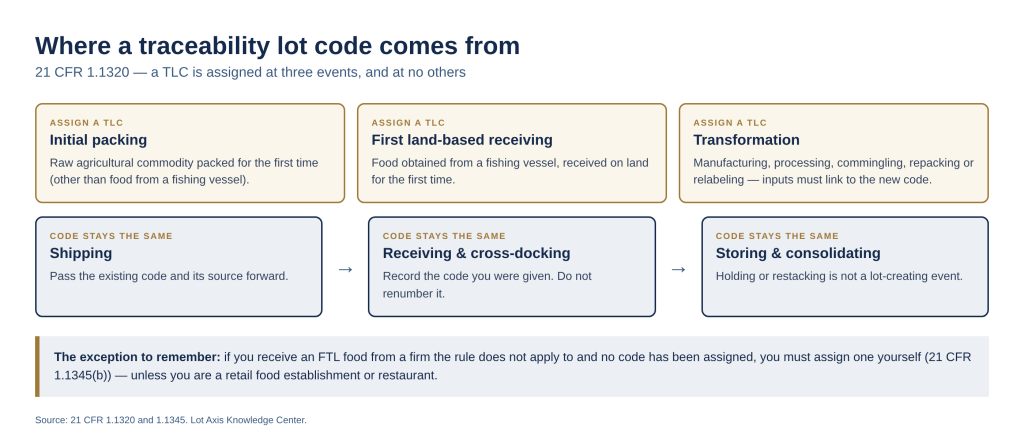
The assignment rule is one of the shortest passages in the whole subpart, and worth memorizing. Section 1.1320 says you must assign a traceability lot code when you do any of the following: initially pack a raw agricultural commodity other than food obtained from a fishing vessel; perform the first land-based receiving of food obtained from a fishing vessel; or transform a food. It then adds the sentence people skip: except as otherwise specified, you must not establish a new traceability lot code when you conduct other activities, such as shipping.[4]
Three consequences follow, and each one causes real arguments in real plants.
You do not get to renumber inbound product. If a case arrives with a TLC, that is the code that must appear in your receiving records, your inventory, and your outbound records — not a new internal number you find easier to type. Downstream firms have to use the code they were given rather than substituting their own reference.[5]
A distributor who only moves product assigns nothing. Cross-docking, consolidating, restacking pallets and shipping onward are not TLC-creating events. The code that came in is the code that goes out.
Repacking is not neutral. Changing a food’s packaging or packing counts as transformation, so a repacker does create a new code — and has to link it back to what went in.[3]
The Part Most People Miss: the TLC Source
The code alone is not enough. The rule also requires the traceability lot code source, defined as the place where the food was assigned a traceability lot code, recorded as a full location description: business name, phone number, physical address, city, state and postal code.[1]
There is an alternative for firms that do not want their supplier locations circulating on every document. A traceability lot code source reference is another way to give FDA access to that location description — the rule’s own examples are the FDA Food Facility Registration Number of the source, or a web address that resolves to the location description.[1] Industry guidance also treats a GS1 Global Location Number as a workable reference, with the location detail held in a master data system rather than printed on the paperwork.[6][7]
This matters commercially. A processor buying through a broker or a co-packer often does not want its customer to see the plant behind the product. The source reference is the mechanism the rule built for exactly that tension, and FDA’s June 2026 FAQ update added clarification on using a corporate headquarters as the source reference.[8]
What You Pass On, and What You Only Keep
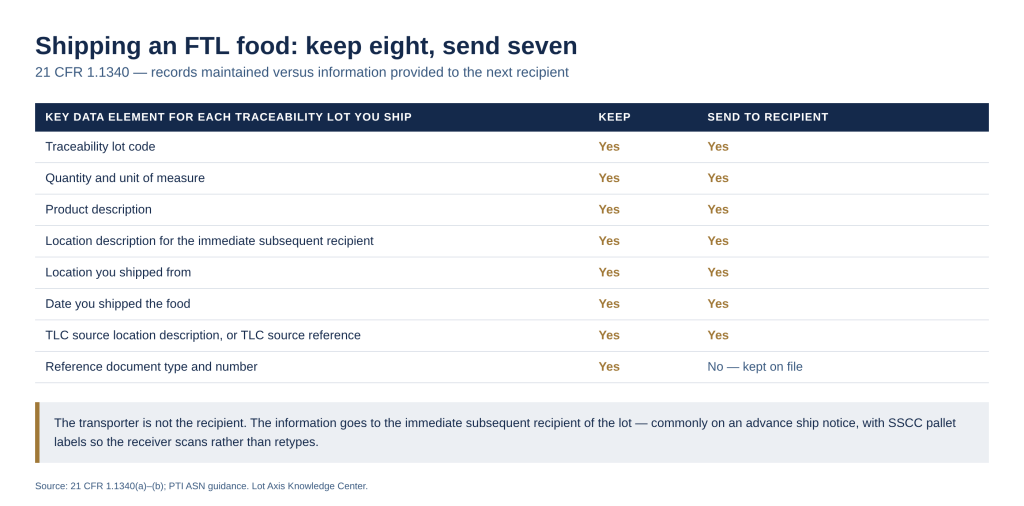
The shipping critical tracking event is where the distinction between “keep” and “share” becomes concrete. For each traceability lot you ship, you must maintain eight items linked to that lot: the TLC; the quantity and unit of measure; the product description; the location description for the immediate subsequent recipient; the location you shipped from; the ship date; the TLC source location description or source reference; and the reference document type and number.[9]
The next paragraph of the same section says you must provide items one through seven to the immediate subsequent recipient — everything except the reference document type and number, which stays on your side.[9] Receiving mirrors it: the receiver keeps the same list, including the TLC source, tied to the lot.[10]
The practical translation is that your advance ship notice, packing list or portal upload has to carry lot-level data, not just case counts. That is why industry guidance points at the EDI 856 ASN with SSCC pallet labels as the sane way to send it — one pallet scan resolves to every GTIN, lot and quantity on that pallet instead of a receiving clerk keying lot numbers off a paper manifest.[6][11]
Transformation Is Where the Chain Can Break
For a processor, transformation is the moment the rule tests your systems. Section 1.1350 requires, for each new traceability lot you create, the TLC, product description and quantity used for each input lot, plus the new TLC, the location where you transformed the food, the completion date, the product description, the quantity and the reference document.[12]
Read that carefully and you will notice it is a mass balance. Quantities in, quantities out, lot by lot. A plant that cooks four totes of one raw lot and two of another into a single finished run has to be able to say so afterwards — not approximately, and not from memory. This is the point where clipboard traceability usually fails, because the link between inputs and outputs lives in a shift supervisor’s head or in a batch sheet that never gets keyed in.
One more case catches people out: if you receive FTL food from a firm the rule does not apply to — a small farm below the sales threshold, for instance — you must assign a traceability lot code yourself if one has not been assigned, unless you are a retail food establishment or restaurant.[10] Receiving from an exempt supplier does not make the food exempt in your hands.
What FDA Found When It Tested This
Between March 9 and April 1, 2026, FDA ran traceability readiness tabletop exercises with industry, simulating a records request for a specific product and date range and asking for an electronic sortable spreadsheet within 24 hours. Most firms answered inside the deadline. But FDA reported uneven readiness specifically on traceability lot codes and TLC source information, alongside data standardization and the difficulty of pulling records across multiple systems and partners.[13][14]
The agency is still working the problem in public. It published a discussion paper, “Identifying Additional Flexibilities for Satisfying the Food Traceability Rule’s Lot-Level Tracking Requirement,” held a public meeting on June 15, 2026, and took comments to docket FDA-2014-N-0053 through July 15, 2026.[15][16] Ideas raised included allowing multiple lot codes on mixed shipments and reassigning codes at distribution points.[16] None of that has changed the rule, and the compliance date remains July 20, 2028 — but it tells you where the friction is.
The friction is visible in outbreaks too. In August 2026, jalapeños distributed from Sinaloa, Mexico were linked to a multistate Salmonella Javiana outbreak; the ingredient recall then pushed downstream into 18 meat and poultry products under an FSIS public health alert, with the agency saying it expected more downstream products to be identified as the recall progressed.[17][18] Every one of those downstream identifications is a lot-linking exercise.
What Good Looks Like on the Floor
- Write down your TLC format and stick to it. The rule does not prescribe one; the widely used convention is GTIN plus batch/lot, encoded on a GS1-128 case label under application identifiers (01) and (10).[3][11]
- Print it where it can be scanned, on the case and on the pallet, so receiving does not retype it.
- Record the TLC source once, as master data, and decide now whether you will publish the full location description or use a source reference.
- Capture input lots at the point of use, not at the end of the shift. Transformation records are only as good as the scan at the kettle, the grinder or the fillet line.
- Never renumber inbound lots. If your system cannot store a supplier’s code as the primary lot identity, that is a system problem, not a labeling problem.
How Lot Axis Fits
Lot Axis keeps one record per lot from receiving through transformation to shipping, with the traceability lot code and its source carried on every scan rather than re-entered. When a lot is cut, cooked, blended or repacked, the input codes and quantities are linked to the new output code as the work happens, so the mass balance the rule asks for is a byproduct of running the plant. The same records tell a supervisor which lots are oldest, what is on hold and which customers received a specific run. That is what we mean by Lot Intelligence™ — the traceability data doing daily work, not sitting in a binder waiting for an auditor.
Want to see what your lot codes look like end to end? Book a Lot Axis demonstration and we will walk one of your product flows — receiving, transformation, shipping — and show where a lot code would be lost today.
This article is general information about a federal regulation, not legal advice. Confirm your obligations against the current text of 21 CFR part 1, subpart S and FDA’s Food Traceability List.
Sources
Paste this list at the end of the published post. Keep it to 6–8 authoritative links. The full research package below stays internal.
- 21 CFR 1.1310 — Definitions, including traceability lot, traceability lot code, TLC source and TLC source reference
https://www.law.cornell.edu/cfr/text/21/1.1310
- 21 CFR 1.1320 — When traceability lot codes must be assigned
https://www.law.cornell.edu/cfr/text/21/1.1320
- 21 CFR 1.1340 — Records to keep and provide when shipping a food on the Food Traceability List
https://www.law.cornell.edu/cfr/text/21/1.1340
- 21 CFR 1.1350 — Records required when transforming a food on the Food Traceability List
https://www.law.cornell.edu/cfr/text/21/1.1350
- FDA — FSMA Final Rule on Requirements for Additional Traceability Records for Certain Foods
https://www.fda.gov/food/food-safety-modernization-act-fsma/fsma-final-rule-requirements-additional-traceability-records-certain-foods
- Produce Traceability Initiative — FSMA 204 TLC Source and Reference Guidance (2024)
https://producetraceability.org/wp-content/uploads/2024/02/PTI-FSMA-204-TLC-Source-and-Reference-Guidance-final-1.pdf
- Food Safety Magazine — How FDA’s Traceability Lot Code Requirements Advance Food Traceability
https://www.food-safety.com/articles/8492-how-fdas-traceability-lot-code-requirements-advance-food-traceability
- Quality Assurance & Food Safety — FDA Tabletop Exercises Reveal Traceability Challenges Ahead of FSMA 204 Compliance (June 11, 2026)
https://www.qualityassurancemag.com/news/fda-tabletop-exercises-reveal-traceability-challenges-fsma-204-implementation/