
| KEY TAKEAWAYS
• Since June 20, 2016, every official establishment and retail store that grinds raw beef for sale in commerce has had to keep five specific records for each lot — supplier establishment numbers, all supplier lot numbers and production dates, the names of supplied materials including carryover, the date and time the lot was produced, and the date and time the equipment was cleaned and sanitized.[1][2][4] • FSIS defines a ground beef lot by clean-up boundaries: the amount produced during particular dates and times, following clean up and until the next clean up, using the same source materials.[1][2] • Records must be kept where the grinding happened and held for one year.[2][3] • Inspection program personnel check these records during routine Raw Non-Intact HACCP tasks — not only after a positive test — and document noncompliance when they are missing.[2] • Ground beef is USDA-regulated, so FSMA 204 does not apply to it; this is a separate, already-enforceable recordkeeping regime.[13] • Carryover and clean-up times are the two entries most logs leave blank, and they are exactly the two that decide how wide a recall has to be.[2][5] |
Why This Rule Exists
FSIS wrote the grinding records rule because tracebacks kept dying at the grinder. When a store or a plant mixes trim and boneless beef from several suppliers into one batch and the paperwork only shows what was bought that week, no investigator can tell which supplier’s material went into the product that made someone sick.
The agency said so directly when it announced the final rule in December 2015: outbreak investigations “can be hindered when retail stores produce ground beef by mixing product from various sources but fail to keep clear records that would allow investigators to determine which supplier produced the unsafe product.”[5] The rule was published on December 21, 2015 and took effect June 20, 2016.[4]
It complements the expedited traceback and traceforward procedures FSIS announced in August 2014, under which the agency will ask a sole-source supplier to recall product when contamination most likely occurred at that supplier and part of the originating source lot went to other establishments.[5][10] That is the machinery your grinder log feeds. If your records cannot isolate a source lot, the circle gets drawn around everything.
The Five Things the Rule Actually Requires
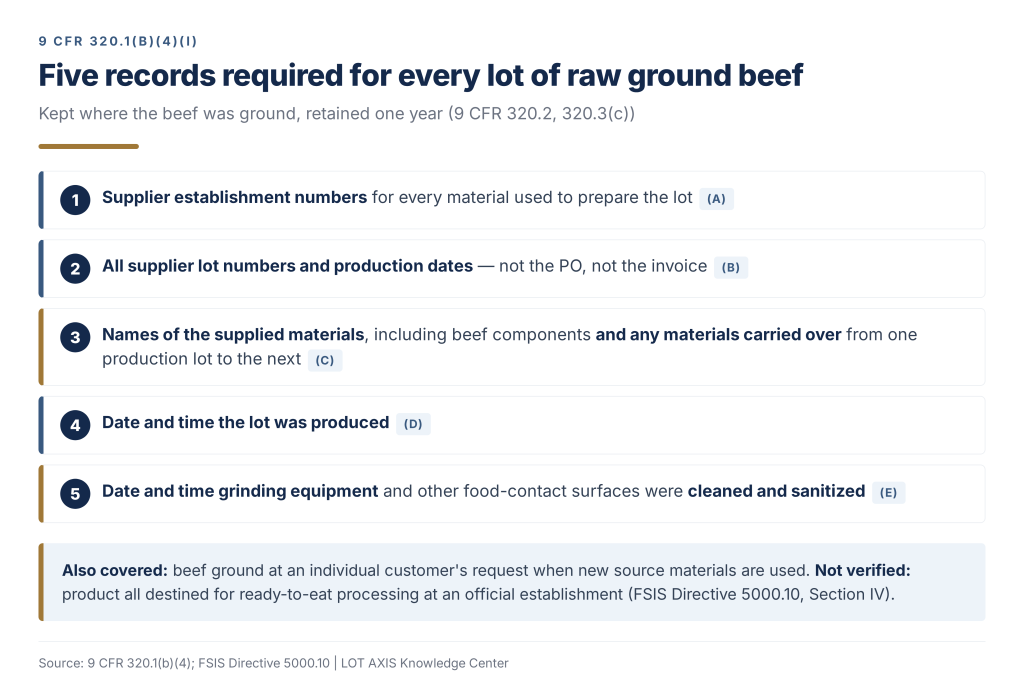
9 CFR 320.1(b)(4)(i) requires official establishments and retail stores that grind raw beef to keep records that fully disclose, for each lot of raw ground beef:[1][2]
- The establishment numbers of the establishments supplying the materials used to prepare that lot.
- All supplier lot numbers and production dates.
- The names of the supplied materials, including beef components and any materials carried over from one production lot to the next.
- The date and time each lot of raw ground beef product is produced.
- The date and time when grinding equipment and other related food-contact surfaces are cleaned and sanitized.
Two details in that list get missed constantly. The first is that item 2 says all supplier lot numbers — not the supplier’s name, not the purchase order, the lot numbers and their production dates. The second is the phrase “materials carried over from one production lot to the next” inside item 3, which is discussed below.
The requirements also reach beef that is ground at an individual customer’s request when new source materials are used, which is what brings the meat case at a retail store inside the same rule.[1][5] And the records must be kept at the location where the beef was ground, for one year.[2][3]
There is one carve-out worth knowing: if an establishment processes all of its ground beef into ready-to-eat product, or ships all of it to another federally inspected establishment that turns all of it into RTE product, FSIS does not verify these grinding records. If any of that raw product is not destined for RTE processing in an official establishment, the grinding records are required and subject to review.[2]
A Lot Is Defined by Clean-Up, Not by the Calendar
This is the part that changes how a plant runs, not just what it files.
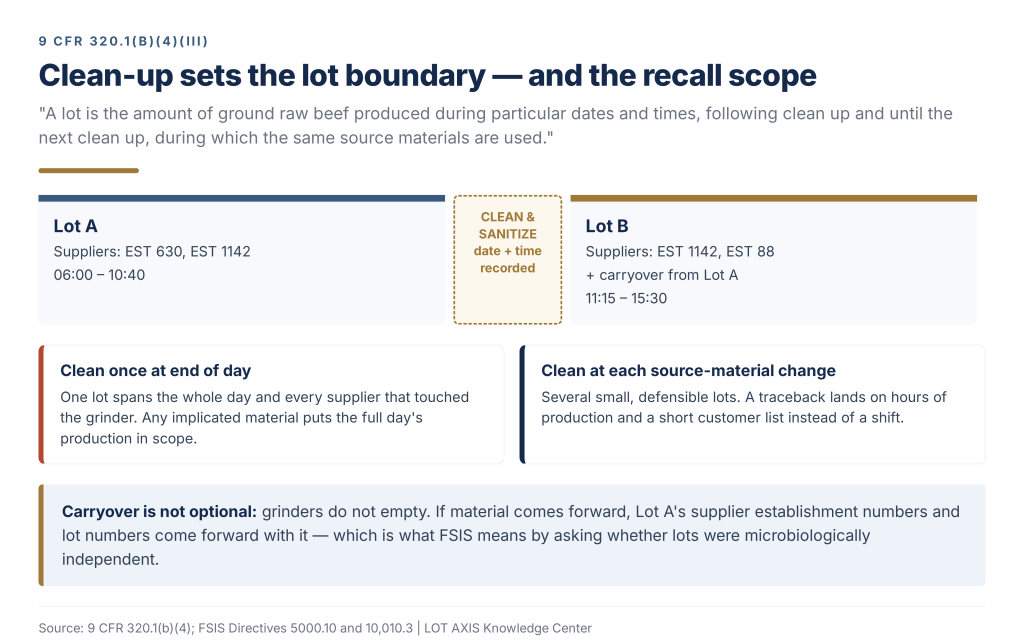
Under 9 CFR 320.1(b)(4)(iii), a lot of raw ground beef is “the amount of ground raw beef produced during particular dates and times, following clean up and until the next clean up, during which the same source materials are used.”[1][2]
Read that as an operating instruction. Your lot boundary is not the shift, not the day, not the production order number you happen to use in your ERP. It is set by two things you control: when you clean and sanitize, and when you change source materials. A plant that cleans once at the end of a long day and runs trim from four suppliers through the grinder has, by the rule’s own definition, produced one enormous lot — and if any part of it is implicated, all of it is.
That is why the fifth record element is not administrative trivia. The cleaning date and time is the fence around the lot. A grinder log with production times but no clean-up times cannot demonstrate where one lot ends and the next begins.
Carryover Is the Line Most Logs Miss
Grinders do not empty completely. Material sits in the throat, the auger and the plate, and some of it goes into the next batch. The rule anticipates that: the names of supplied materials must include any materials carried over from one production lot to the next.[1][2]
In practice this means the record for lot 2 must show not only what was fed into lot 2 but also what came forward from lot 1 — which drags lot 1’s supplier establishment numbers and supplier lot numbers into lot 2’s traceback. Miss that entry and your log is not just incomplete; it is misleading, because it implies a microbiological independence between lots that the equipment did not actually provide.
FSIS reasons in exactly these terms during a traceback. Its E. coli O157:H7 traceback directive tells investigators to identify all source materials and potential suppliers of beef components used in the sampled lot, and to determine whether other product may not be microbiologically independent from the contaminated product.[6] Your carryover and clean-up entries are what answer that question. The agency’s own retail grinding log template is described as tracking the source materials used, the products produced and “any microbiological independence between lots” — the same idea, in a form you can hand to a supervisor.[7]
What an Inspector Actually Does
You do not need a positive sample for these records to be examined. FSIS Directive 5000.10 instructs inspection program personnel to verify grinding recordkeeping while performing routine Raw Non-Intact HACCP tasks in the Public Health Information System, and for breaded ground beef products, the Heat Treated–Not Fully Cooked–Not Shelf Stable HACCP task. The inspector requests the production records for a specific lot and checks whether the required information is there. If it is not, they document noncompliance with 9 CFR 320.1(b)(4), 320.2 or 320.3.[2]
Where a retail store shares a facility with a federally inspected establishment, compliance investigators verify the retail side separately under the in-commerce surveillance methodology.[2]
So the practical test is not “do we have a binder.” It is: pick a lot from three weeks ago, and produce, on request, every supplier establishment number, every supplier lot number and production date, the carryover, the production date and time, and the clean-up date and time. In minutes, at the grinding location.
What Good Looks Like on the Floor
- Scan source material in, do not transcribe it. Supplier establishment numbers and supplier lot numbers are the two fields that get miskeyed most often, and they are the two an investigator uses first.
- Make clean-up an event in the record, not a note on a clipboard. Time-stamp it, and let it close the lot automatically.
- Give carryover its own field. If the answer is “none, after full clean-up,” the record should say that too.
- Keep lots deliberately small. Lot size is a business decision with a recall price attached. Cleaning between supplier changes is more expensive than cleaning once a day, and far cheaper than one recall drawn around a full day’s production.
- Rebuild one lot as a drill. Ground beef recalls are usually modest in size when the records are good — a February 2026 recall of raw ground beef for E. coli O145 covered 22,912 pounds produced on a single day, identified down to the case code and time stamps printed on the packaging.[8][9] That precision comes from records, not luck.
- Remember the deadline is one year, not forever. Records must remain retrievable at the grinding location for a year; archiving them somewhere no one can reach on a Friday afternoon defeats the purpose.[3]
One clarification worth making internally: because ground beef is regulated by USDA, it sits outside FDA’s FSMA 204 Food Traceability Rule. If your plant handles both USDA and FDA products, you are running two regimes on one floor — and unlike FSMA 204, the grinding records rule has been enforceable for nine years.[13]
How Lot Axis Fits
Lot Axis is built for lot-controlled processing: barcode-driven receiving that captures supplier establishment numbers and supplier lot numbers as data, production runs that consume specific input lots into a specific output lot, and clean-up and carryover recorded as part of the run rather than on a separate sheet. When an inspector asks for one lot, the answer is a query, not an archaeology project — and the same records tell a plant manager what the yield was, which supplier’s trim performed, and which customers received it.
That is what we mean by Lot Intelligence™: the records you already have to keep, made useful every day instead of only during an investigation.
Want to see a grinder log rebuilt as live data? Schedule a Lot Axis demonstration and we will walk one of your grind flows — receiving, grinding, clean-up, shipping — end to end.
This article is general information about federal recordkeeping regulations, not legal advice. Confirm your obligations against the current text of 9 CFR part 320 and current FSIS directives, and with your inspection program personnel.
Sources
Paste this list at the end of the published post. Keep it to 6–8 authoritative links. The full research package below stays internal.
- 9 CFR 320.1 — Records required to be kept (see paragraph (b)(4))
https://www.ecfr.gov/current/title-9/chapter-III/subchapter-A/part-320/section-320.1
- FSIS Directive 5000.10 — Verifying that Records are Kept by Official Establishments that Grind Beef
https://www.fsis.usda.gov/policy/fsis-directives/5000.10
- 9 CFR 320.3 — Record retention period
https://www.ecfr.gov/current/title-9/chapter-III/subchapter-A/part-320/section-320.3
- Final rule: Records To Be Kept by Official Establishments and Retail Stores That Grind Raw Beef Products (80 FR 79231, December 21, 2015)
https://www.govinfo.gov/content/pkg/FR-2015-12-21/pdf/2015-31795.pdf
- USDA Finalizes Rule to Ensure Retailers Can Track Sources of Ground Meats (FSIS news release, December 14, 2015)
https://www.fsis.usda.gov/news-events/news-press-releases/usda-finalizes-rule-enhance-consumer-protection-ensure-retailers
- FSIS Directive 10,010.3 — Traceback Methodology for E. coli O157:H7 in Raw Ground Beef Products and Bench Trim
https://www.fsis.usda.gov/policy/fsis-directives/10010.3
- FSIS Retail Guidance — Retail Beef Grinding Records and the Grinder’s Log template
https://www.fsis.usda.gov/inspection/compliance-guidance/retail-guidance
- FSIS Recalls and Public Health Alerts
https://www.fsis.usda.gov/recalls