
| KEY TAKEAWAYS
• The Produce Traceability Initiative states that its case-level requirements are aligned with the FDA Food Traceability Rule and cover approximately 90–95% of the requirements. • What PTI calls genuinely new is the traceability lot code source and the traceability lot code source reference — a location, not a number on a barcode. • The industry convention is that a produce traceability lot code is the case GTIN plus the batch/lot code, and FDA does not require that code to appear on the label at all. • The remaining gap is mostly not label design. It is harvest and cooling records, inbound and outbound capture, a written traceability plan, two-year retention, and the ability to hand FDA an electronic sortable spreadsheet within 24 hours. • The compliance date is July 20, 2028. That is enough time to close the gap properly and not enough to start in 2028. |
What PTI Already Bought You
If you pack or ship fresh produce in North America, you have probably been living with the Produce Traceability Initiative for more than a decade. PTI is voluntary, industry-built and focused on one thing: batch or lot tracking at the case level.[1] Its seven milestones walk a company from obtaining a GS1 company prefix, through assigning a GTIN to every case configuration and printing human-readable information and a GS1-128 barcode on each case, to the two that everyone forgets — reading and storing the GTIN and lot from every case received and every case shipped.[2]
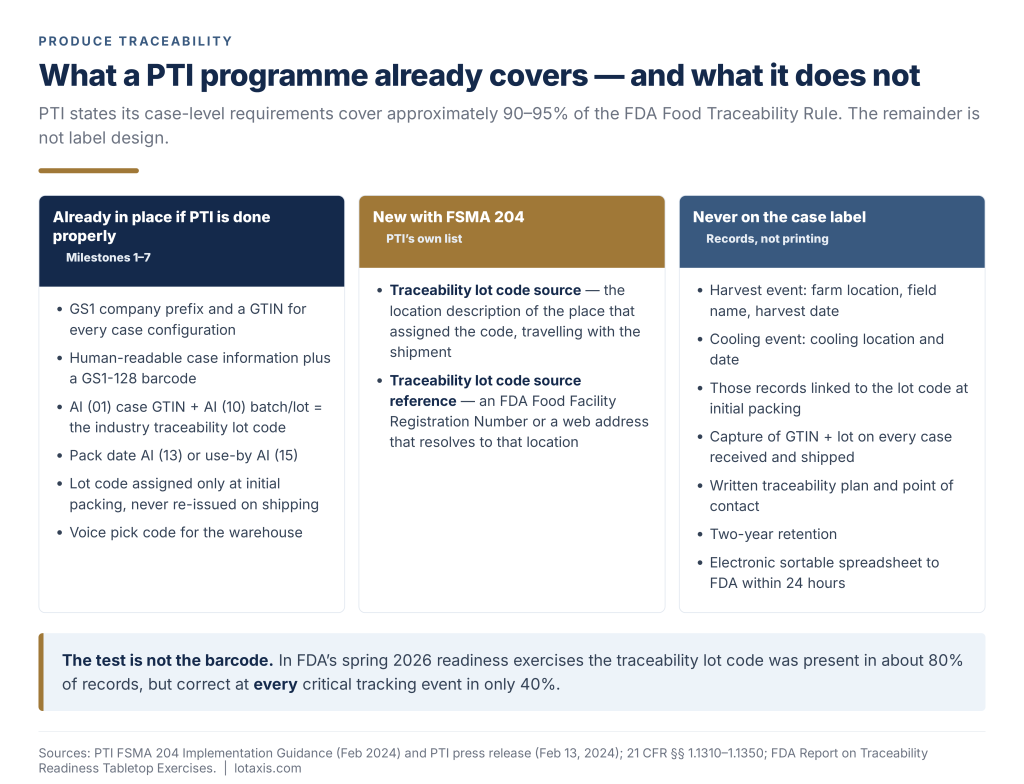
When the FDA Food Traceability Rule landed, PTI convened more than a hundred industry members to compare the two. Their published conclusion is worth quoting: the requirements of PTI for case-level traceability “are aligned with the Final Rule and cover approximately 90–95% of the requirements. What is new to PTI is the Traceability Lot Code Source and the Traceability Lot Code Source Reference.”[3]
That is a good headline for a produce business. It is also a headline worth reading carefully, because 5–10% of a recordkeeping rule is not 5–10% of the work.
The Number Was Already Right
Start with the piece you do not have to change. Under the rule, a traceability lot code is “a descriptor, often alphanumeric, used to uniquely identify a traceability lot within the records of the firm that assigned it.”[4] FDA does not dictate its format, and — a point that surprises people every time — FDA does not require the traceability lot code to appear on the product label or packaging at all.[5]
The produce industry settled the format question itself. PTI has defined the traceability lot code as the combination of the case GTIN and the lot code, carried on the harmonized case label as AI (01) GTIN-14 plus AI (10) batch/lot, usually alongside AI (13) pack date or AI (15) use-by date.[1][6] If your labels already carry those application identifiers and your systems already store both fields together, your traceability lot code exists and is defensible.
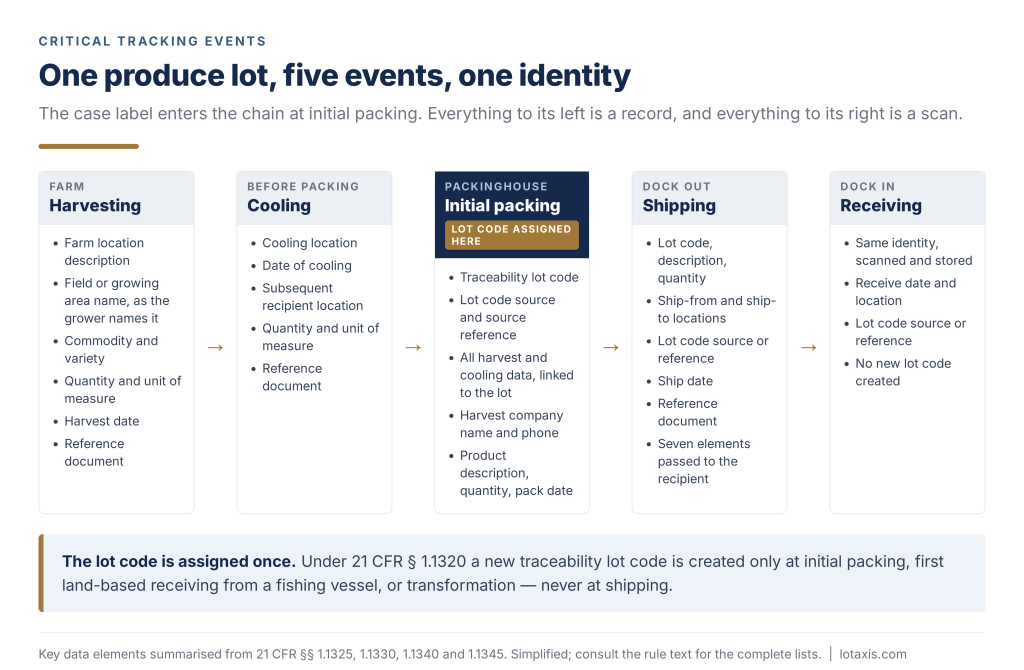
The same goes for the moment you assign it. The rule says you assign a traceability lot code only when you initially pack a raw agricultural commodity, perform the first land-based receiving of a food from a fishing vessel, or transform a food — and that you must not create a new code for other activities such as shipping.[7] A PTI shop already behaves this way: the packing line prints the case label, and the code rides downstream untouched.
The Two Elements That Are New
The traceability lot code source is not another code. It is the place where the code was assigned — for produce, the location description of the packinghouse: business name, physical address, city, state, postal code, country and phone.[6] It has to travel with the shipment as a key data element, not sit in a supplier master file that only your sales team can see.
The traceability lot code source reference is FDA’s alternative: instead of passing the whole location description down the chain, you may pass a reference that gives FDA access to it. The rule offers the FDA Food Facility Registration Number or a web address that resolves to the location description as examples.[4][6] PTI’s implementation guidance recommends the web-address approach, with a site that lets FDA retrieve the source location by entering the traceability lot code and a government email address, and treats a GLN — with a GLN extension for individual fields — as the practical way to identify locations precisely.[6]
This is the honest new build in the project. Everything else on the list you have probably been doing in some form.
The Events Your Label Never Touched
Here is where the remaining percentage hides. The critical tracking events in the rule for produce are harvesting, cooling before initial packing, initial packing, shipping and receiving.[11][13] PTI labels start at initial packing. Two of those events happen before a case exists.
For harvesting, the records must include the location description for the immediate subsequent recipient, the commodity and variety, quantity and unit of measure, the location description for the farm, the name of the field or growing area — which must match the name the grower uses — the harvest date, and the reference document type and number.[8] For cooling before initial packing, add the cooling location and the date of cooling.[8]
Then initial packing pulls all of it forward. Under § 1.1330, the packer must link to the traceability lot: the commodity and variety, the date and quantity received, the farm location, the field name, the harvest company’s business name and phone number, the harvest date, the cooling location and date if applicable, the traceability lot code assigned, the product description, the quantity packed, the location description for where you packed it (the traceability lot code source) and any source reference, the date of initial packing, and the reference document type and number.[9]
Read that list next to your harvest tickets. For most operations the information exists — on a paper ticket in a truck cab, in a field supervisor’s notebook, in a grower portal — and the gap is not knowledge but linkage: nothing today ties the ticket to the lot code the labeller printed four hours later.
A Label Is Not a Record System
The second gap is structural. PTI Milestones 6 and 7 — read and store the GTIN and lot on inbound and outbound cases — are the ones companies quietly skip, because printing a label is a one-time capital project and scanning every case is a daily operating habit.[2] The rule does not give you that option. Shipping and receiving are critical tracking events in their own right, each with its own key data elements, and shippers must pass seven of them to the immediate subsequent recipient.[10] PTI’s own guidance points at the EDI 856 advance ship notice as the mechanism for doing that at volume.[14][16]
On top of the event records sit three requirements that no barcode can satisfy: a written traceability plan describing how you keep records, identify listed foods and assign lot codes, plus a named point of contact and, for farms, a farm map; two-year retention of all required records; and the ability to give FDA, on request, an electronic sortable spreadsheet of the relevant records within 24 hours.[11][12]
That last one is the real test. FDA ran traceability readiness tabletop exercises with fifteen companies between March 9 and April 1, 2026. Most participants met the 24-hour expectation using ordinary business records. But the traceability lot code was present in about 80% of records and the traceability lot code source in about 73%; only 40% carried the correct code at every critical tracking event, and only 27% carried a complete lot code source.[15] The hard part was never the barcode. It was whether one identity survives every hand-off and lands in a single sortable file.
The Gap Analysis You Can Do This Week
PTI’s guidance opens with the same advice, and it takes an afternoon, not a consultant.[1]
- Pick one lot you shipped last month. Pull every record that touches it: harvest ticket, cooling log, pack run, case label spec, bill of lading, ASN.
- Lay the key data elements for each event beside the records and mark each one captured, captured but not linked, or missing.
- Check the two new ones. Does your location description for the packinghouse go out with the shipment, or does it live only in a customer’s vendor file? Do you have a source reference, and does it resolve?
- Test the 24-hour question. Can you produce a sortable spreadsheet of those records — same field names, one row per lot — without anyone retyping?
- Write down who owns each gap and the date it closes. Most will be linkage, not new data.
- Do not wait for the list to grow. Buyers commonly ask for the same data set on produce items that are not on the Food Traceability List at all.[3]
One note on timing: the compliance date for the rule’s recordkeeping requirements is now July 20, 2028, and FDA has continued to work publicly on flexibilities for lot-level tracking, releasing a discussion paper and holding a public meeting on June 15, 2026.[11][15] Industry groups continue to press for clearer boundaries on relabeling, spot purchases and commingled product.[17] Flexibility discussions change the details. They do not change the shape of what a packer has to be able to show.
How Lot Axis Fits
A PTI programme already gives you the identity. What is usually missing is one system that holds that identity from the field bin to the bill of lading — receiving, production and shipping driven by the same scan, so the field name, the harvest date, the cooling record, the pack run and every customer who received a case are all attached to one traceability lot code rather than to five documents in four places.
That is what we mean by Lot Intelligence™: the records a regulator may ask for are a by-product of how the plant already runs, and the same links tell a produce operations manager which grower, which field and which pack run actually performed. When the sortable spreadsheet is one export rather than one week, traceability stops being an annual anxiety.
Want to know exactly where your gap is? Book a Lot Axis walkthrough and we will map one produce lot — harvest to receipt — against the rule’s key data elements with you, and show you what is already there.
This article is general information about FDA recordkeeping requirements, not legal advice. Verify your own coverage, exemptions and obligations with FDA’s current guidance or qualified counsel. Status as of September 14, 2026.
Sources
Paste this list at the end of the published post. Keep it to 6–8 authoritative links — primary law, agency pages and the industry guidance the article relies on. The full research package below stays internal.
- FDA — FSMA Final Rule on Requirements for Additional Traceability Records for Certain Foods
https://www.fda.gov/food/food-safety-modernization-act-fsma/fsma-final-rule-requirements-additional-traceability-records-certain-foods
- 21 CFR § 1.1325 — Records for harvesting or cooling a raw agricultural commodity on the Food Traceability List
https://www.law.cornell.edu/cfr/text/21/1.1325
- 21 CFR § 1.1330 — Records for initial packing of a raw agricultural commodity on the Food Traceability List
https://www.law.cornell.edu/cfr/text/21/1.1330
- 21 CFR part 1, subpart S — Additional traceability records for certain foods (full rule text)
https://www.ecfr.gov/current/title-21/chapter-I/subchapter-A/part-1/subpart-S
- FDA — What You Need to Know About the Food Traceability Rule: Recordkeeping Information for Produce Farms
https://www.fda.gov/media/169510/download
- Produce Traceability Initiative — PTI FSMA 204 Implementation Guidance (February 12, 2024)
https://producetraceability.org/wp-content/uploads/2024/02/PTI-FSMA-204-Implementation-Guidance-FINAL-2.12.24-1.pdf
- Produce Traceability Initiative — PTI FSMA 204 Traceability Lot Code Source and Source Reference Guidance (2024)
https://producetraceability.org/wp-content/uploads/2024/02/PTI-FSMA-204-TLC-Source-and-Reference-Guidance-final-1.pdf
- FDA — Frequently Asked Questions on the FSMA Food Traceability Rule
https://www.fda.gov/food/food-safety-modernization-act-fsma/frequently-asked-questions-fsma-food-traceability-rule