| KEY TAKEAWAYS
• The Food Traceability Rule requires a written traceability plan from everyone covered by it — the plan is a standing obligation, not something you produce during an outbreak. • 21 CFR 1.1315 lists exactly five things it must contain, and four of them apply to every processor: record procedures, how you identify covered foods, how lot codes are assigned, and a named point of contact. • You must update the plan as practices change and keep the superseded version for two years. • When FDA ran readiness exercises with 15 companies in spring 2026, it asked for the traceability plan alongside the records; the traceability lot code appeared in 80% of records and the TLC source in 73%, but only 40% captured the correct lot code at every tracking event they performed and only 27% captured a complete TLC source. • Compliance is due July 20, 2028, and a consumer coalition asked Congress on August 12, 2026 to lift the funding restriction behind that date — the deadline is not guaranteed to stay put. |
The Cheapest Requirement in the Rule
Most processors reading about FSMA 204 start with the hard part: lot codes, key data elements, the sortable spreadsheet. That is understandable, and it is the wrong starting point.
The Food Traceability Rule — FDA’s regulation implementing Section 204(d) of the Food Safety Modernization Act, codified at 21 CFR part 1, subpart S — opens its recordkeeping requirements with a traceability plan.[1] It is a short written document. It costs nothing but decisions. And it is the only part of the rule you can finish this week.
It is also the part that forces every other decision into the open. You cannot describe how you assign traceability lot codes without deciding how you assign them. You cannot describe how you identify covered foods without listing your products against the Food Traceability List. The plan is not paperwork about the work — writing it is the work.
What the Rule Actually Asks For
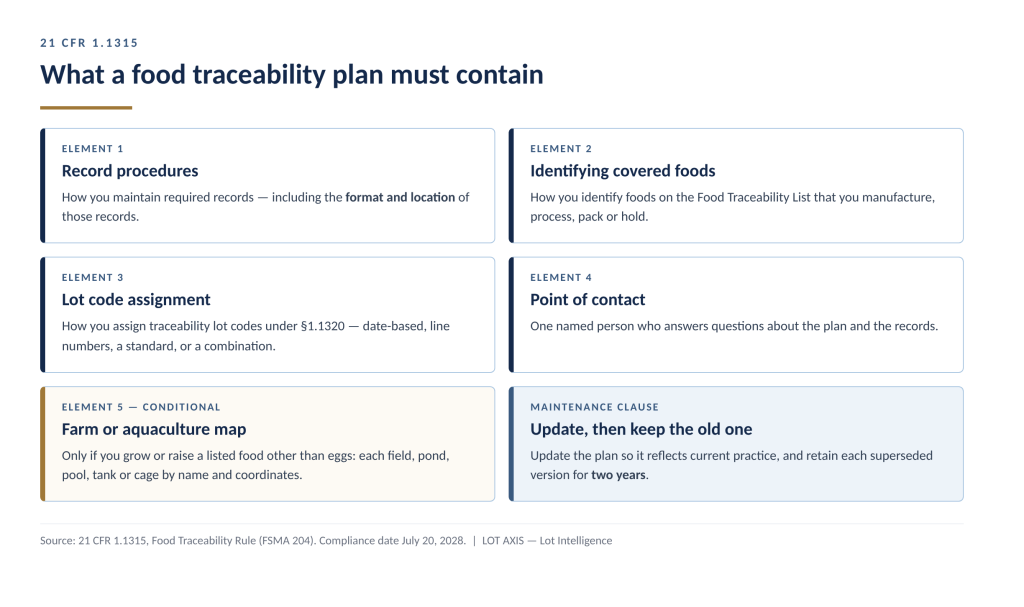
Section 1.1315 requires anyone subject to the rule to establish and maintain a plan containing five things.[1][2]
- How you keep the records. A description of the procedures you use to maintain the records required by the subpart, including the format and location of those records. Paper, spreadsheet, ERP, plant system — the rule does not care which, but it wants to know where an investigator will find them and in what form.
- How you identify covered foods. A description of the procedures you use to identify foods on the Food Traceability List that you manufacture, process, pack or hold. Most plants run a mix of covered and uncovered items — finfish and crustaceans next to a USDA-regulated line, or leafy greens next to something exempt. The plan has to say how your people tell them apart.
- How traceability lot codes are assigned. A description of how you assign traceability lot codes in accordance with §1.1320, if applicable. That section limits assignment to three moments: initially packing a raw agricultural commodity, performing the first land-based receiving of food from a fishing vessel, or transforming a food — and it says you must not create a new code for other activities such as shipping.[2] Extension guidance is blunt about the level of detail expected here: state whether you use a date-based system, line numbers, a specific identification standard, or a combination — and if someone else assigns the code, explain how that works too.[3]
- A point of contact. A statement identifying who answers questions about your plan and your records. One name, one phone number, one email. Name a backup while you are at it; outbreaks do not check the vacation calendar.
- A farm or aquaculture map, if you grow or raise. If you grow or raise a listed food other than eggs, the plan must include a map showing the location and name of each field or growing area — or for aquaculture, each pond, pool, tank or cage — with geographic coordinates.[1] Most processors skip this element. Seafood operations with their own grow-out do not.
Then the maintenance clause, which is where plans quietly fail: you must update the plan so it reflects your current practices, and you must keep the previous version for two years after each update.[1] A plan written once and filed is worse than useless during an inspection, because it documents a system you no longer run.
Who Needs One, and Who Does Not
The obligation follows the food, not the size of the company. If you manufacture, process, pack or hold a food on the Food Traceability List, you need a plan — and the list reaches finfish and smoked finfish, crustaceans, bivalve molluscan shellfish, fresh and fresh-cut leafy greens, melons, tomatoes, peppers, cucumbers, herbs, tropical tree fruits, soft cheeses, shell eggs and nut butters, including those foods used as ingredients in the same form.[4]
Subpart S also contains a long list of full and partial exemptions — small producers, certain farms, foods that receive specific kinds of processing, and others.[5] Two practical points about them. First, an exemption you are relying on is itself a documented conclusion; write down which products you consider out of scope and why, and keep that reasoning with your plan. Second, exemption from FDA’s rule does not exempt you from your customers, who increasingly ask for lot-level data in supplier agreements regardless of what the regulation compels.
Food under USDA’s exclusive jurisdiction — beef, pork, lamb, domestic poultry — sits outside this rule, but a plant that receives listed ingredients through a shared dock is still handling covered food.
What FDA Learned When It Asked 15 Companies
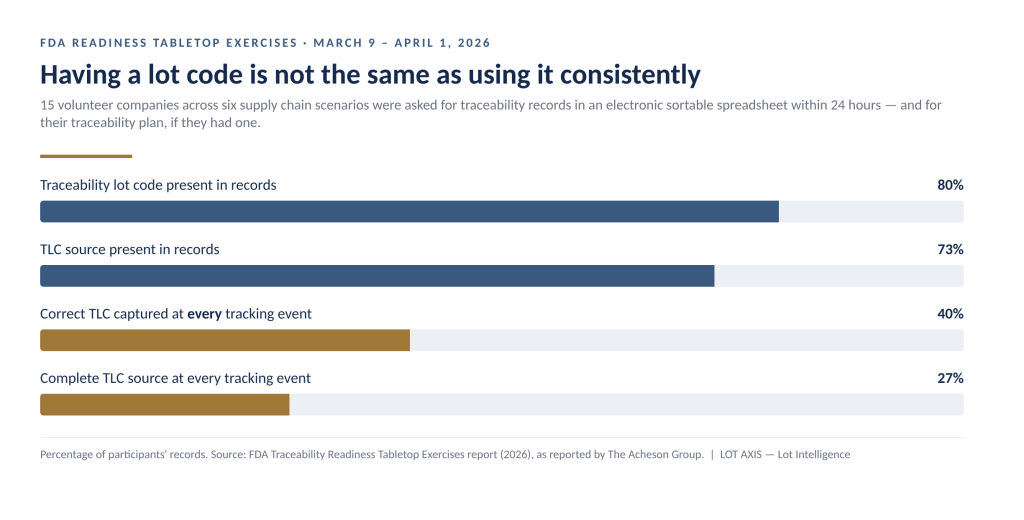
This is not theoretical. Between March 9 and April 1, 2026, FDA ran traceability readiness tabletop exercises with 15 volunteer companies spanning processors, distributors, retail food establishments and restaurants, across six supply chain scenarios. The exercise simulated a real records request: produce traceability records for a specified product and date range in an electronic sortable spreadsheet within 24 hours — and the traceability plan, if the firm had one.[6]
Most firms answered inside the 24 hours, and FDA called overall readiness encouraging. The detail underneath is the useful part. Participants used everything from invoices, purchase orders and bills of lading to warehouse management systems, ERP, RFID and GS1 barcodes — and the technology mattered less than whether trading partners had agreed on what data to collect, keep and share.[6] But on the lot code itself: the traceability lot code was present in 80% of participants’ records and the TLC source in 73%, while only 40% captured the correct lot code across every critical tracking event they performed, and only 27% captured a complete TLC source.[7]
Read those last two numbers as a warning about plans specifically. Having a lot code somewhere is not the same as assigning it consistently at each event — and the document where consistency gets defined is the traceability plan.
Write It This Afternoon: A One-Page Structure
- List every product you make. Mark each as on the Food Traceability List, exempt, or out of jurisdiction, with a one-line reason.
- For each record type — receiving, production, shipping — name the system or the form, where it lives, who maintains it, and how long it is kept. The rule requires two years.
- Lot codes. State the format of your traceability lot code, the event at which it is assigned, who assigns it, and where the code is physically applied. Name your TLC source location.
- Covered-food identification. Describe how staff know a listed food when they see it: item master flags, label markings, storage segregation, receiving checks.
- Name, title, phone, email, and a backup.
- Map, if you grow or raise a listed food: fields or containers, names and coordinates.
- Revision block. Date, author, what changed. Archive the previous version for two years.
Two things to note while writing it. Records may be kept as original paper, electronic records or true copies, and may be held offsite or by another entity — but you remain responsible for producing them onsite within 24 hours.[8] And when FDA asks, you must also hand over whatever is needed to understand your records: coding systems, glossaries, abbreviations, and how your fields map to the required data elements.[8] If your lot code format only makes sense to your production manager, the plan is where you translate it.
The Deadline Is Not as Fixed as It Looks
Compliance currently sits at July 20, 2028. FDA proposed a 30-month extension in 2025, and the FY2026 appropriations act then directed that no appropriated funds be used to administer or enforce the rule before that date; FDA has said it intends to comply with that direction.[9][10] The rule covers an estimated 323,000 domestic businesses operating more than 484,100 establishments, which is why coordination time was the stated reason for the delay.[10]
But the restriction rides on a single appropriations cycle. On August 12, 2026, the Safe Food Coalition wrote to congressional leaders asking them to strip the rider so FDA can enforce the rule sooner.[11] Whether or not that succeeds, the planning conclusion is the same: build to the requirement, not to the date.
How Lot Axis Fits
A traceability plan is a description of a system. The easier your system is to describe, the shorter the plan — and the more likely it is still accurate a year later.
Lot Axis was built for lot-controlled food processing: barcode-driven receiving, production and shipping that keep one current record of every lot from receiving through transformation to the customer. The traceability lot code is assigned in one defined place, printed on the label, and carried by every scan afterward — so section 3 of your plan is two sentences instead of two pages of exceptions. The same records tell you what you actually have on hand today, which is why we call it Lot Intelligence™: traceability data used to run the plant, not just to answer regulators.
Write the plan first. It costs an afternoon, and it will tell you precisely which parts of your operation are not ready.
Want to see what your traceability plan looks like when the system does the describing? Schedule a Lot Axis demonstration and we will walk one product flow — receiving, transformation, shipping — end to end.
This article is general information about a federal regulation, not legal advice. Confirm your obligations against the current text of 21 CFR part 1, subpart S and FDA’s Food Traceability List.
Sources
Paste this list at the end of the published post. Keep it to 6–8 authoritative links. The full research package below stays internal.
- 21 CFR 1.1315 — What traceability plan must I have for foods on the Food Traceability List?
https://www.law.cornell.edu/cfr/text/21/1.1315
- 21 CFR 1.1320 — When must I assign traceability lot codes?
https://www.law.cornell.edu/cfr/text/21/1.1320
- 21 CFR 1.1455 — How must records be maintained and made available (24-hour rule)?
https://www.law.cornell.edu/cfr/text/21/1.1455
- FDA — FSMA Final Rule on Requirements for Additional Traceability Records for Certain Foods
https://www.fda.gov/food/food-safety-modernization-act-fsma/fsma-final-rule-requirements-additional-traceability-records-certain-foods
- FDA — Food Traceability List
https://www.fda.gov/food/food-safety-modernization-act-fsma/food-traceability-list
- UF/IFAS Extension (EDIS FS475) — Food Traceability Rule Part 3: What Is a Food Traceability Plan and Who Is Required to Have One? (June 17, 2026)
https://ask.ifas.ufl.edu/publication/FS475
- Food Safety Magazine — FDA Traceability Rule Readiness Exercises Reveal Supply Chain Coordination Matters More than Technology (June 11, 2026)
https://www.food-safety.com/articles/11507-fda-traceability-rule-readiness-exercises-reveal-supply-chain-coordination-matters-more-than-technology
- Congressional Research Service (R48925) — The FDA’s Food Traceability Rule: Overview and Issues for Congress
https://www.congress.gov/crs_external_products/R/PDF/R48925/R48925.1.pdf