

| KEY TAKEAWAYS
• Accuracy tells you whether a record is correct. Visibility tells you what you have, where it is, how old it is, and whether it is actually available to sell. • In fresh food, age is commercial, not just regulatory: peer-reviewed research reports that U.S. retailers commonly require 70% of shelf life remaining for fresh products and 80% for shelf-stable, so good product can be refused at the dock. • An audit of one CPG manufacturer’s warehouse found inventory selected for shipment had 72% of its shelf life remaining on average — and a retailer described receiving product with one month left after eight months inside the manufacturer’s network. • Setting age thresholds by SKU instead of one blanket rule was worth up to 8.7% more profit and 14.7% less food waste across 450+ products in the same study. • Cross-sector working-capital research put a record $1.94 trillion tied up in working capital in 2025, with days of inventory rising and average holding time reaching 56 days. • 43% of supply chain professionals say they struggle to maintain supply chain visibility; companies using real-time tracking were 68% more likely to report improved visibility and inventory control. |
Inventory Accuracy Is Not Inventory Visibility
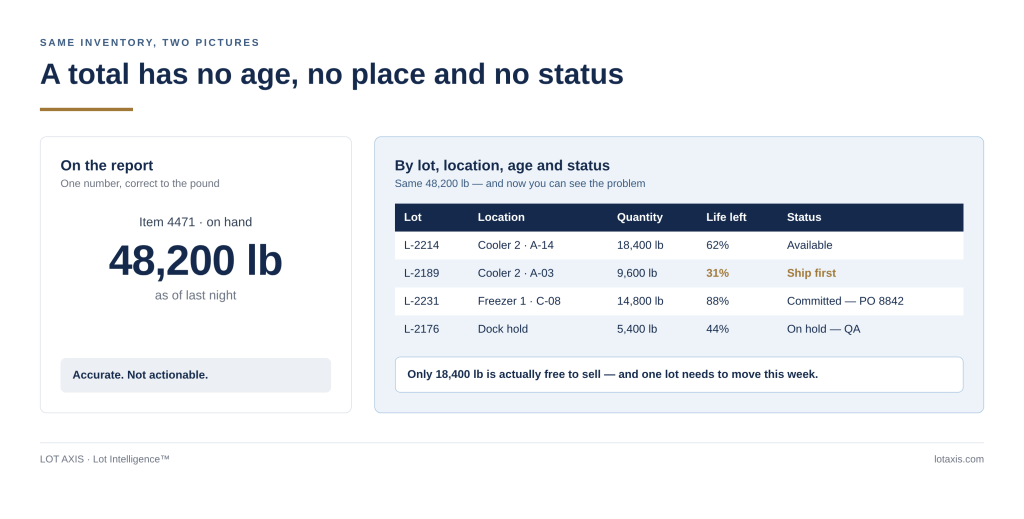
A monthly inventory report can balance to the penny and still leave a plant manager without what they need to run today.
The total may be right. But which lots are available? Where are they? Which are committed to orders, which are on hold, which are aging, and which will be refused by a customer even though they are perfectly safe to eat?
Accuracy is a statement about a record. Visibility is a statement about the operation: current, usable information on each lot’s quantity, location, age, status and movement. The gap between the two is where money leaks, and the industry knows it — in GS1 US research published in April 2025, 43% of supply chain professionals reported struggling to maintain supply chain visibility, even while 64% described themselves as highly confident in managing disruption. The same study found companies implementing real-time tracking technologies were 68% more likely to report improved visibility and better inventory control.[1]
Confidence and visibility are not the same thing either.
The Clock That Does Not Appear on the Report
Here is the part that makes food different from every other kind of inventory. Your product has a clock running on it, and the clock is commercial before it is ever a safety matter.
Peer-reviewed research published in Production and Operations Management studied exactly this problem with data from a large consumer packaged goods manufacturer. The authors report that U.S. retailers commonly require a minimum of 70% of shelf life remaining for fresh products such as dairy, packaged meat and eggs, and 80% for shelf-stable products. A European distributor they interviewed applies the “one-third” rule: no more than a third of shelf life at the manufacturer, no more than another third at the distribution center, so the product arrives at store with at least a third of its life left.[2]
Read those numbers again from a processor’s chair. On a fresh item, the customer may reject product that has used barely 30% of its life. Age, not quality, ends its commercial life.
And age accumulates quietly. An audit at the manufacturer’s own warehouse found that inventory selected for shipment to retailers had, on average, 72% of its shelf life remaining — meaning more than a quarter of the clock was gone before the truck left. One retailer in the same research described receiving product with only one month of remaining shelf life after it had spent eight months inside the manufacturer’s distribution network.[2]
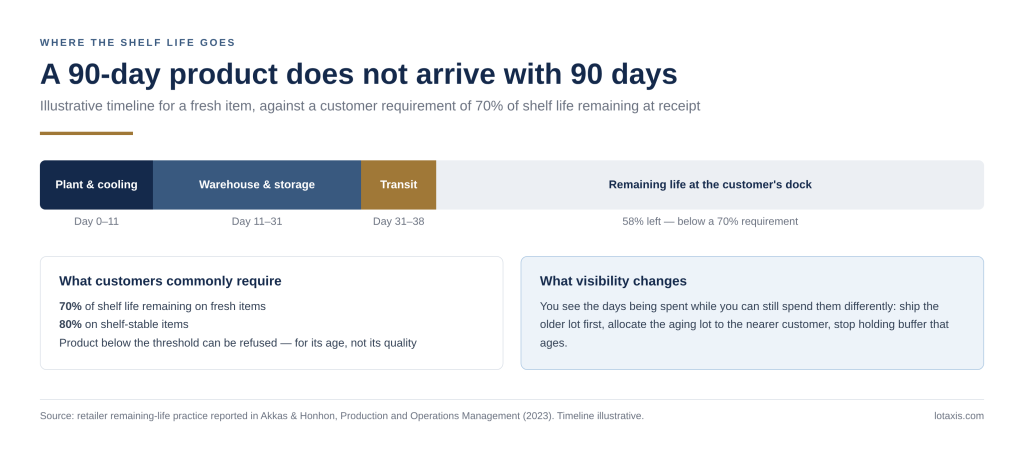
Nobody decided to do that. It is what happens when the person allocating inventory can see quantities but not ages.
The upside is measurable in the other direction. When the researchers computed age thresholds SKU by SKU instead of applying one blanket rule across 450+ products, they found 9–10% of SKUs were being managed on the wrong threshold — and correcting it was worth up to 8.7% higher profit and 14.7% less food waste, which at that manufacturer meant up to $292,561 saved and 1,846 truckloads of waste avoided annually.[2]
That is what age-aware inventory is worth. And you cannot manage what your system does not show you.
Where the Hidden Costs Show Up
1. Aging Product and Write-Offs
Without a clear view of which lots should move first, older product sits behind newer receipts. The result is markdowns, rework, donation or disposal.
Note the difference between two rules that sound similar. FIFO ships what arrived first. FEFO ships what expires first. They are not the same lot when production dates, storage temperatures and shelf lives vary, and only one of them protects you at the customer’s dock. Choosing correctly requires knowing each lot’s actual age and remaining life — not the item’s average.
2. Cash and Space You Pay For Regardless
Inventory you cannot see clearly tends to grow, because buffer stock is how teams protect themselves from a system they do not trust. That buffer is cash, and it is space.
The scale of the cash question is not in dispute. The Hackett Group’s 2026 working capital research, covering the largest 1,000 U.S. non-financial public companies, found a record $1.94 trillion in total working capital opportunity for 2025, up from $1.73 trillion, with days inventory outstanding rising and the average time companies held goods reaching 56 days.[3] That figure spans all sectors — but the food-specific version is harsher, because in food the buffer does not simply sit there. It ages.
Space is finite too. USDA’s biennial survey found U.S. gross refrigerated warehouse capacity of 3.99 billion cubic feet as of October 1, 2025, of which only 82% is usable storage once aisles, posts and equipment are excluded.[4] Cold space costs money by the pallet position whether the pallet in it is sellable or not.
3. Stockouts That Should Not Be Stockouts
The opposite failure is just as expensive: usable inventory exists but cannot be located, carries the wrong status, or is sitting in a location nobody checked. Production stops, purchasing expedites material the plant already owns, or customer service quotes a later ship date.
A lot that cannot be found quickly is functionally the same as a lot that does not exist — except that you already paid for it.
4. Labor Spent Reconciling Instead of Running
Poor visibility creates a shadow inventory system: phone calls, spreadsheets, handwritten notes, and the one person who knows where things actually got moved. Supervisors spend their shift comparing warehouse reality with office records rather than improving throughput.
That is not a data problem. It is capacity spent on bookkeeping.
5. Customer Commitments — Now Priced Automatically
Inventory visibility is what lets you tell a customer today, on the call, whether product is available and which lot will ship. Increasingly, being wrong about that has a published price.
Effective January 1, 2025, Kroger raised its on-time arrival compliance threshold from 90% to 93% and applied a fee of 3% of the invoiced amount to purchase orders that arrive late for vendor-caused reasons, assessed as an invoice deduction, alongside an inbound compliance fee schedule covering pallet quality, load quality, documentation, shipping accuracy and EDI data.[5] A shipment you discover is short at 5 p.m. is no longer a phone call. It is a deduction.
6. Traceability and Containment
The same lot-level records that tell you what is sellable are the records you need when a lot must be investigated. Under FSMA 204, covered records must generally be produced within 24 hours, in an electronic sortable spreadsheet when requested, with compliance required by July 20, 2028.[6][7] When a hold is placed, the ability to say immediately what remains on site, what was consumed and what shipped is what keeps the scope small.
Visibility Protects More Than Inventory
The financial damage from poor visibility never arrives as one line item. A little extra purchasing here, an emergency transfer there, a rejected load, a monthly write-off, hours of reconciliation. They look like six separate problems. They are usually one: the operation does not have a single current view of its inventory.
The goal is not more data. It is turning every receiving, production, movement, hold, allocation and shipping transaction into information a manager can act on the same day.
From Inventory Records to Inventory Intelligence
Lot Axis captures inventory as the work happens — scanned at receiving, production, palletizing and shipping — so what you see is what is on the floor: quantity, lot, location, age, status and what is committed.
That means the aging lot surfaces before it becomes a write-off, the located lot gets used instead of repurchased, and the answer a customer needs is available while they are still on the phone. This is Lot Intelligence™: traceability data used every day to protect margin, not just produced on demand during an audit.
Poor inventory visibility is rarely one dramatic expense. It is a series of small ones that quietly erode margin. Making inventory visible is how processors start controlling them.
A Quick Self-Check
- ✓ Can you list, right now, every lot with less than 30 days of usable life left?
- ✓ Do you ship FIFO or FEFO — and can your system tell the difference?
- ✓ What percentage of shelf life remains, on average, when your product leaves the dock?
- ✓ How much of your inventory is buffer you hold because the records are not trusted?
- ✓ What did you write off last quarter, by lot, and would earlier visibility have saved it?
See Your Inventory by Lot, Location, Age and Status
Schedule a demonstration. Bring your hardest inventory question — the aging lot, the missing pallet, the load a customer refused — and we will show you where the answer lives.
Lot Intelligence™ — Label It. Track It. Trace It. Control It.
This article is general information, not legal, regulatory or financial advice. Confirm your obligations under FDA requirements and your customers’ current supplier compliance and shelf-life specifications.
Sources
Paste at the end of the published post. Full research package stays internal.
- GS1 US — Powering Supply Chain Confidence: The Role of Data and Standardization (Redpoint Research, April 22, 2025)
https://www.gs1us.org/industries-and-insights/media-center/press-releases/redpoint-research
- Akkaş, A. & Honhon, D. — Determining maximum shipping age requirements for shelf life and food waste management, Production and Operations Management (2023)
https://doi.org/10.1111/poms.13963
- com — U.S. firms face record $1.94T liquidity challenge, Hackett Group working capital survey (August 5, 2026)
https://www.cfo.com/news/us-firms-face-record-194t-liquidity-challenge-hackett-north-american-working-capital-survey-says/826774/
- USDA NASS — Capacity of Refrigerated Warehouses, 2025 Summary (February 9, 2026)
https://esmis.nal.usda.gov/sites/default/release-files/795764/rfwh0126.pdf
- Kroger — Vendor compliance program updates, effective January 1, 2025
https://kroger.onenetwork.com/wp-content/uploads/2025/03/1-VNC-Program-Updates_final_signed.pdf
- FDA — Requirements for Additional Traceability Records for Certain Foods (FSMA 204)
https://www.fda.gov/food/food-safety-modernization-act-fsma/fsma-final-rule-requirements-additional-traceability-records-certain-foods
- Food Safety Magazine — FDA traceability readiness exercises reveal coordination matters more than technology (June 11, 2026)
https://www.food-safety.com/articles/11507-fda-traceability-rule-readiness-exercises-reveal-supply-chain-coordination-matters-more-than-technology
- FDA — Tracking and Tracing of Food
https://www.fda.gov/food/new-era-smarter-food-safety/tracking-and-tracing-food