
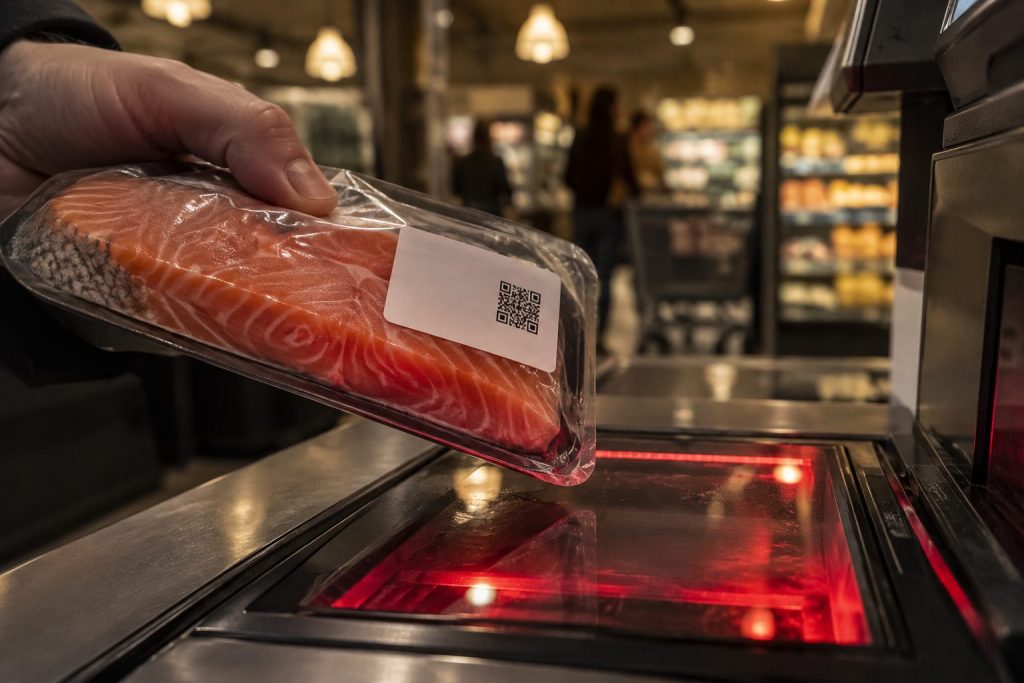
| KEY TAKEAWAYS
• Sunrise 2027 is an industry goal set through GS1, not a law: by the end of 2027 retail point-of-sale systems should be able to read a defined set of 2D barcodes alongside the UPC. [1][2] • The only thing the register must process is the product number (GTIN). But a 2D code can also carry the lot, use-by date and weight, and retailers that read them are already blocking expired product at the till and targeting recalls by batch. [4][6][12] • Fresh, random-weight meat, seafood and deli is where 2D shows up first: Woolworths New Zealand now carries it on all its own-brand fresh meat in North Island stores, and Tesco switched a whole own-label sausage range in April 2026. [12][14] • For a processor the risk is not the scanner. It is the data behind the code. A date entered back to front can block good product at checkout. [13] |
A Deadline That Is Not a Regulation
If you sell into retail, you will start hearing “Sunrise 2027” from buyers, label suppliers and printer salespeople, often with a tone that suggests a compliance date. It is worth being precise about what it is.
Sunrise 2027 is the U.S. name for a global goal agreed through GS1, the standards body behind the UPC. By the end of 2027, all retail point-of-sale systems should be capable of reading and processing a defined set of 2D barcodes, in addition to the linear barcodes they read today. [1][2] Outside the United States it is called Ambition 2027. No regulator set the date. GS1 US says plainly that “it is not necessary to implement all the capabilities of 2D by that date.” [1]
Three symbols are in scope for general retail: GS1 DataMatrix, a QR code using GS1 Digital Link syntax, and a Data Matrix using GS1 Digital Link syntax. [5] The UPC is not going away. During the transition a product carrying a 2D code still needs its linear barcode, because not every register can read the square one yet. [5]
That is the whole of the formal requirement. The reason it matters to a food processor is what else those square codes can carry.
What the Register Can Read
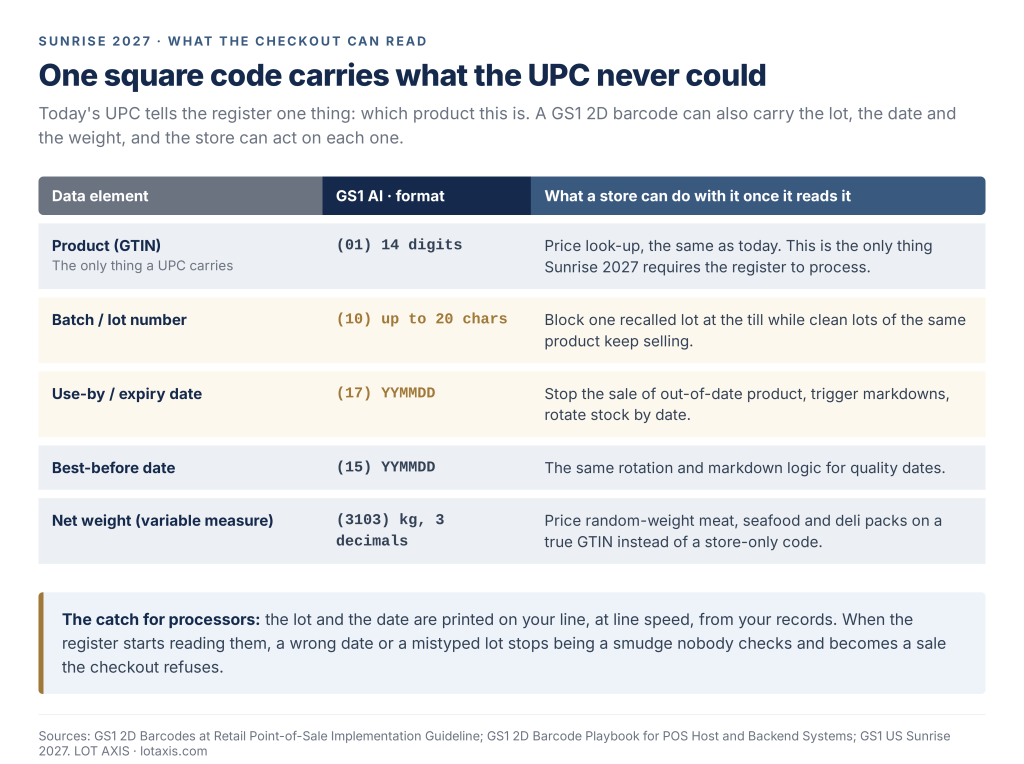
A UPC carries one thing: the Global Trade Item Number (GTIN) that tells the register which product this is. A GS1 2D barcode can carry the GTIN plus attributes, each marked with a GS1 Application Identifier (AI): (10) batch or lot, (17) expiration or use-by date, (15) best-before date, (13) packaging date, and net weight for random-weight packs. [2] Those are the same identifiers most processors already print on a GS1-128 case label. Sunrise 2027 puts them on the consumer pack and in front of the checkout.
GS1’s own guidance for retail systems lists what a store can do once it reads them: prevent the sale of out-of-date products automatically at the register, run more targeted recalls, manage expiry and markdowns, and improve replenishment. [6] The initial goal is narrower. The register only has to process the GTIN from a 2D code by the end of 2027. [2][4] Lot and date are optional and depend on each retailer’s systems. Your customer’s buyer will tell you which ones they want.
For random-weight fresh food there is a second change. Most variable-measure meat, seafood and deli packs today carry a Restricted Circulation Number: a store-only code holding weight or price. GS1 notes that a Restricted Circulation Number is at best unique within one country and is not a GTIN. [8] A 2D code lets that pack carry a true GTIN, the weight and the lot together, so the fresh case can be managed like the centre of the store.
What the Early Adopters Are Actually Doing
The strongest evidence comes from retailers who started years before the deadline, and it clusters in exactly the categories Lot Axis customers pack.
Woolworths (Australia). GS1 reports that Woolworths and selected suppliers used 2D barcodes to cut food waste by up to 40% in the categories involved, and that the system can alert a cashier when a scanned product is past its date. [11]
Woolworths New Zealand. Working with its integrated meat supplier Hilton Foods, Woolworths NZ put GS1 DataMatrix codes on all fresh meat under the Woolworths brand in its North Island stores. With the best-before date in the barcode, the stores automatically block the sale of expired items at the register, and markdown pricing near the date is now generated automatically instead of by hand. [12]
Tesco (UK). After two years of pilots with GS1 UK, Tesco said in April 2026 that QR codes powered by GS1 were scannable at every till. [13] Days later it became the first UK supermarket to move an entire own-label range, its core sausages, off linear barcodes. [14] The reasons given were the ones that matter to a processor: expiry dates sharpen ordering and cut waste, and batch codes allow targeted recalls rather than blanket withdrawals. [13]
In the United States, large brands including Procter & Gamble, Nestlé and PepsiCo have publicly joined the initiative. [18] GS1 keeps a live table of which scanner models can read 2D codes today, need a software update, or cannot be upgraded; it was updated on 22 September 2026. [3]
Readiness Is Not the Same as Reading
It is tempting to assume that once scanners can read the code, the job is done. The early test data says otherwise.
GS1 US gave retailers a Barcode Capabilities Test Kit to find out what their systems could actually do. In the first phase, every participating retailer had some trouble processing GS1 AI data such as the expiration date. Many already had image scanners installed, but the 2D settings were switched off. Where they were on, the systems still needed updates to handle the full syntax. [4]
The supply side has its own problem. In a VDC Research study commissioned by GS1 US, 70% of logistics operations reported barcode readability problems every week, caused by poor label quality, inconsistent labelling or outdated scanners. [10] That was measured on today’s barcodes, before anyone asks a packing line to print a dense square code with variable data.
The practical reading for a processor: your retail customers will switch on lot and date capture unevenly, one chain at a time, one category at a time. The code you print needs to be right before any of them do.
Four Places It Breaks Before the Store
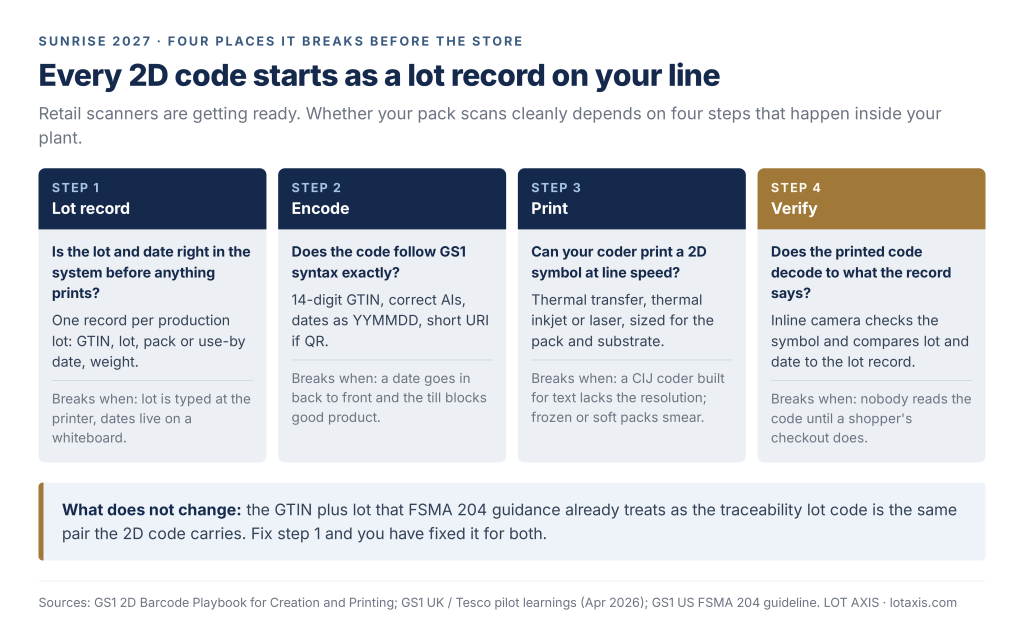
A 2D code with a lot and a date cannot be printed on the carton at the packaging supplier the way a UPC is. GS1’s printing guidance is direct about it: GTIN-only codes can go on the artwork, but batch-level data is typically printed inline on the production line, and that “introduces manufacturing challenges.” [7] In practice there are four steps, and each one breaks in a predictable way.
- The lot record. The code can only be as right as the record it is printed from. If the lot is keyed in at the coder, or the use-by date is worked out from a whiteboard, the 2D code will carry that mistake to the till.
- Encoding. GS1 syntax is unforgiving. From the Tesco pilots, GS1 UK listed the traps: GTINs must be 14 digits, so pad 12- and 8-digit numbers with leading zeros; AIs must be correct or the scanner does not know what it is reading; keep QR web addresses short so the code stays printable; and dates must be YYMMDD. “Entering the date back to front can block a perfectly good product at point of sale.” [13]
- Printing. GS1 warns that not every printer can produce a 2D code good enough for retail scanners. A continuous inkjet coder, the kind many plants use for lot and date text, often has a maximum print height of 24 dots, which may not be enough. [7] Tesco found real products that make this hard: packs that go through deep-freeze, and bread, which is bagged before the date is applied, so the code lands on a soft, uneven surface. [13]
- Verification. A slightly smudged date is readable by a person. A scanner either decodes the code or it does not, and a 2D code can decode cleanly and still hold the wrong date. The only safe check is an inline read that compares what was printed with the lot record.
Where This Meets FSMA 204
None of this is a new data model. GS1 US guidance for the FDA Food Traceability Rule says the GTIN plus lot can be used to determine the traceability lot code the rule requires, and that it can be carried in a barcode. [15][16] The FDA rule itself sets no labelling requirement. What Sunrise 2027 adds is a place where the store can finally read the lot. FMI’s traceability guide calls the lot code “the data element that is least often tracked to the retail store today.” [17]
So one piece of discipline serves both: one clean record per production lot, holding the GTIN, the lot code and the date, printed from that record rather than retyped, and linked to every input lot. Get that right and the FSMA 204 spreadsheet, the case label and the 2D consumer code all say the same thing.
A Short Plan for the Next 15 Months
- Ask your top retail customers which 2D symbol they prefer and whether they will read lot and date, and for which categories. Start with fresh meat, seafood and deli. [9]
- Check your GTINs. Random-weight items still on store-only codes need real GTINs first. [8]
- Audit your coders on the lines that feed retail packs. Could each one print a 2D code at line speed on that pack and substrate?
- Fix the source of the data. Lot and date should come from the production record, not the operator’s keypad.
- Plan verification before the first retailer turns lot capture on, not after the first rejected pallet.
How Lot Axis Fits
Lot Axis keeps one current record of every lot, from receiving through transformation to the shipped case, with the GTIN, lot code and dates captured by barcode scans rather than typed. That record is what a GS1-128 case label, a 2D consumer code or an FSMA 204 request should be printed or built from, so they all agree. That is what we mean by Lot Intelligence™: the lot data you already need to run the plant, correct enough to be read by your customer’s checkout.
Want to see how your lot and date data would look to a 2D scanner? Schedule a Lot Axis demonstration and we will walk one of your retail products from production lot to printed label.
This article is general information about a voluntary industry standard and a federal regulation, not legal advice. Confirm symbol and data requirements with each retail customer and against current GS1 specifications.
Sources
Paste this list at the end of the published post. The full research package below stays internal.
- GS1 US — What is GS1 Sunrise 2027?
https://www.gs1us.org/industries-and-insights/by-topic/sunrise-2027
- GS1 — 2D Barcodes at Retail Point-of-Sale Implementation Guideline
https://ref.gs1.org/guidelines/2d-in-retail/
- GS1 — 2D Barcode Playbook for Retail POS Host and Backend Systems (Release 1.0.1)
https://ref.gs1.org/sme-guidance/2d-retail-systems-playbook/1.0.1/
- GS1 — 2D Barcode Playbook for Creation and Printing (Release 1.0.1)
https://ref.gs1.org/sme-guidance/2d-barcode-creation-and-printing-playbook/1.0.1/
- GS1 — AIDC Fresh Foods Sold at Point-of-Sale Implementation Guideline
https://ref.gs1.org/guidelines/fresh-foods/
- GS1 New Zealand — Woolworths NZ cuts food waste with 2D barcodes
https://www.gs1nz.org/membership/member-stories/woolworths-nz-2d-barcodes/
- GS1 — Woolworths Australia seeing multiple benefits from 2D barcodes
https://www.gs1.org/insights-events/case-studies/woolworths-australia-seeing-multiple-benefits-2d-barcodes
- GS1 US — Application of GS1 System of Standards to Support FSMA 204
https://documents.gs1us.org/adobe/assets/deliver/urn:aaid:aem:8037d451-b557-4b0f-9fa8-fc94f94e4547/GS1-US-Application-of-GS1-System-of-Standards-to-Support-FSMA-204-Guideline.pdf