| KEY TAKEAWAYS
• Seafood processing software has to handle what general food software often skips: species and market names, wild or farm-raised origin, variable weights and yields that change from one delivery to the next. [5][6][14] • Most finfish, all smoked finfish and all crustaceans are on FDA’s Food Traceability List, with specific records for the first land-based receiver of fish from a vessel. [1][2] • Seafood HACCP records must be made when the event is observed and kept one to two years; computer records are fine with integrity controls. [3] • The best test is a demo on your own species, your own lots and FDA’s 24-hour spreadsheet. |
Why Seafood Processing Software Is Its Own Category
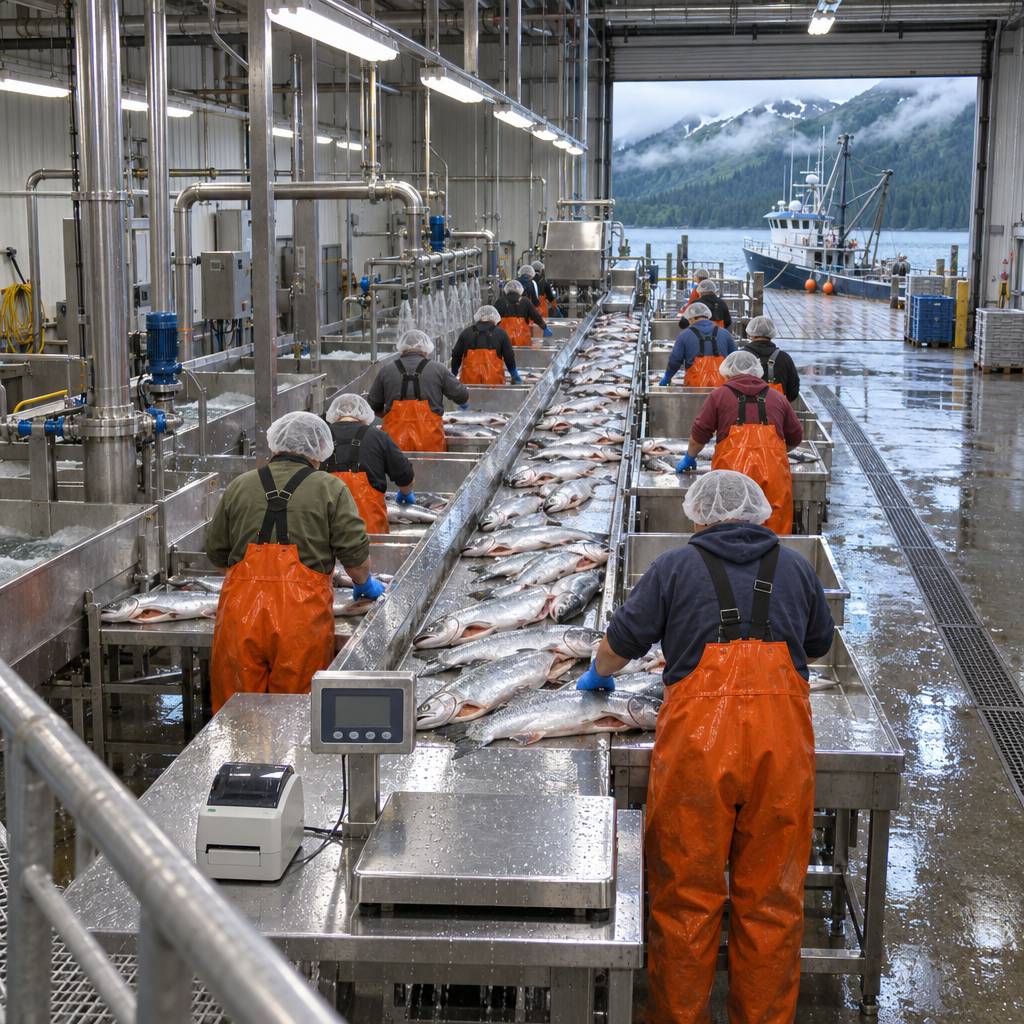
Seafood processing software has a harder job than most plant software. The raw material changes every day. Fish come off different boats, from different waters, at different sizes and temperatures, and the same species can yield very differently from one delivery to the next. On top of that sit several sets of rules: FDA’s seafood HACCP regulation, the Food Traceability Rule, USDA country of origin labeling and, for importers, NOAA’s Seafood Import Monitoring Program.
The cost of a weak record shows up in a recall. On November 3, 2026, FDA classified two recalls of cold-smoked salmon and trio products as Class I, its most serious level, after New York state sampling found possible Listeria monocytogenes. [9][8] The Norwegian salmon carried one lot, D080-148, and the enforcement reports list 86 cases of each product. [9] A narrow recall depends on knowing exactly which cases belong to which lot.
U.S. plants produced $12 billion of processed fishery products in 2023, and the country imported 6.3 billion pounds of seafood. [20] This article walks the plant floor, from dock to truck, and sets out what a seafood system should capture at each station, with a plain note on how Lot Axis does it.
At the Dock: Receiving That Starts the Record
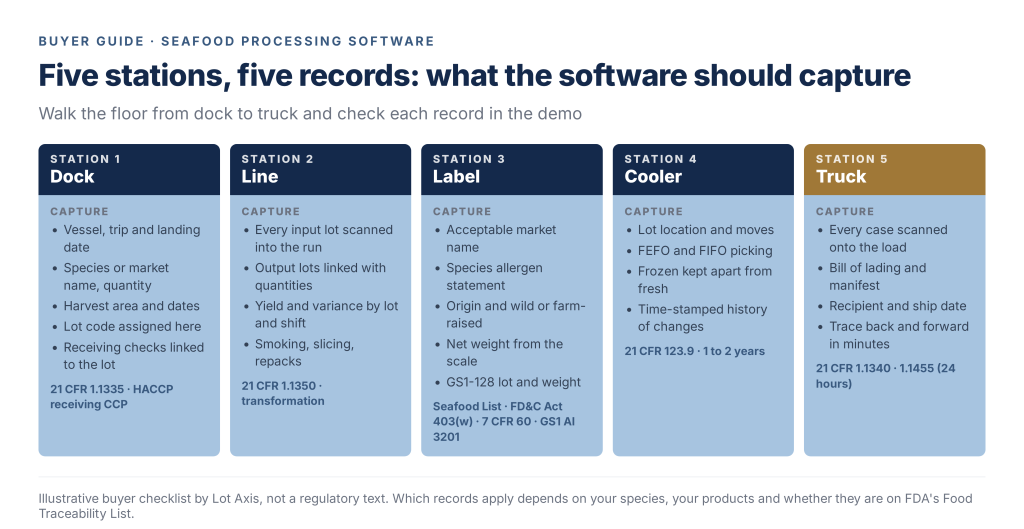
For fish on the Food Traceability List, the first land-based receiver from a fishing vessel must keep seven items for each traceability lot: the lot code it assigns, the species or acceptable market name, quantity and unit of measure, harvest date range and locations for the trip, its own location as the lot code source, the landing date and the reference document. [1] That list covers more than you might expect. Finfish of every kind except Siluriformes such as catfish, all smoked finfish and all crustaceans, including shrimp, crab, lobster and crayfish, are on the list. Raw bivalves covered by the National Shellfish Sanitation Program are exempt. [2]
Receiving is also a HACCP control point. For histamine-forming species such as tuna and mahi mahi, FDA’s guidance says fish exposed to air or water above 83°F should be chilled to 40°F or less within 6 hours of death, or 9 hours in cooler conditions, and processors can rely on harvest vessel records to show it was done. [4] Those records only help if you can find them. In a September 2026 warning letter, FDA told one California processor it had no monitoring records for the receipt of fishery products since November 23, 2022. [10]
What to look for: a receiving screen that captures the vessel, trip and landing date, links the vessel’s paperwork to the lot, and assigns the lot code at the dock instead of later in the office.
How Lot Axis does it: receiving is scanned on the handheld at Unload, where a supplier’s GTIN barcode is looked up automatically. The lot code is calculated by the system, using GS1 for seafood or your own prefix-and-date format. Nobody types it.
On the Line: Yield, Transformation and Catch Weights
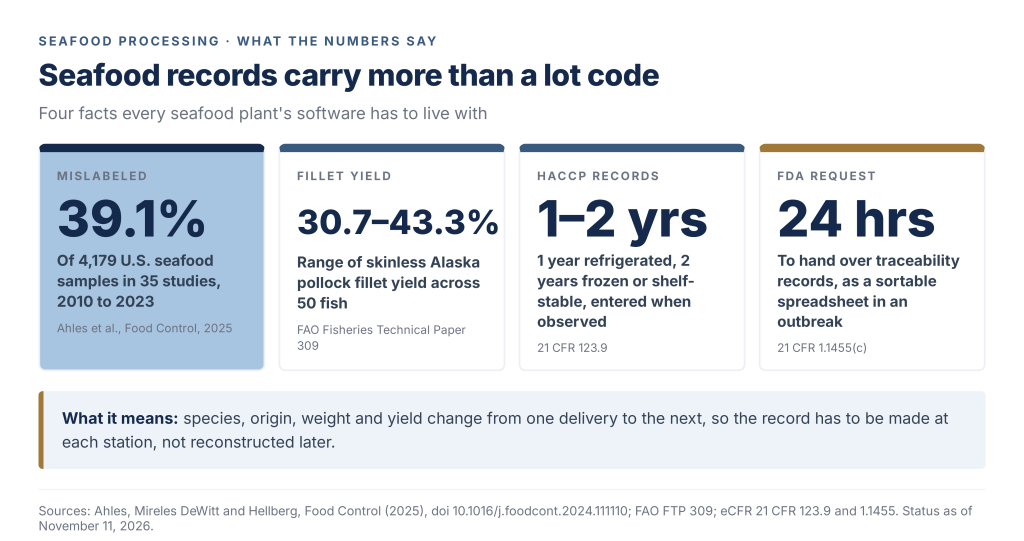
Seafood yields swing more than buyers of general food software expect. In FAO’s yield tables, skinless Alaska pollock fillets averaged 35.5% across 50 fish, with a range from 30.7% to 43.3%. [14] A plant that knows its yield only by the week cannot tell whether the low number came from the fish, the shift or the machine.
The line is also where traceability is most often broken. Filleting, smoking, slicing, cooking and repacking are transformation events, and the new lot must be tied to every input lot with its quantity. [16] FDA explained why smoked fish stays on the list: contamination is often “introduced after smoking when the finfish is sliced.” [15] That is the step where a system has to know which sides went into which packs.
Then there is weight. Seafood is sold by catch weight, and GS1 gives the net weight its own field on the case label, Application Identifier 3201, in pounds with one decimal. [17] Typing weights from a scale display into a label is where errors creep in.
What to look for: inputs scanned into each run by lot, yield and variance reported by lot and by shift, and weights that go from the scale straight to the label.
How Lot Axis does it: raw materials are scanned into production by work order, by box or by full pallet, and every label printed is linked to them. Rebox links each source unit to each new unit. Yield and variance are reported by lot, and the system connects to Rice Lake, Avery Weigh-Tronix and Western Scale Co. scales and to Marelec and Bizerba sorters.
Want to see your own species run through it? Book a Demo and bring one lot from last season.
At the Label Printer: Name, Origin, Allergen and Weight
A seafood label carries more rules than most. The statement of identity should be an acceptable market name from FDA’s Seafood List, and vernacular names are generally not acceptable. [6] Fish and crustacean shellfish are major food allergens, and the law requires the species to be named, such as cod or shrimp, rather than “fish” or “shellfish.” [11] At retail, fish and shellfish must show country of origin and whether they are wild or farm-raised, and every supplier in the chain must pass that information on and keep records for one year, ready for USDA within five business days. [5]
Getting it wrong is common. A 2025 meta-analysis of 35 U.S. studies found 39.1% of 4,179 seafood samples mislabeled. [12] Getting it wrong on purpose is expensive: in 2026, a Dallas seafood business was fined $250,000 for selling Chilean salmon as Scottish or European. [13]
What to look for: label text that comes from the product record, not from whoever sets up the printer that morning, and an origin and method of production that travel with the lot.
How Lot Axis does it: the lot code is created when the label prints, on GS1-128 case labels, and label layouts are set up for your products during implementation.
In the Cooler and on the Truck
Seafood HACCP records must show the date and time of the activity and the initials of the person, and information “shall be entered on records at the time that it is observed.” [3] They are kept for at least one year for refrigerated products and two years for frozen, preserved or shelf-stable products, and records kept on computers are acceptable “provided that appropriate controls are implemented to ensure the integrity of the electronic data and signatures.” [3] Food Traceability Rule records are kept for two years. [7]
Storage and shipping are where good lot data turns into fewer losses: fresh product picked first-expiring-first-out, frozen lots kept separate from previously frozen ones, and every case recorded onto the right trailer.
How Lot Axis does it: inventory is tracked by lot with FEFO and FIFO, pallets are built and moved by scan, and every unit is scanned onto the load with a bill of lading and a unit-level manifest. Every transaction is date- and time-stamped, and every change is kept in history with the machine it came from.
When FDA Calls: The 24-Hour Test
During an outbreak or recall, FDA can ask for your traceability records within 24 hours, as an electronic sortable spreadsheet for foods on the list. [7] FDA ran that test in March 2026 with 15 companies, including a wild-caught finfish supply chain. Only 27% had a complete lot code source at every step. [18] FDA cannot enforce the rule before July 20, 2028, and it is taking comments until December 6 on possible lot-level flexibilities. [19] Buy for the rule as written and ask any vendor how it handles change.
How Lot Axis does it: Back Trace and Forward Trace run from any unit, pallet, lot or load. Screen views export to Excel or CSV, and recalled cartons can be voided in one batch.
Seeing Seafood Processing Software Work on Your Product
We have built Lot Axis with seafood plants from Alaska to Atlantic Canada. It runs on premise, on your own server, and the lot record is made at the station where the work happens. That is Lot Intelligence™: when someone asks where a case came from, the answer is already there.
There is one catch we tell every buyer. Software only links what gets scanned. If a tote moves from the dock to the line without a scan, no system can trace it. The best seafood processing software makes the scan the easiest step on the floor.
Ready to walk your plant floor with us? Book a Demo. Or see how Lot Axis works for seafood processors.
This article is general information, not legal advice. Requirements depend on your species, products, regulator and food safety plan. Recall and comment-period details are as of November 11, 2026; FDA cannot enforce the Food Traceability Rule before July 20, 2028. Confirm current requirements with FDA, USDA, NOAA or your state agency.
Sources
Paste this list at the end of the published post. The full research package below stays internal.
- eCFR — 21 CFR 1.1335, Records for the first land-based receiver of food obtained from a fishing vessel
https://www.ecfr.gov/current/title-21/section-1.1335
- FDA — Food Traceability List
https://www.fda.gov/food/food-safety-modernization-act-fsma/food-traceability-list
- eCFR — 21 CFR 123.9, Seafood HACCP records
https://www.ecfr.gov/current/title-21/section-123.9
- FDA — Fish and Fishery Products Hazards and Controls Guidance
https://www.fda.gov/food/seafood-guidance-documents-regulatory-information/fish-and-fishery-products-hazards-and-controls
- eCFR — 7 CFR Part 60, Country of Origin Labeling for Fish and Shellfish
https://www.ecfr.gov/current/title-7/subtitle-B/chapter-I/subchapter-C/part-60
- FDA — Guidance for Industry: The Seafood List, FDA’s Guide to Determine Acceptable Seafood Names
https://www.fda.gov/regulatory-information/search-fda-guidance-documents/guidance-industry-seafood-list-fdas-guide-determine-acceptable-seafood-names
- eCFR — 21 CFR 1.1455, How records must be maintained and made available
https://www.ecfr.gov/current/title-21/section-1.1455
- FDA — Krasnyi Oktyabr Inc. Recalls Starfish Seafood Premium Cold Smoked Norwegian Salmon (October 2026)
https://www.fda.gov/safety/recalls-market-withdrawals-safety-alerts/krasnyi-oktyabr-inc-recalls-starfish-seafood-premium-cold-smoked-norwegian-salmon-sliced-227g8oz