| KEY TAKEAWAYS
• Of the 16 meat and poultry recalls and public health alerts FSIS announced between August 7 and October 24, 2026, 11 concerned import eligibility or inspection status, not how the product was made. [7][9][20] • Supplier approval and inbound lot verification are different jobs. Approval is a decision made once in the office; verification has to happen at the dock, for each lot. [1][4] • FSIS recommends a certificate of analysis “for each lot of product received, on a lot-by-lot basis” for beef trim used in ground product. [4] • When a supplier’s ingredient is recalled, the receiving record decides how fast you can answer which of your lots used it. [5][12] |
Eleven of Sixteen
On October 24, FSIS announced that an Illinois company was recalling 946 pounds of beef jerky. The jerky had been produced without federal inspection, and the bags carried “another facility’s mark of inspection,” establishment number 1885. [7] Two weeks earlier, a Miami importer recalled potato chips containing pork cracklings from Colombia, a country not eligible to export meat to the United States. The bags did “not bear any import marks on the labels.” [20] In August, a Florida company recalled 29,628 pounds of Argentine beef that had entered the country without FSIS import reinspection. [9]
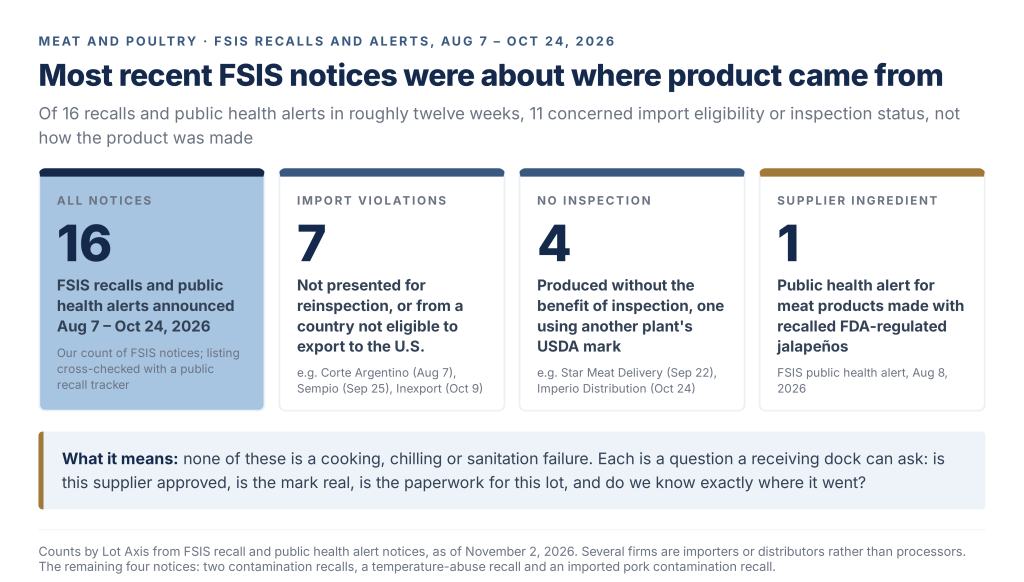
None of these is a cooking, chilling or sanitation failure. By our count of FSIS notices, the agency announced 16 recalls and public health alerts between August 7 and October 24, 2026. Seven were import violations. Four were products made without the benefit of inspection. One more was an alert for meat products made with jalapeños that an FDA-regulated supplier had recalled for possible Salmonella. [11][20] That is 12 of 16 where the question was where the product, or an ingredient in it, came from.
Several of those firms were importers and distributors, not processors. But every one of those products crossed somebody’s receiving dock first. That dock is the cheapest place in the supply chain to stop it.
Two Jobs, Often Confused
Most plants have a supplier approval program. Fewer have a real inbound lot verification step. They are not the same.
Supplier approval answers one question: is this supplier allowed to send us this item? It is done in the office, with audits, letters of guarantee and specifications, and reviewed every so often.
Inbound lot verification answers a different question: is the lot on this truck what the approved supplier, the paperwork and the specification say it is? It has to happen at the dock, every load, usually by someone on the receiving crew rather than the quality manager.
A strong approval program with a weak dock check gives you a well-organized file and no protection. The supplier can be approved and the lot can still be wrong.
What FSIS and FDA Expect at Receiving
For meat and poultry, the expectations sit inside HACCP. An establishment’s hazard analysis must be kept “including all supporting documentation.” [3] If you decide a hazard in an incoming material is not reasonably likely to occur because your supplier controls it, the receiving records are part of that support.
FSIS’s guideline for STEC in raw beef spells out what that looks like for beef used in ground product. It recommends three things: a letter of guarantee from each supplier describing its STEC controls, a certificate of analysis showing the actual test result, sampling method, testing method and product description, and ongoing verification testing. The COA “should be obtained for each lot of product received, on a lot-by-lot basis.” [4] The guideline also describes a plant buying boxed beef through a broker from different slaughter plants each week, with guarantees that say the beef was meant for intact use and no lot test data. FSIS calls that approach “flawed.” [4] Grinding logs must then record the supplier establishment numbers and all supplier lot numbers for each lot of raw ground beef. [19]
Imports have their own gate. Under 9 CFR 327.6, every lot offered for entry is to be reinspected by FSIS before it is allowed into the United States, and passed product carries an official import mark with the import establishment’s number. [6][14] The establishment number on any USDA mark can be checked against FSIS’s Meat, Poultry and Egg Product Inspection Directory, which is updated weekly. [8]
Plants that also make FDA-regulated products face a more explicit rule. Under the preventive controls rule, a receiving facility “must approve suppliers … and document that approval, before receiving” their materials, and must follow written receiving procedures that ensure materials come “only from approved suppliers.” Use of those procedures “must be documented.” [1] Raw materials must also be “inspected and segregated or otherwise handled as necessary” to make sure they are suitable. [1] A facility regulated entirely by USDA does not register with FDA, so these rules reach mixed plants, not pure meat plants. [15]
FSMA 204 lists eight receiving data elements, from the lot code and quantity to the reference document number. [2] Meat and poultry under USDA’s exclusive jurisdiction are outside that rule. [15] But your produce, cheese or seafood suppliers may be keeping those records, and their lot code is the one you will need when they recall.
Audit schemes say the same thing. SQF’s approved supplier program requires a current record of approved suppliers, receiving inspections and supplier audits, and accepts materials from unapproved suppliers only in an emergency, after inspection. [16]
An Approved Supplier Can Still Ship a Bad Lot
Approval is a judgment about a supplier’s system. It is not a guarantee about any one lot.
Researchers who audited 72 slaughterhouses applying to supply beef and pork to a large meat processor found that 10% did not qualify, and pig slaughterhouses were disqualified two and a half times as often as cattle plants. [17] A separate study of supplier audits concluded that “certification status does not imply high performance” of a food safety system. [18] Approval filters out weak suppliers. It does not watch every lot from the good ones.
This year showed what happens next. On April 20, California Dairies recalled bulk powdered milk and buttermilk powder for possible Salmonella. [12] Ten days later FSIS issued a public health alert after FDA told it “that multiple FSIS-regulated establishments received FDA-regulated ingredients formulated with dry milk powder that had been recalled.” The alert was still being updated in mid-May. [5] Earlier in the year, a fried rice recall that began at 3.4 million pounds grew to nearly 37 million pounds, with glass traced to an ingredient. [13]
In October, a receiving dock worked the way it should. A retail customer complained about warm product temperatures at delivery. The supplier investigated, found a warehouse cooler with temperature deviations, and recalled about 1.58 million pounds of ready-to-eat meat and poultry. [10] The check happened at the customer’s dock. Better if it happens at yours.
Six Checks at the Dock
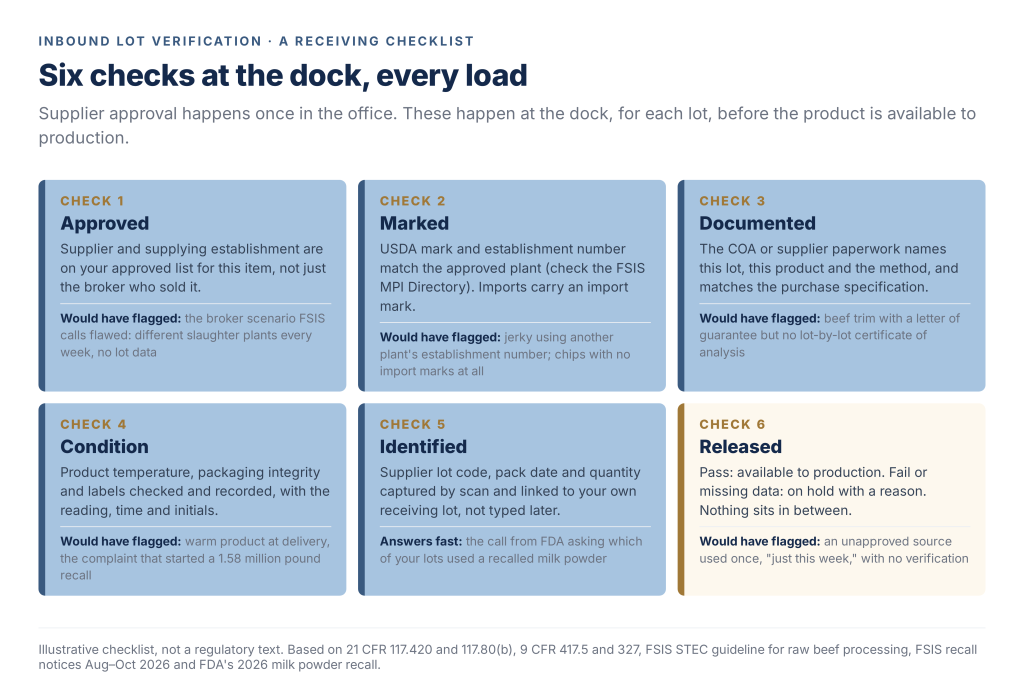
A receiving step that holds up in an audit and in a recall comes down to six checks, done for every lot:
- The supplier and the supplying establishment are on your list for this item. A broker is not a supplying establishment.
- The USDA mark and establishment number match the approved plant. Imported product carries an import mark. No mark, no receipt.
- The COA or supplier paperwork names this lot and this product, and matches your purchase specification.
- Temperature, package integrity and labels are checked and recorded with the reading, time and initials.
- The supplier’s lot code, pack date and quantity are captured by scan and linked to your own receiving lot, not typed in later from a delivery slip.
- A lot that passes is available to production. A lot that fails, or is missing data, goes on hold with a reason. Nothing sits in between.
Write the first three into the approval program and the last three into the receiving procedure. Then test them: pick a finished lot from last month and ask your team to name every supplier lot in it, with the COA for each. The time it takes is your real recall readiness.
Make the Receiving Record Do the Work
Most receiving failures are not dramatic. The log is filled in at the end of the shift. The lot number is copied from the box by hand, or not at all. The COA sits in an email inbox, not attached to the lot it describes.
Each of those works until someone calls. When FDA notified FSIS about the milk powder, the useful question for every affected plant was simple: which of our lots used it? [5] The answer depends on one record made at the dock and one link made at the grinder or mixer. If both were scanned when they happened, the answer takes minutes and the recall stays narrow. If not, the safe answer is everything made during those weeks.
How Lot Axis Fits
Lot Axis is built to make that record at the moment it happens. On the handheld, Load/Unload records incoming boxes and pallets by scan, and a supplier’s GTIN barcode can be looked up at Unload so the product description comes from the case rather than from memory. When those raw materials are scanned into production, by work order, by box or by full pallet, every label printed is linked to them. Back Trace runs from a finished case to the received raw material, and Forward Trace runs from a received lot to everything it went into. Every transaction is date- and time-stamped and every change is kept in history. That is Lot Intelligence™: the answer to “which of our lots used it?” is already in the system.
Want to see how a receiving scan becomes a trace? Book a Demo and bring a recent delivery slip.
This article is general information, not legal advice. Receiving and supplier requirements depend on your products, regulator and HACCP or food safety plan. Recall counts and details are as of November 2, 2026; the FSMA 204 compliance date is July 20, 2028. Confirm current requirements with FSIS, FDA or your state agency.
Sources
Paste this list at the end of the published post. The full research package below stays internal.
- eCFR — 21 CFR Part 117, Subpart G, Supply-Chain Program (incl. § 117.420 Using approved suppliers)
https://www.ecfr.gov/current/title-21/chapter-I/subchapter-B/part-117/subpart-G
- eCFR — 21 CFR 1.1345, What records must I keep when I receive a food on the Food Traceability List?
https://www.ecfr.gov/current/title-21/chapter-I/subchapter-A/part-1/subpart-S/subject-group-ECFRbfe98fb65ccc9f7/section-1.1345
- eCFR — 9 CFR 417.5, HACCP Records
https://www.ecfr.gov/current/title-9/chapter-III/subchapter-E/part-417/section-417.5
- FSIS — Guideline for Minimizing the Risk of Shiga Toxin-Producing E. coli (STEC) in Raw Beef (including Veal) Processing Operations (copy hosted by the N.C. Department of Agriculture)
https://www.ncagr.gov/meat-poultry-inspection/IndustryGuidelineSTECBeefProcessingOperations/download?attachment=
- FSIS — Public Health Alert for Various Meat and Poultry Products Containing FDA-Regulated Dairy Products That Have Been Recalled (April 30, 2026, updated May 15, 2026)
https://www.fsis.usda.gov/recalls-alerts/fsis-issues-public-health-alert-various-meat-and-poultry-products-containing-fda
- eCFR — 9 CFR Part 327, Imported Products
https://www.ecfr.gov/current/title-9/chapter-III/subchapter-A/part-327
- FSIS — Imperio Distribution LLC Recalls Beef Jerky Products Produced Without the Benefit of Inspection (October 24, 2026)
https://content.govdelivery.com/accounts/USFSIS/bulletins/430601c
- FSIS — Meat, Poultry and Egg Product Inspection Directory
https://www.fsis.usda.gov/inspection/establishments/meat-poultry-and-egg-product-inspection-directory