
| KEY TAKEAWAYS
• Traceability records are made on the floor, often by people in their first months. 95% of manufacturers PMMI surveyed are struggling to hire skilled operators, and only 14% rank printed SOPs or manuals as the most effective way to onboard them. [4] • FDA’s 2026 readiness drills found only 40% of participants’ records carried a properly assigned lot code at every step, and some left out quantities altogether. [3] • The rules already assume trained people: 21 CFR 117.4 covers “temporary and seasonal personnel,” and the traceability plan must describe the procedures you actually use. [1][2] • The best test of a system is not a demo. It is whether your newest hire can make a correct record without help. |
The Person Who Makes the Record
On October 20, the Oklahoma Medical Marijuana Authority recalled flower from a licensed grower after batches failed yeast and mold testing. A week later it added products from a batch that had passed. A portion of that good batch, OMMA explained, “was later mixed with a failed batch.” [7]
The rule was clear and the tracking system was in place. The problem happened in someone’s hands.
What OMMA did next is the interesting part. It did not write a new rule. It changed the screen. Recalled batches and every package made from them now show a warning symbol and a blue recall alert in Metrc, the state’s tracking system, so that anyone holding them sees it. [7] The regulator decided that the right action had to be obvious to the person in front of the inventory.
That is the subject of this article. Every traceability system is judged in a demo by the people who buy it. It is used every day by people who did not choose it, many of whom started recently. If they cannot make a correct record without help, the system exists on paper only.
The Workforce Your System Has to Work For
The numbers on the plant floor are not friendly to complicated software.
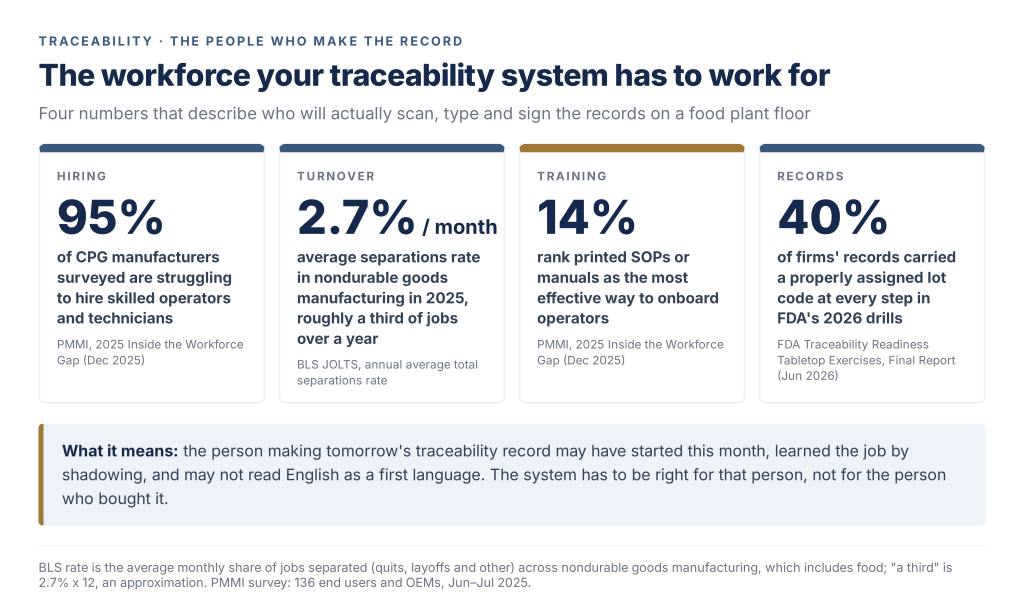
U.S. food manufacturing employed about 1.77 million people in September 2026. [14] In nondurable goods manufacturing, the BLS category that includes food, separations averaged 2.7% of jobs every month in 2025, and hires 2.6%. [5][13] Over a year, that is roughly a third of the workforce moving through the door. And it is not expected to ease: Deloitte and The Manufacturing Institute project that U.S. manufacturing could need 3.8 million workers by 2033, with up to 1.9 million of those jobs going unfilled. [12]
PMMI’s 2025 workforce study found 95% of consumer goods manufacturers struggling to hire skilled operators and technicians, and nearly 60% expecting it to get harder. Companies told PMMI the problem is made worse by “high turnover among new hires.” [4] Training mostly happens by shadowing and printed materials, and PMMI warns that “training can vary by shift, and tribal knowledge disappears when experienced staff leave.” Only 14% ranked printed SOPs or manuals as the most effective way to onboard operators. [4][9]
PMMI’s 2026 processing report goes further. Equipment, it says, now needs to be designed “for less-experienced employees,” with simplified, picture-based interfaces, mistake-proofing and multi-language screens. [10][11] Machine builders have taken the hint. Traceability software should too.
Language matters as well. In meat and poultry, a large share of frontline workers were born outside the United States and speak Spanish or another language at home. [18] A study of 1,265 meat industry trainees found food safety scores “improved dramatically when training was conducted in the native language.” [17]
What the Rules Already Assume
None of the traceability rules use the word usability. They do assume competent people.
Under FDA’s food safety rule, every individual who manufactures, processes, packs or holds food, “including temporary and seasonal personnel,” must be qualified for their assigned duties and trained in food hygiene and food safety, and that training must be documented. [2] The person scanning a pallet in week one is covered.
FSMA 204 adds a traceability plan. It must describe “the procedures you use to maintain the records,” including their format and location, how you assign lot codes, and a point of contact, and it must be updated to reflect “your current practices.” [1] A plan that describes a process only the quality manager can follow does not describe your current practices. It describes the quality manager.
Workplace safety law has settled the training question more directly. OSHA’s policy is that required training must be presented “in a manner that employees can understand,” and that employers who give work instructions in a language other than English must train in that language too. [6] That policy covers safety training, not traceability. But it makes the point well: if the person did not understand the instruction, the instruction did not happen.
Where Records Actually Break
FDA’s Traceability Readiness Tabletop Exercises, run with 15 companies this spring, show what a gap looks like in practice. The lot code was present or inconsistently present in 80% of participants’ records, but only 40% captured the properly assigned lot code at every step they performed. [3] Some firms sent complete shipping data but omitted “input and output quantities where required.” In other cases, the traceability plan said produce was field packed, while the spreadsheet named a cooling facility as the lot code source. [3]
Those are not technology failures. FDA said so itself: the technology “was less determinative of success” than whether trading partners had agreed on what data to collect and share. [3] Inside a plant, the same agreement has to exist between the system and the person using it. If the screen lets someone type the lot code, someone will type it wrong. If quantity is optional, it will be skipped on a busy shift.
Research outside food makes the same point. In a controlled data entry study, checking typed entries by eye was not significantly better than typing them once, and only 0.06% of errors were blank or out of range, so most mistakes looked like plausible data. [16] In a hospital study, transcription errors ran at 6.1% on units without barcode scanning and were eliminated on units that used it. [8] A hospital is not a food plant. But a mistyped lot number and a mistyped medication order fail the same way: they look fine until someone needs them.
The New-Hire Test
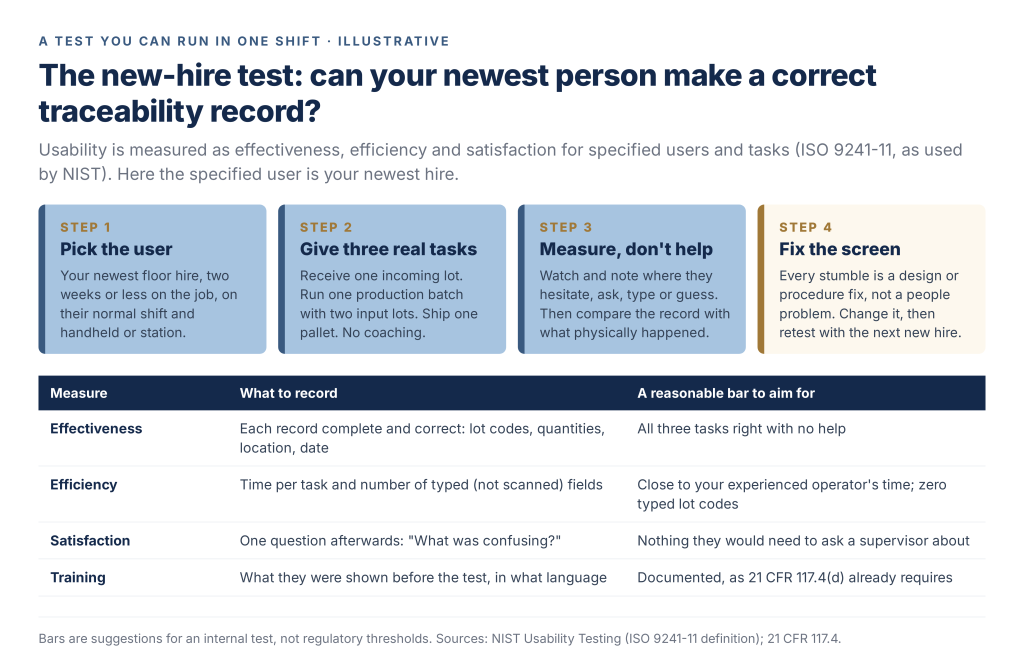
Usability has a standard definition. NIST, following ISO 9241-11, describes it as the extent to which a product can be used “by specified users to achieve specified goals with effectiveness, efficiency and satisfaction in a specified context of use.” [15] For traceability, the specified user should be your newest hire.
A practical version takes one shift:
- Pick the user. Your newest floor hire, two weeks or less on the job, on their normal shift and device.
- Give three real tasks. Receive one incoming lot. Run one production batch with two input lots. Ship one pallet. No coaching.
- Measure, don’t help. Note every hesitation, question, typed field and guess. Then compare the record with what physically happened: right lots, right quantities, right location and date.
- Fix the screen, not the person. Every stumble is a design or procedure change. Make it, then repeat the test with the next new hire.
Start where your records feed the most other records, usually receiving or the production run that consumes several lots. Run the test on the night or weekend shift as well as days, because that is where shadowing is thinnest and the experienced operator is least likely to be standing nearby. Keep the notes. They become the change list for the system and the evidence that your training works.
If the record is right, fast and needed no supervisor, the system works for the people who will actually use it. If not, you have found your next recall problem before a regulator did.
Design Rules That Survive Turnover
- Scan, don’t type. Lot codes, locations and pallet IDs should come from a barcode, never a keyboard.
- One task, one screen. Receive, move, consume and ship should each be a short, separate flow.
- Make quantity required. If the rule needs it, the screen should not move on without it.
- Make the wrong move hard. A lot on hold should look different and refuse to ship, as OMMA’s new Metrc flag does for recalled packages. [7]
- Use pictures and the floor’s language. Short, visual task guides beat a binder, as PMMI’s respondents said. [4]
- Write the plan the way the floor works, and update it when the floor changes. [1]
- Train by task and keep the record. 21 CFR 117.4(d) already requires it. [2]
How Lot Axis Fits
Lot Axis was built for the people who make the record. On the handheld, Load/Unload, Move, Inventory, Palletize and Process Raw Materials are separate scan-driven tasks: the operator scans boxes or pallets rather than typing lot codes. At the production station, the label printed for each case carries its lot, linked to the raw materials scanned into the run. Every transaction is time-stamped and every change is kept in history. As one customer, Rusty McLain of McLain Farms, put it, he “never realized full traceability could be so easy.” That is what we mean by Lot Intelligence™: a correct record made by whoever is on shift, not only by the person who knows the system best.
Want to see whether your newest hire could run it? Book a 15-minute call and bring one of your floor tasks.
This article is general information, not legal advice. Training and recordkeeping requirements depend on your products, regulator and role in the supply chain. Workforce figures and recall details are as of October 28, 2026; the FSMA 204 compliance date is July 20, 2028. Confirm current requirements with FDA, FSIS or your state agency.
Sources
Paste this list at the end of the published post. The full research package below stays internal.
- eCFR — 21 CFR Part 1, Subpart S, Additional Traceability Records for Certain Foods (incl. § 1.1315 traceability plan)
https://www.ecfr.gov/current/title-21/chapter-I/subchapter-A/part-1/subpart-S
- eCFR — 21 CFR 117.4, Qualifications of individuals who manufacture, process, pack, or hold food
https://www.ecfr.gov/current/title-21/chapter-I/subchapter-B/part-117/subpart-A/section-117.4
- S. FDA — Traceability Readiness Tabletop Exercises Final Report (June 2026)
https://www.fda.gov/media/192993/download
- PMMI — Finding Skilled Workers Remains a Major Challenge That May Worsen (2025 Inside the Workforce Gap, December 10, 2025)
https://www.pmmi.org/news/finding-skilled-workers-remains-a-major-challenge-that-may-worsen
- S. Bureau of Labor Statistics — JOLTS Table 20, Annual average total separations rates by industry
https://www.bls.gov/news.release/jolts.t20.htm
- OSHA — Training Standards Policy Statement (April 28, 2010)
https://www.osha.gov/laws-regs/standardinterpretations/2010-04-28
- Oklahoma Medical Marijuana Authority — Product Recall Issued for Blue Collar Criminals Collective, LLC; Metrc Inventory Display Update (October 20, 2026, updated)
https://oklahoma.gov/omma/about/news/2026/updated-recall-issued-for-flower-grown-by-blue-collar-criminals-collective-llc-gaai-njve-0z9p.html
- Poon et al., Effect of Bar-Code Technology on the Safety of Medication Administration, New England Journal of Medicine (2010)
https://doi.org/10.1056/NEJMsa0907115