| KEY TAKEAWAYS
• The largest U.S. compilation — 35 studies, 4,179 samples, 32 states, 2010–2023 — found an overall mislabeling rate of 39.1%. But 26.2% was species substitution and 17.1% was an unacceptable market name: two very different failures. [1] • For the top 10 most-consumed U.S. seafoods, which are roughly 80% of consumption, the substitution rate was 13.9%, against 42.5% for the species researchers investigate most often. The headline rate is not your rate. [1] • Risk concentrates in processed and blended product. DNA work on Los Angeles retail found 0% mislabeling across 48 packaged squid samples, while 95% of 43 imitation crab products contained at least one undeclared species. [2] • Enforcement in 2026 was not only about species. A Dallas wholesaler was fined $250,000 under the Lacey Act for relabelling Chilean salmon as European, and NOAA levied $222,902 over “dolphin safe” claims on 3.4 million pounds of tuna. [3][5] • Grade is a claim too. U.S. grade standards are voluntary, but once you print Grade A you have adopted a defined defect and flavour limit — 15 defect points, against 30 for Grade B. [15] |
Read the Breakdown, Not the Headline
If you process or distribute seafood, you have seen the statistic quoted at you: something like four in ten seafood products are mislabeled. It comes from a real and careful piece of work, and reading it properly is the most useful thing an honest processor can do this quarter.
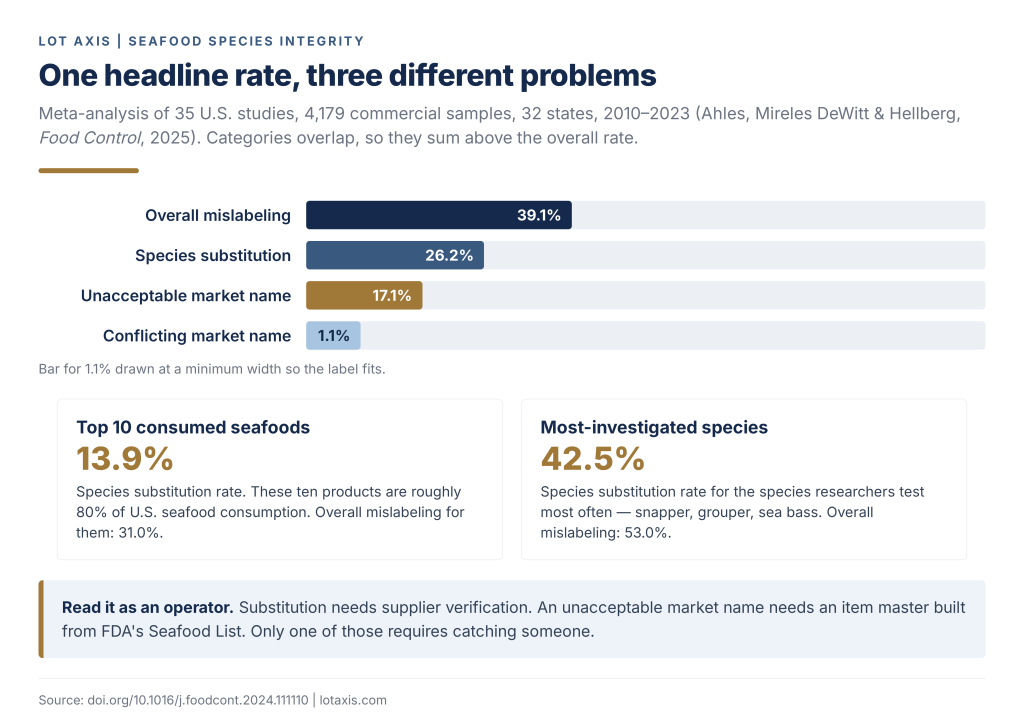
Researchers at Chapman University and Oregon State University compiled every U.S. seafood market study they could find between 2010 and 2023 — 35 studies, 4,179 commercial samples, 32 states — and reported an overall mislabeling rate of 39.1%, which also means 60.9% of samples were correctly labeled. Underneath that number, species substitution accounted for 26.2% of samples, unacceptable market names for 17.1%, and conflicting market names for 1.1%.[1]
Those categories matter more than the total. Substitution is one species sold as another. An unacceptable market name is the right fish under the wrong name — usually a regional or vernacular name that FDA does not accept for interstate commerce. One is fraud or a broken supply chain. The other is a records-and-naming discipline failure that a plant can fix on its own, without catching anybody.
The study also did something nobody had done before: it separated the species Americans actually eat from the species researchers like to test. The top 10 consumed seafoods — about 80% of U.S. consumption — had a mislabeling rate of 31.0% and a substitution rate of 13.9%. The most frequently investigated species ran at 53.0% and 42.5%.[1] The alarming figure you see in headlines is weighted toward snapper, grouper and sea bass, not toward shrimp, salmon and canned tuna.
None of this makes the problem small. A 2024–2025 DNA study of Seattle found 18% of salmon samples mislabeled overall, and inside sushi restaurants 32.3% of “wild” salmon was farmed.[6] DNA barcoding of New England markets found 10.5% of shark and swordfish samples substituted, including endangered species sold as swordfish.[7] It makes the problem locatable, which is different.
Where the Risk Actually Concentrates
The pattern in the recent laboratory work is consistent: the more processing between the fish and the pack, the harder the name is to defend.
A 2025 study applied DNA barcoding to 48 frozen squid samples from 13 Los Angeles retailers and DNA metabarcoding to 43 imitation crab products. Every one of the squid samples matched an FDA acceptable market name — a 0% mislabeling rate. The surimi products were another world: an average of six species detected per sample, 38 unique species overall, only 72% of samples containing at least one seafood ingredient actually listed on the package, and 95% containing at least one undeclared species.[2]
Single-species frozen product, properly named, holds up. Blended, minced and battered product — where the morphology is gone and the formulation changes by batch — is where the paperwork has to carry the whole claim. That is precisely where most processors’ records are thinnest.
Most “Mislabeling” Is a Naming Problem
FDA publishes the answer key, and it is free. The Seafood List gives the acceptable market name, common names, scientific name and vernacular names for seafood sold in U.S. interstate commerce.[8] The vernacular names are printed in red for a reason: they are names that must not be used, because using them can render the product misbranded. FDA recognises an acceptable market name as a suitable statement of identity under 21 CFR 101.3, and the general principle in 21 CFR 102.5 is that a common or usual name must accurately identify the food and must not be confusingly similar to the name of a different food.[9][10]
FDA backs this with import action. Import Alert 16-04 — “Detention Without Physical Examination of Seafood Products That Appear To Be Misbranded” — exists because FDA has found shipments offered for entry under fictitious, substituted or otherwise incorrect species names, and firms on its Red List have shipments detained without examination.[11]
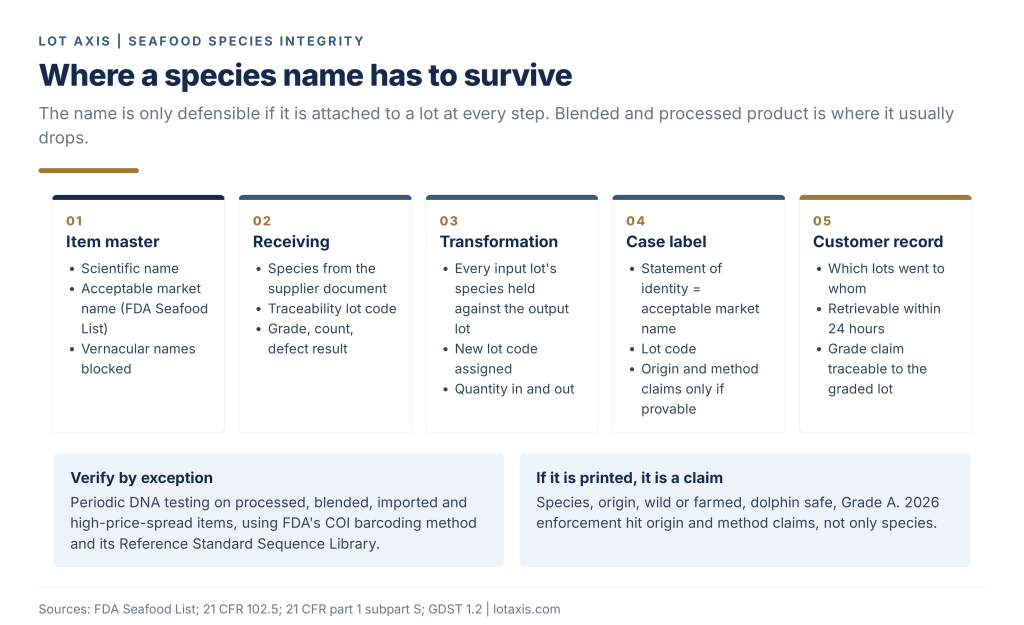
So the first control is not a laboratory. It is a rule that every inbound item on your master file carries the scientific name and the acceptable market name from the Seafood List, and that no one in purchasing, production or sales is allowed to invent a friendlier one.
Enforcement Is Broader Than Species
Two 2026 cases are worth putting in front of your team, because neither was a species swap.
In July 2026 a Dallas seafood wholesaler was sentenced to a $250,000 fine, three years’ probation and a compliance plan after pleading guilty to two Lacey Act false-labeling counts: between January 2020 and February 2022 it sold Chilean salmon labeled as salmon from Scotland and other European origins. NOAA estimated the illegal gain conservatively at about $200,000 — a fine larger than the fraud.[3]
In March 2026 NOAA Fisheries issued $222,902 in civil penalties against two importers whose canned and pouched yellowfin tuna bore “dolphin safe” logos it was not entitled to: 74 shipments totalling 2.2 million pounds in one case, 29 shipments totalling 1.2 million pounds in the other, found through retail market spot-check audits.[5]
Private litigation is moving too. After genetic testing of shrimp from 44 Charleston-area restaurants, the South Carolina Shrimpers Association sued under the federal Lanham Act and state unfair trade practices law over “local” shrimp claims.[12] Meanwhile the IUU Fishing and Labor Rights Coalition reports that of $25 billion of U.S. seafood imports in 2024, more than 60% — $15.3 billion — entered outside SIMP reporting requirements, and that imports of non-covered look-alike species far exceed the covered species they substitute for.[13]
The common thread: origin claims, method claims and sustainability claims are audited with the same seriousness as species. If it is printed, it is a claim.
Grade Is a Claim Too
Grade gets less attention and creates just as much dispute. U.S. Standards for Grades for fishery products are voluntary, adopted under the Agricultural Marketing Act of 1946 and issued as NOAA Seafood Inspection Program policy rather than as mandatory law.[14]
Voluntary does not mean vague. The standards define Grade A as good flavour and odour with defects within the Grade A limit, and set the arithmetic: a maximum of 15 defect points for Grade A, 30 for Grade B, 40 for Grade C, with sample units and acceptance numbers drawn from the tables in 50 CFR 260.61. For shrimp, sample size itself is specified by count per pound.[15]
Once your label or spec sheet says Grade A, you have adopted that definition, and a customer or an inspector can test you against it. The practical requirement is that the grade, the count or size range and the defect result are recorded against the lot they were determined on — not held as a product-level habit. A grade claim you cannot tie to a lot is a claim you cannot defend.
The Records That Defend an Honest Processor
Here is the reassuring part: the federal rule you are already implementing asks for the species data.
Under the FDA Food Traceability Rule, first land-based receiving of a food from a fishing vessel requires the species and/or acceptable market name for unpackaged food, along with harvest date range, harvest locations and the traceability lot code; for packaged food, the product description — and for seafood, the product name may include the species and/or acceptable market name.[16][17] The GDST seafood traceability standard goes further and carries the scientific (Latin) name plus a species code as product master data, alongside a linking key data element of batch, lot or serial number at every event.[18]
Put those together and the control set is short:
- Name it once, at the item level. Scientific name and acceptable market name on the item master, sourced from the Seafood List, with vernacular names blocked.
- Capture the name against the lot at receiving, from the supplier’s document, not from memory or the box artwork.
- Carry it through transformation. When two inbound lots become one production lot, the output record holds the species of every input. Blended product is where undeclared species appear.
- Verify by exception. Periodic DNA testing on your highest-risk items — processed, blended, imported, high price spread — using FDA’s own approach. FDA’s validated method is COI barcoding, and its Reference Standard Sequence Library holds authenticated barcode sequences for thousands of seafood specimens, publicly searchable.[19]
- Keep the grade with the lot, with the count, defect points and who graded it.
That is a supplier-verification programme, not a science project. And every one of those records is a record you can produce to FDA within 24 hours if you are asked.
How Lot Axis Fits
Lot Axis keeps one current record of every lot — barcode-driven receiving, production and shipping — so the species name, market name, grade and count travel with the lot instead of living in a spec binder. When a lot is transformed, the inputs stay attached to the output, which is exactly what a blended-product species question needs. And when a customer, an auditor or a regulator asks what was in a case, the answer is a lookup rather than an investigation. That is what we mean by Lot Intelligence™: compliance data used every day as operating information.
If your product names are honest, the only thing standing between you and proving it is the record.
Want to see species, market name and grade carried lot by lot on your own product flow? Schedule a Lot Axis demonstration and we will walk one inbound lot through production and out the door with the names attached.
This article is general information about seafood labeling and federal recordkeeping, not legal advice. Confirm your obligations against the current text of 21 CFR parts 101 and 102, 21 CFR part 1 subpart S, and current FDA guidance. Regulatory status described is as of September 21, 2026.
Sources
Paste this list at the end of the published post. Keep it to 6–8 authoritative links — primary law, agency pages, standards bodies and peer-reviewed work. The full research package below stays internal.
- Ahles, Mireles DeWitt and Hellberg — A meta-analysis of seafood species mislabeling in the United States, Food Control (2025)
https://doi.org/10.1016/j.foodcont.2024.111110
- FDA — The Seafood List (searchable database of acceptable market names)
https://hfpappexternal.fda.gov/scripts/fdcc/?set=SeafoodList
- FDA — Guidance for Industry: The Seafood List, FDA’s Guide to Determine Acceptable Seafood Names
https://www.fda.gov/regulatory-information/search-fda-guidance-documents/guidance-industry-seafood-list-fdas-guide-determine-acceptable-seafood-names
- FDA — Import Alerts for the Fishery and Seafood Products industry (including Import Alert 16-04, misbranded seafood)
https://www.accessdata.fda.gov/cms_ia/industry_16.html
- FDA — DNA-Based Seafood Identification
https://www.fda.gov/food/reference-databases-and-monitoring-programs-food/dna-based-seafood-identification
- S. Department of Justice — Dallas Seafood Business Fined $250,000 for Falsifying Country of Origin for Salmon (July 17, 2026)
https://www.justice.gov/opa/pr/dallas-seafood-business-fined-250000-falsifying-country-origin-salmon
- NOAA Fisheries — U.S. Grading Standards and Procedures for Grading (Part 5, November 2024)
https://www.fisheries.noaa.gov/s3/2024-11/Part-5-Grading-Standards-11.22.24.pdf
- FDA — FSMA Final Rule on Requirements for Additional Traceability Records for Certain Foods
https://www.fda.gov/food/food-safety-modernization-act-fsma/fsma-final-rule-requirements-additional-traceability-records-certain-foods