| KEY TAKEAWAYS
• In a 2026 survey of more than 600 U.S. manufacturing leaders, 65% of frontline supervisors reported losing up to four hours per shift to manual data entry and reconciliation, and only 9% said they could identify the root cause of a shop-floor issue immediately. • Only about 3 in 10 manufacturers say they can access shop-floor data in real time; half still rely on manual logs, paper and spreadsheets. • 69% of manufacturers say they still make decisions reactively, after an event, rather than before it. • In food and beverage specifically, only 22% report fully automated inventory management. • Kroger raised its on-time arrival compliance threshold to 93% effective January 1, 2025, with a 3% of invoiced amount fee on late purchase orders — so a shipment problem discovered at 5 p.m. is a deduction, not a phone call. • FDA expects traceability records in an electronic sortable spreadsheet within 24 hours under FSMA 204, with compliance required by July 20, 2028. |
The Test
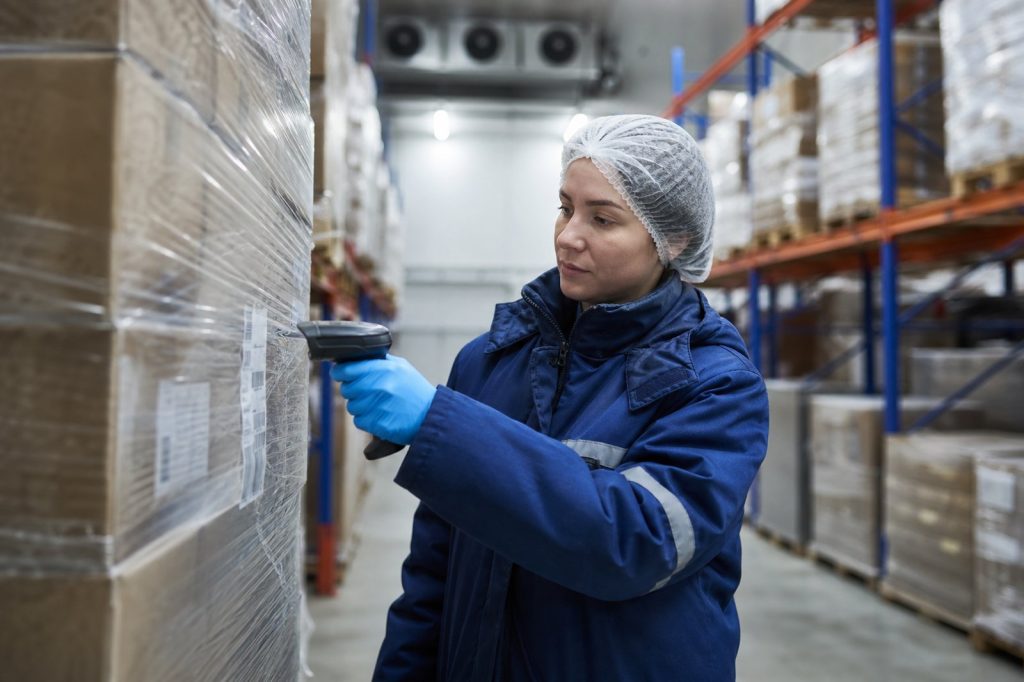
A plant manager should not need a meeting, a spreadsheet reconciliation, or a chain of phone calls to find out what is happening in the facility. The information needed to run the day should be available while there is still time to change the day.
That is what operational readiness actually means: recognizing an issue, understanding its impact, and responding before it becomes a missed shipment, an inventory write-off, a quality hold or a customer complaint.
So here is a simple test. Pick five questions. Ask whether your plant can answer each one in under two minutes, from current data, without anyone leaving the room.
Most plants cannot, and the research says so plainly. In a 2026 survey of over 600 U.S. manufacturing leaders, 74% reported that reporting delays slow production, 65% of frontline supervisors said they lose up to four hours per shift to manual data entry and reconciliation, and — the number that should stop you — only 9% said they could find the root cause of a shop-floor issue immediately. Half of plants still run on manual frontline logs, paper trails and spreadsheets.[1][2]
Separately, a 2026 survey of manufacturing executives found that 69% still make decisions reactively, after an event has already happened, rather than proactively.[3] The information exists. It arrives too late to use.
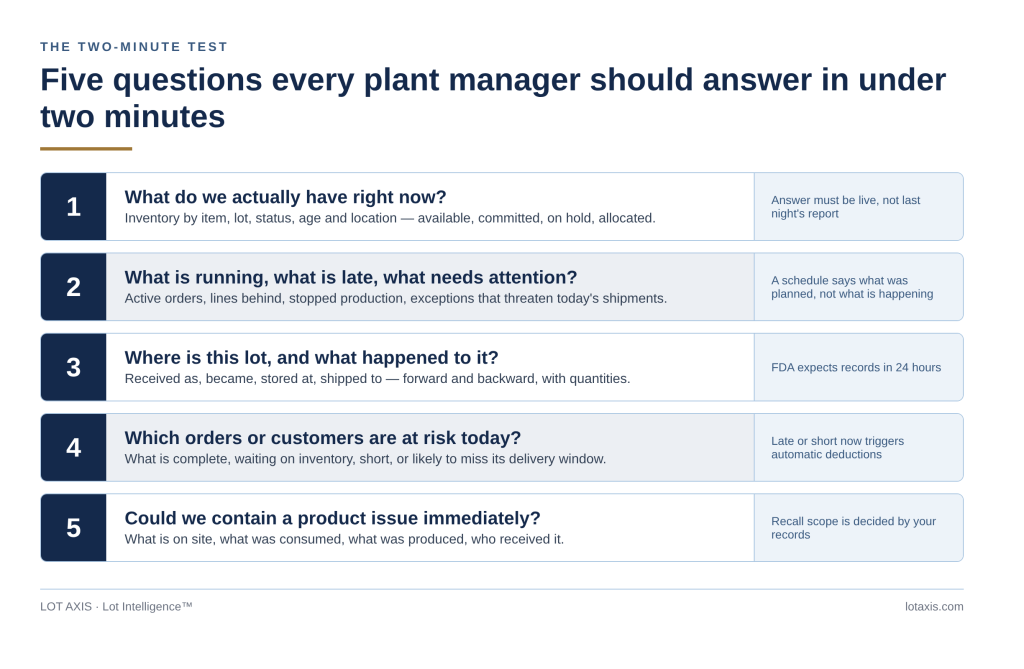
1. What Do We Actually Have Available Right Now?
Not a total from last night’s report. Current inventory by item, lot, status, age and location — what is available, what is committed, what is on hold, what is already allocated to production.
This one is worth testing because the industry is not as automated as it sounds. In the 2025 State of Food Manufacturing survey, only 22% of food and beverage respondents reported fully automated inventory management, with 48% partially automated.[4] “Partially automated” usually means the system is authoritative for some things and a person with a clipboard is authoritative for the rest.
The consequences are measurable. A peer-reviewed 2025 case study at a dairy processor applied structured improvement to inventory control and cut inventory discrepancies by 36.6%, with documented cost savings and improved on-time-in-full performance.[5] That is one plant, not a benchmark — but it shows the size of the gap that ordinary discipline can close.
If answering this question requires walking the warehouse or comparing two systems, the plant is being managed from estimates.
2. What Is Running, What Is Late, and What Needs Attention?
A schedule tells you what was planned. Operational visibility tells you what is happening. A manager should see which orders are active, which lines are behind, where production has stopped, and which exceptions threaten today’s commitments.
Food manufacturers already know where the value sits: in the same survey, real-time production monitoring dashboards were the most widely implemented Industry 4.0 technology at 41%, and respondents said data analytics delivered the most value in identifying production bottlenecks (33%), tracking line performance (31%) and monitoring yield loss (27%).[4]
The dashboard is not the point. Seeing the problem while you can still change the outcome is the point.
3. Where Is This Lot, and What Happened to It?
Pick a lot. Where was it received, what did it become, where is it stored, has it shipped, and in what quantities?
This is a daily operations question long before it is a compliance question. But the compliance version has a clock on it: under FSMA 204, covered records must generally be provided to FDA within 24 hours of a request, in an electronic sortable spreadsheet when asked, with compliance required by July 20, 2028.[6][7]
FDA tested this in practice. In tabletop exercises held March 9 to April 1, 2026 with 15 companies across the supply chain, most firms did respond within 24 hours — and FDA’s own conclusion was that proactive supply chain coordination, more than any particular technology, drove the strongest results. The hardest data elements to produce were the traceability lot code and its source.[7][8]
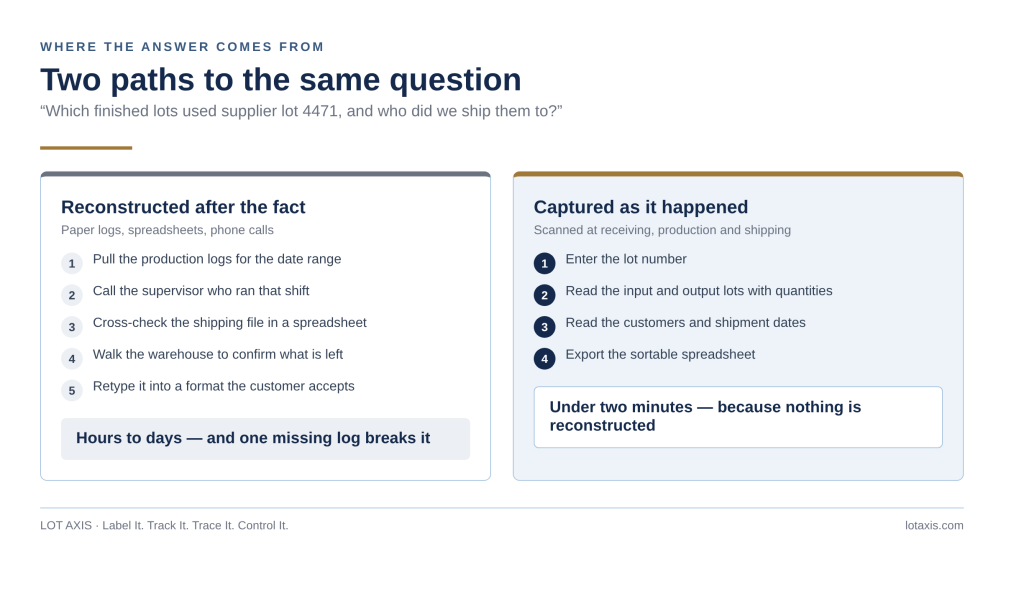
Note what that means for the two-minute test. Answering FDA in 24 hours is achievable by scrambling. Answering your own supervisor in two minutes is not — that only happens when the record was captured as the work was done.
There is a customer service dividend too. When a buyer calls about a lot, “we will look into it and call you back” is a different company than one that answers on the call.
4. Which Orders or Customers Are at Risk Today?
Readiness means connecting what is happening on the floor to what you promised customers: which orders are complete, which are waiting on inventory, which will be short, and which are likely to miss a delivery window.
The cost of getting this wrong is no longer a conversation — it is automatic. Effective January 1, 2025, Kroger raised its on-time arrival (ORAD) compliance threshold from 90% to 93% and implemented an enterprise-wide inbound compliance fee schedule covering pallet quality, load quality, documentation, shipping accuracy and EDI data connections. Purchase orders that are late because of vendor-caused issues are subject to a fee of 3% of the invoiced amount, assessed as an invoice deduction. Kroger also began requiring near-real-time location updates on inbound deliveries from May 1, 2025 and temperature updates from November 1, 2025.[9] Industry analyses report comparable on-time-in-full deduction programs at other national accounts, typically in the 1–3% range per violation, with the burden of proof on the supplier during a short dispute window.[10]
Read that again as an operations problem rather than a finance problem. If you learn at 5 p.m. that a line ran short, you have a deduction. If you learn at 10 a.m., you have options: switch the line, substitute, split the shipment, call the buyer first.
5. Could We Contain a Product Issue Immediately?
The last question uses all the others. If a lot goes on hold, can you immediately say what remains on site, what was consumed in production, what finished goods came out, and which customers received them?
Recall scope is decided by how precisely you can answer that. When the link between an ingredient lot and specific finished lots cannot be proven, the only defensible scope is everything that might have contained it — which is how a recall grows from a few lots to months of production.
A plant that answers this question every day does not need a different operating mode during a recall. Recall readiness becomes a by-product of ordinary discipline.
Instant Visibility Is the Operating Standard
The two-minute test is not about speed for its own sake. It reveals whether your information is current, connected and usable — or whether it has to be assembled by people before anyone can decide anything. Four hours per shift of reconciliation is not an information problem. It is the plant’s capacity being spent on bookkeeping.
Lot Axis is built to remove the assembly step. Scanned receiving, production, palletizing and shipping capture the record once, at the point of work, and the inventory position, the lot genealogy, the order status and the trace all read from the same data.
That is Lot Intelligence™: not another report, but an operation where the answer is already there when the question is asked.
Run the Test This Week
- ✓ Ask for available inventory by lot and location, and time the answer
- ✓ Ask which orders are at risk today, before the end-of-day report exists
- ✓ Pick one finished lot and ask for its input lots and its customers
- ✓ Ask how many hours per shift your supervisors spend reconciling data
- ✓ Ask what would have to happen for a hold to be contained in one hour
Ready to See What Your Managers Can Answer in Two Minutes?
Schedule a demonstration. Bring your five hardest questions and we will answer them live against sample data — inventory, production, lots, orders, containment.
Lot Intelligence™ — Label It. Track It. Trace It. Control It.
This article is general information, not legal or regulatory advice. Confirm your obligations under FDA requirements and your customers’ current supplier compliance policies.
Sources
Paste at the end of the published post. Full research package stays internal.
- L2L — 74% of manufacturers caught in “data chaos” despite increasing tech spend (survey of 600+ U.S. manufacturing leaders, May 2026)
https://www.l2l.com/blog/manufacturing-data-report-press-release
- L2L — Manufacturing Data Paradox report
https://www.l2l.com/data-paradox-report
- Food Industry Executive — 2025 State of Food Manufacturing: Digital Transformation
https://marketing.foodindustryexecutive.com/hubfs/2025%20State%20of%20Food%20Manufacturing_%20Digital%20Transformation.pdf
- FDA — Requirements for Additional Traceability Records for Certain Foods (FSMA 204)
https://www.fda.gov/food/food-safety-modernization-act-fsma/fsma-final-rule-requirements-additional-traceability-records-certain-foods
- Food Safety Magazine — FDA traceability readiness exercises: coordination matters more than technology
https://www.food-safety.com/articles/11507-fda-traceability-rule-readiness-exercises-reveal-supply-chain-coordination-matters-more-than-technology
- Quality Assurance & Food Safety — FDA tabletop exercises reveal traceability challenges ahead of FSMA 204 compliance
https://www.qualityassurancemag.com/news/fda-tabletop-exercises-reveal-traceability-challenges-fsma-204-implementation/
- Kroger — Vendor compliance program updates, effective January 1, 2025 (ORAD threshold and compliance fees)
https://kroger.onenetwork.com/wp-content/uploads/2025/03/1-VNC-Program-Updates_final_signed.pdf
- Brazilian Journal of Operations & Production Management — Enhancing inventory accuracy in dairy industries (2025)
https://bjopm.org.br/bjopm/article/view/2439