| KEY TAKEAWAYS
• Each identifier names one physical thing: a Plant UID one plant, a Package UID one container, a Retail Item ID one unit. Trouble starts when the thing and the record stop agreeing. [2][3] • Since March 2026, every unit a New York distributor sends to a dispensary must carry its own Retail Item ID QR code, and since December 17, 2025 every container must carry its own Package UID. [1][9] • Regulators find mismatches in the adjustment report. A Michigan retailer logged more than 1,100 adjustments in eight months and could not account for 571 package tags; it paid $5,500 and had 30 days to reconcile or lose its license. [4] • Recalls are announced by batch and UID. If your records cannot connect a batch to every package and unit made from it, you cannot answer one. [6][7] |
571 Tags That Were Not on the Shelf
On November 24, 2025, an agent from Michigan’s Cannabis Regulatory Agency opened a package adjustments report in Metrc, the state’s tracking system. One adult-use retailer in Ypsilanti had recorded more than 1,100 adjustments in eight months, with notes saying “entry error” or “scale variance.” [4]
A month later the agent visited. The store had roughly 200 to 300 products on site and 630 active package tags in Metrc. The retailer’s own count in January found 69 tags on site. The other 571 were products that had been sold or destroyed without the record catching up. Five tags of concentrates had been adjusted down by 130 units as “waste” to match the shelf, although none of the 130 had been destroyed. The retailer’s lawyer put it plainly: the issue “boiled down to improperly conducting inventory audits and reconciliations.” [4]
The consent order fined the store $5,500, required an internal audit within 30 days showing Metrc matched physical inventory, and said the license would be suspended until it did. [4] It was not a diversion case. It was a record that drifted away from the room it described, one adjustment at a time.
Three Identifiers, Three Jobs
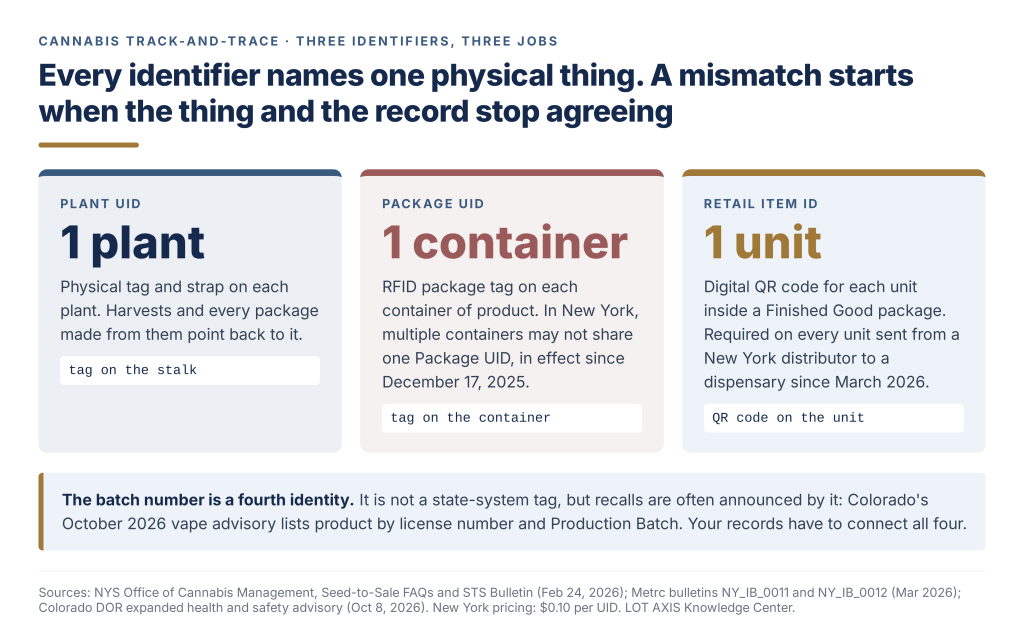
Most state track-and-trace systems use the same building blocks. New York’s Office of Cannabis Management (OCM) describes them clearly in its seed-to-sale FAQ. [2]
Plant UIDs identify individual plants, each with a physical tag and strap. Package UIDs identify a package or lot, each with a physical tag. Retail Item UIDs identify individual retail units inside a finished package, and they are digital only, a QR code printed from your own software or from Metrc. In New York, each UID costs $0.10 under the state’s contract. [2]
A fourth identity sits alongside these: the batch or production batch number. It is not a state tag, but it is what labels carry and what recalls are announced by. Colorado’s expanded vape advisory of October 8, 2026 lists affected product “by license number and Production Batch identifier” and tells consumers to check the label. [6] A California recall notice from September 2026 tells buyers to check the package “for the UID and batch number(s).” [7]
Each identifier names exactly one thing. That is the rule a mismatch breaks.
What New York Changed in 2026
New York moved to Metrc in late 2025 and phased in unit-level identification over four months. [1][9]
- December 17, 2025: every package a distributor sends to a dispensary must carry its own Package UID. OCM’s bulletin is blunt: distributors may not send “multiple packages to dispensaries using one Package UID even if multiple packages contain the same product types and batch ID.” [1]
- January 12, 2026: all retail inventory had to be entered into Metrc against a Package UID. [1]
- March 1, 2026: every finished unit a dispensary receives must carry a Retail Item ID QR code. [1]
- March 31, 2026: each package must also carry a Finished Good designation in Metrc and a “TestPassed” or “RetestPassed” status before transfer. [9]
Metrc’s guidance explains why the unit code matters. A Retail Item ID “extends product recalls to individual units,” and New York’s label rule for a scannable code linked to the certificate of analysis is met by it. [3][2] In California, where the code is optional, Metrc added recall alerts to consumer scans in 2025. [18] Metrc also warned distributors not to remove an existing QR code that links to the certificate; the Retail Item ID can go on as an additional label. [10]
The rollout also added new ways to get it wrong. A package should be marked as a Finished Good only when it is count-based, in final form, not in transit and has no child packages. When a finished package is split, the operator must select “Same Item” so the designation and unit lineage carry over; if not, the child packages lose both. [3] Allotment of Retail Item IDs follows the unit count in the package, not the number of codes printed, so a miscounted package means a miscounted allotment. [3]
Where Mismatches Start
The state systems allow corrections, and the rules about them tell you where errors come from.
In Metrc, a wrong item name on a new package can be fixed with “Change Items,” but only within 24 hours of creating the package. [11] A package created in error should be discontinued rather than adjusted, but only until something else has happened to it: an adjustment, a manifest, a test submission or a child package. [12] Ohio’s Division of Cannabis Control spells out the rest: adjustments must use the right reason code, the notes must describe what happened and may point to a log kept outside Metrc, and adjustments may not be used to move product between packages or for repackaging. Misuse “may result in retesting, administrative hold, destruction of product, or further action.” [5]
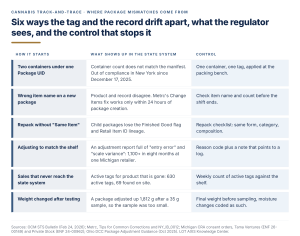
Read the enforcement orders and the same patterns repeat:
- Adjusting to the shelf. The Ypsilanti retailer adjusted “a large number of packages up or down based solely on stock on hand.” [4]
- Weights changed after testing. In 2024 a Michigan grower adjusted one package up 387 grams and another up 1,812 grams after the test samples had been taken, so the samples were smaller than the new weights required. A new employee had miscounted and misweighed. The fine was $12,000. [13]
- Records that describe work never done. At another Michigan grow, Metrc showed 1,513 plants harvested. Inspectors found 3,500 plants still growing and no harvest. [14]
- Weights nobody checked. The grower fined $2 million in September 2026, with 20 licenses revoked, shipped bags labeled as flower that tested as dirt and mulch. The company admitted it was “unfamiliar with how to enter product weight into Metrc” and had not weighed the shipments. [15][16]
The last case is extreme. The first three are ordinary mistakes that grew because nobody compared the record with the room until a regulator did.
What a Mismatch Costs
Costs arrive in layers. The first is rework: a discontinued package tag “cannot be recovered,” so a mistake costs a new tag, a new package and the labor to relabel. [5] In New York, product without Retail Item IDs after the cutoff had to be relabeled at the distributor or sent back to the processor. [1]
The second is held product. Ohio lists retesting, administrative hold and destruction as consequences of improper adjustments. [5] California’s track-and-trace rules require a receiving licensee to reject a shipment whose type or quantity does not match the manifest; the Department of Cannabis Control’s June 2026 proposal keeps that rule and adds that the receiver must accept in the same unit of measure the sender used. [17][8]
The third is enforcement. Michigan’s administrative code requires a retailer to “accurately enter all transactions, current inventory, and other information” into the state system. [19] The CRA fined operators more than $4 million in roughly a month this autumn, according to trade press. [16]
The fourth is the one that matters most. When Colorado widened its Craft vape advisory on October 8, the product had been sold at 504 stores between November 5, 2025 and October 7, 2026. [6] Five days later, on October 13, the state added one more production batch from the same maker. It had “initially passed testing,” was retested after laboratory concerns came up in an investigation, and exceeded the limit for the pesticide chlorfenapyr. It had been sold at 226 stores between September 26, 2025 and July 11, 2026. [6] A passed test is not permanent. Every store had to find the affected batches on its shelves, and a store whose package records no longer match its inventory cannot do that quickly.
Four Weekly Checks
- Count active tags against the shelf. Pull the active package list and count it against what is physically there. The gap is your reconciliation work for the week.
- Read your own adjustment report. Look for repeated “entry error” or “scale variance” notes, and for adjustments with no log behind them. A regulator will read it the same way. [4][5]
- One container, one tag, at the bench. Tag when the package is made, not at the dock, and check item name and count the same shift. [1][11]
- Trace one batch end to end. Pick a batch and list every package and unit made from it and where each one went. Time it.
How Lot Axis Fits
The state system records what the regulator needs. It does not tell you which batch went into which package on which shift, or why a weight changed. Lot Axis records each step at the moment it happens, by barcode scan: harvest or receipt, processing, packaging, testing holds and shipment. The batch, the package tag and the unit codes are linked in one record, weights are captured from the scale rather than typed, and a variance is flagged when it occurs, not when the count fails. That is what we mean by Lot Intelligence™: the record you use to run the operation is the same record that answers the regulator.
Want to see one of your batches traced to every package and unit? Schedule a Lot Axis demonstration and we will run it with your own products.
This article is general information, not legal advice. Track-and-trace rules differ by state; New York dates, California’s proposed rulemaking and Colorado’s advisory are as of October 14, 2026. Confirm current requirements with your state regulator.
Sources
Paste this list at the end of the published post. The full research package below stays internal.
- NYS Office of Cannabis Management — STS Bulletin: Final Reminder, February 28 Deadline for Retail Item ID Transfers (February 24, 2026)
https://cannabis.ny.gov/system/files/documents/2026/02/sts-bulletin-14.pdf
- NYS Office of Cannabis Management — Seed-to-Sale Frequently Asked Questions
https://cannabis.ny.gov/sts-faqs
- Metrc — Bulletin NY_IB_0012: Finished Goods and Retail Item ID Best Practices (March 23, 2026)
https://www.metrc.com/wp-content/uploads/2026/03/NY_IB_0012-Finished-Goods-and-Retail-Item-ID-Best-Practices_V2.pdf
- Michigan Cannabis Regulatory Agency — Tama Ventures, LLC dba Herbology Cannabis Co. Ypsilanti, Consent Order and Formal Complaint, ENF 26-00149 (2026)
https://www.michigan.gov/cra/-/media/Project/Websites/cra/Disciplinary-Actions/2026/July/Tama-Ventures-LLC-dba-Herbology-Cannabis-Co-Ypsilanti-AUR000993-Consent-Order-and-Stipulation-and-Fo.pdf
- Ohio Division of Cannabis Control — Guidance: Package Adjustments in Metrc (October 2025)
https://dam.assets.ohio.gov/image/upload/com.ohio.gov/DCC/DCC_Metrc_Package_Adjustment_Guidance.pdf
- Colorado Marijuana Enforcement Division — Health and Safety Advisories: Staycon LLC dba Craft (September 25, October 8 and October 13, 2026)
https://sbg.colorado.gov/med/health-and-safety-advisories
- California Department of Cannabis Control — Recall Notice: Iced Infused Flower (September 10, 2026)
https://recalls.cannabis.ca.gov/recalls/6aa1a4bcb4769c715186bad8
- California Department of Cannabis Control — DCC-2026-02-R: Track and Trace Updates (proposed rulemaking, June 5, 2026)
https://www.cannabis.ca.gov/cannabis-laws/rulemaking/dcc-2026-02-r/