
| KEY TAKEAWAYS
• First-in, first-out (FIFO) ships the lot that arrived first. First-expired, first-out (FEFO) ships the lot with the least life left. For produce, those are often different lots. • In a blackberry field study, 57% of berries arriving at the packinghouse did not have enough shelf life left for the longest supply routes, and nothing about them looked different. [1] • Temperature drives the gap. Produce held at 20 °C (68 °F) deteriorates about 7.5 times as fast as at 0 °C (32 °F). [6] • Customers already apply expiry logic at the receiving dock: US retailers commonly require 70% of shelf life remaining on fresh food. FEFO is how you meet that rule on purpose. [2] • California’s uniform date-label law took effect July 1, 2026, and it pushes “sell by” dates into code that only the supply chain reads. [13] |
The Oldest Pallet Is Not Always the One About to Expire
Most cold rooms run on a simple rule: ship the oldest product first. It is easy to teach, easy to audit and works well when every lot ages at the same speed.
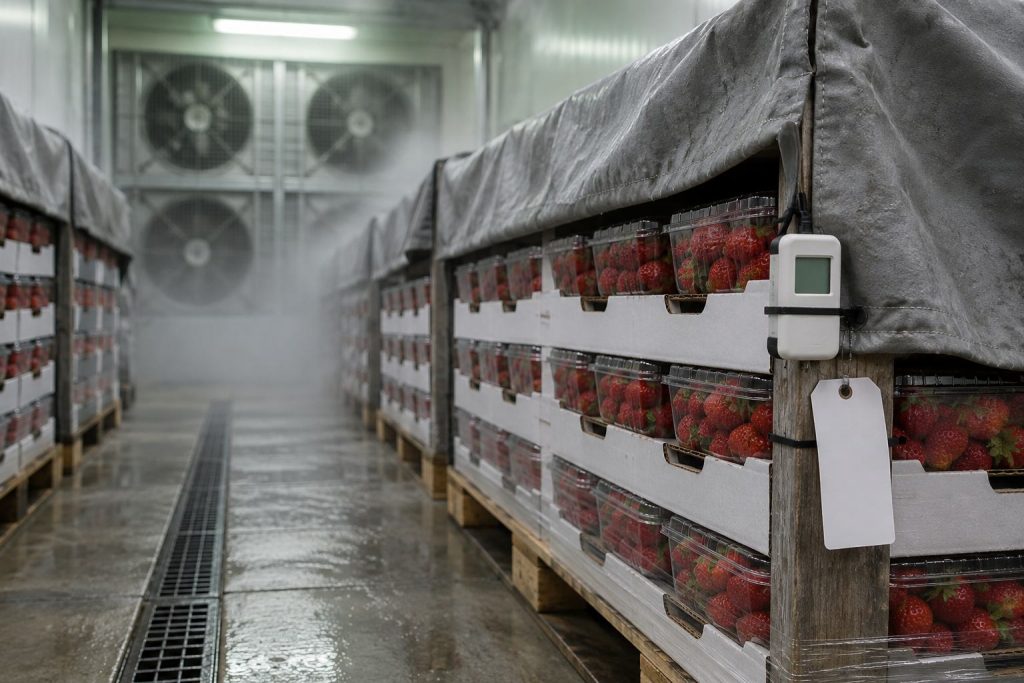
Fresh produce does not. A team from the University of South Florida followed blackberries from the field to the packinghouse and logged the temperature inside the pallets. The temperatures varied widely, and 57% of the berries arriving at the packinghouse no longer had enough remaining shelf life for the longest routes the shipper served. The loss “was not physically visible.” Some of those pallets would have been sent on long routes anyway, which is how avoidable waste is created. [1]
The same researchers found that uneven precooling at the centre of a pallet produces uneven shelf life that is also invisible. Their conclusion was practical: with simple temperature measurements, much of that waste can be avoided by shipping the first-expiring product first. [1]
FIFO, FEFO and the Shipping-Age Rule
There are three common ways to decide which lot goes on the next truck.
FIFO ships the lot received or produced first. It treats age as a stand-in for remaining life.
FEFO ships the lot with the earliest expiry or the least remaining shelf life, regardless of when it arrived. Researchers trace the idea to the late 1980s; the aim is to match each lot’s remaining life to the transport time ahead of it. [3]
Shipping-age thresholds sit on top of either one: a maximum age beyond which a lot may no longer ship to a retailer. In a 2023 study in Production and Operations Management, Akkaş and Honhon note that most such policies are “one-size-fits-all” rules. Using real data from a consumer goods manufacturer, they found 9 to 10% of more than 450 products had suboptimal shipping-age thresholds, and that correcting them could raise profit by up to 8.7% and cut waste by up to 14.7%. [2]
When the product carries a printed date and is stored at a steady temperature, FIFO and FEFO usually pick the same lot. The trouble starts when lots arrive out of order, come from different suppliers, or have had different temperature histories.
Why Produce Breaks First-In, First-Out
For produce, the clock does not run at one speed. UC Davis postharvest material gives relative deterioration rates for produce that is not chilling-sensitive: taking 0 °C (32 °F) as 1.0, the rate is 3.0 at 10 °C (50 °F), 7.5 at 20 °C (68 °F) and 15 at 30 °C (86 °F). Relative shelf life falls from 100% at 0 °C to 33% at 10 °C and 13% at 20 °C. [6] UC Davis classes berries, broccoli, leaf lettuce, spinach and sweet corn as “very high” perishability, with a potential storage life of under two weeks even at near-optimum conditions. [20]
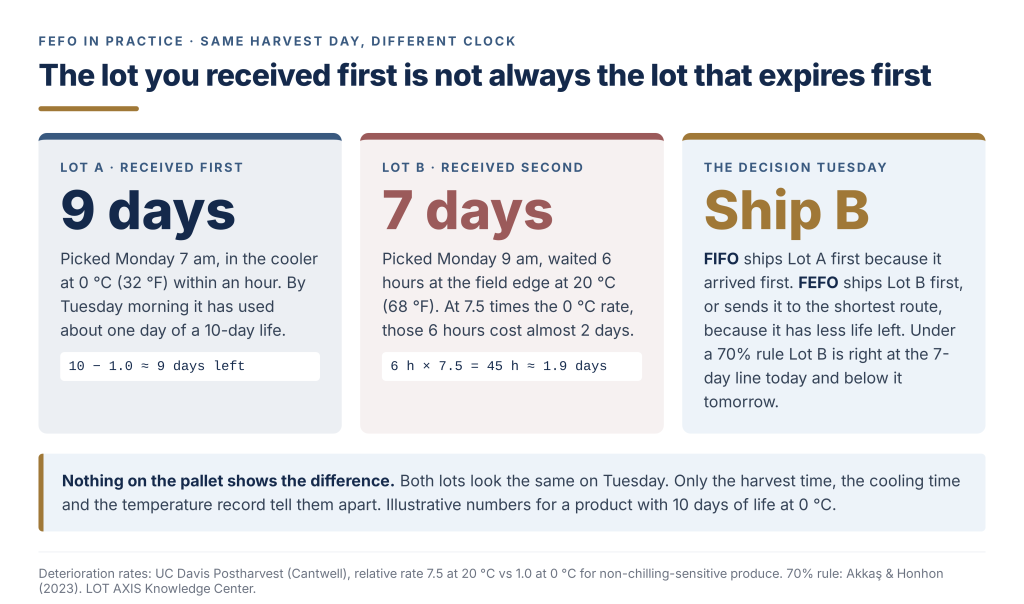
Run those numbers on two lots picked the same Monday morning. Lot A reached the cooler within an hour. Lot B sat at the field edge for six hours at 20 °C. Six hours at 7.5 times the rate costs Lot B almost two days of life before it is cooled at all. By Tuesday, a product with ten days of life at 0 °C has about nine days left in Lot A and about seven in Lot B. FIFO ships Lot A first because it was received first. FEFO ships Lot B, or sends it to the closest customer, because it will expire first. The worked example is in the diagram below.
Studies of this “dynamic FEFO” approach, which uses the temperature history to estimate each lot’s remaining life, have reported savings of 8 to 15% for perishables compared with stock planning based only on receipt date, according to the University of Bremen’s Intelligent Container research programme. [4] In a strawberry trial that tagged flats with temperature sensors from grower to store, Brecht and colleagues found that FEFO distribution delivered more consistent quality than FIFO, with fewer losses and more satisfied consumers. [5]
The losses that FEFO avoids eventually show up in someone’s numbers. USDA’s Economic Research Service estimated an average supermarket loss rate of 11.6% across 31 fresh vegetables, based on shipments received versus pounds sold at about 2,900 stores. [7] Your customer feels that shrink, which is why they write shelf-life rules into their purchase terms.
The Rule Your Customer Already Applies
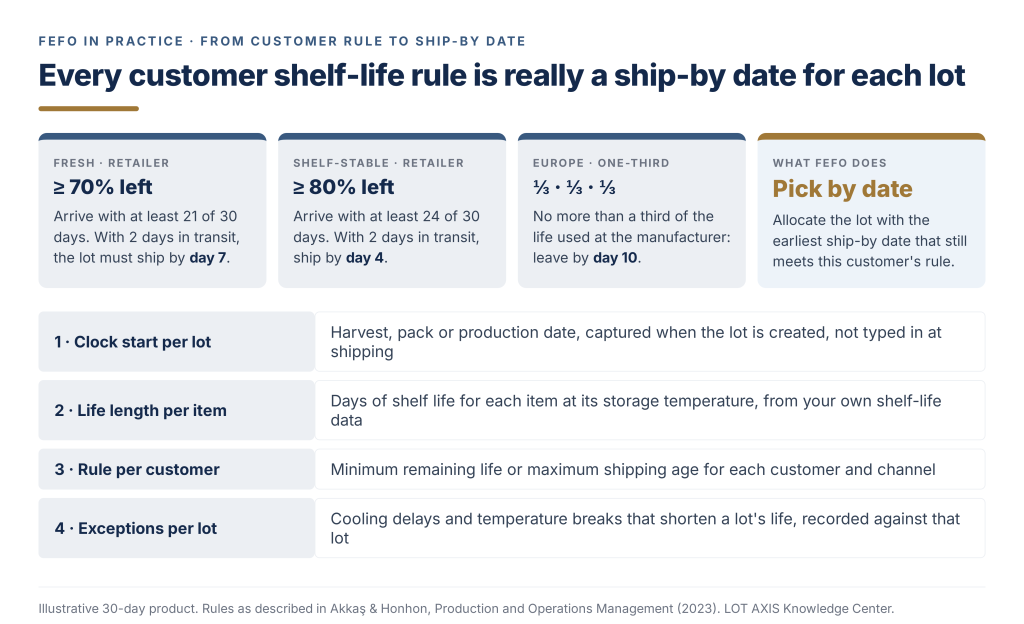
Akkaş and Honhon report that US retailers commonly require at least 70% of shelf life remaining on arrival for fresh products such as dairy, packaged meat and eggs, and 80% for shelf-stable products. European distributors often use a “one-third” rule: no more than a third of the life used at the manufacturer, a third at the distribution centre, and at least a third left at the store. [2]
Each of those rules is really a ship-by date for each lot. On a 30-day product with two days in transit, a 70% rule means the lot has to leave by day 7; an 80% rule, by day 4. A lot that misses its window is not unsafe. It is just unsellable to that customer, and it usually becomes a markdown, a donation or waste.
FEFO done properly answers a slightly different question from “which lot is oldest”. It asks which lot has the earliest ship-by date that still meets this customer’s rule. That can be different for a retailer with a 70% rule and a food-service distributor who accepts shorter life.
What the Date on the Label Does and Does Not Mean
FEFO needs a date to sort by, and in the US most of those dates are voluntary. Except for infant formula, product dating is not required by federal regulation. [8][9] FDA and FSIS encourage “Best if Used By” for quality dates. FDA’s 2019 letter to industry cited an estimate that date-label confusion accounts for about 20% of consumer food waste. [10] In December 2024 the two agencies asked for public input on date labeling practices; the comment period closed March 5, 2025. [11][12] As of October 5, 2026, no proposed rule has followed in the Federal Register.
California moved first. Under Food and Agricultural Code section 82001, food manufactured on or after July 1, 2026 that carries a quality or safety date must use “BEST if Used by” (quality) or “USE by” (safety), and food labeled “sell by” may not be sold in the state. Coded “sell by” dates that consumers cannot easily read are still allowed. [13][14] In other words, the date you rotate stock by may now sit in a code rather than in plain text. Federally, the Food Date Labeling Act (H.R. 4987) was still in committee as of this writing. [15] ReFED estimates more than 3.5 million tons of food are discarded each year because of confusion over date labels. [16]
The EU draws a harder line. Under Regulation 1169/2011, highly perishable foods carry a “use by” date, and after that date the food is deemed unsafe. [17] There, a FEFO slip can mean product that cannot legally be sold at all.
Making FEFO Work on the Floor
FEFO fails in most plants for one reason: the date is not in the system when the pick is made. Four pieces of data per lot fix that.
- A clock start, captured when the lot is created. Harvest, pack or production date, scanned or printed at the time, not typed in at shipping. GS1’s case label guidance gives you the fields: Application Identifier (15) for best before and (17) for expiration, and for blends the date is calculated from the oldest input. [18]
- A shelf-life length per item, from your own shelf-life data at your storage temperature.
- A rule per customer: minimum remaining life or maximum shipping age, held where the order is allocated.
- Exceptions recorded against the lot. A cooling delay or a temperature break shortens one lot’s life. If it is written on a clipboard, the picker never sees it.
Then allocate by lot, not by location. A picker sent to “the front of row 6” will ship whatever is in front. A picker sent to a specific lot will ship the right one, and the scan confirms it. The record of which lot went to which customer is the same record FSMA 204 asks for when you ship a food on the Food Traceability List: the traceability lot code and quantity for each shipment. [19]
How Lot Axis Fits
Lot Axis records every lot with its dates when it is received or produced, by barcode scan, and holds inventory at lot level so stock can be allocated FEFO or FIFO by item. Pickers scan the lot they pick, so the system confirms the right lot went on the right order, and the shipment record ties each lot to its customer. With a date on every lot, you can see which lots are getting close to a customer’s shelf-life limit while there is still time to ship them. That is what we mean by Lot Intelligence™: the lot record you use to run the cooler is the same one that answers a customer, an auditor or a recall.
Want to see your inventory sorted by what expires first? Schedule a Lot Axis demonstration and we will walk through one of your own cold rooms.
This article is general information, not legal or regulatory advice. Date labeling rules differ by product and jurisdiction; confirm your obligations against the current text of California Food and Agricultural Code section 82001, 21 CFR 107.20, FSIS labeling guidance and any customer specifications that apply to you.
Sources
Paste this list at the end of the published post. The full research package below stays internal.
- Nunes, M.C.N. et al. — Improvement in fresh fruit and vegetable logistics quality: berry logistics field studies, Philosophical Transactions of the Royal Society A (2014)
https://doi.org/10.1098/rsta.2013.0307
- Akkaş, A. and Honhon, D. — Determining maximum shipping age requirements for shelf life and food waste management, Production and Operations Management (2023)
https://ideas.repec.org/a/bla/popmgt/v32y2023i7p2173-2188.html
- UC Davis (Cantwell) — Postharvest Handling: Maintaining Quality and Safety (effect of temperature on deterioration)
https://ucanr.edu/sites/default/files/2020-11/339182.pdf
- USDA Economic Research Service — Amounts and rates of retail food loss vary by type of fresh vegetable
https://www.ers.usda.gov/data-products/charts-of-note/chart-detail?chartId=92786
- California Food and Agricultural Code § 82001 — Uniform quality and safety date labels (from July 1, 2026)
https://leginfo.legislature.ca.gov/faces/codes_displaySection.xhtml?lawCode=FAC§ionNum=82001.
- Federal Register — Food Date Labeling, Request for Information (FSIS and FDA, December 4, 2024)
https://www.federalregister.gov/documents/2024/12/04/2024-27810/food-date-labeling
- 21 CFR 107.20 — Infant formula “Use by” date (eCFR)
https://www.ecfr.gov/current/title-21/chapter-I/subchapter-B/part-107/subpart-A/section-107.20
- GS1 US — North American Industry Guidance for Standard Case Code Labeling
https://gs1us.org/content/dam/gs1us/documents/industries-insights/by-industry/food/North-American-Guidance-for-Case-Code-Labeling.pdf