| KEY TAKEAWAYS
• In FDA’s 2026 traceability drills most firms got records in within 24 hours, but only 40% of participants’ records carried the properly assigned traceability lot code across every step they performed. [1] • No federal rule says “run a mock recall.” FDA requires a written recall plan for foods with a hazard needing a preventive control, and FSIS requires written recall procedures. FDA’s own guidance recommends mock recalls to test them. [5][6][8] • The audit schemes do set a frequency: at least annually for SQF and BRCGS, and every six months for PrimusGFS. BRCGS expects traceability within 4 hours, with a mass balance. [10][11][12] • A useful drill takes one real lot, one clock and about two hours. The value is in the gaps you write down, not in the percentage at the bottom. |
Why a Mock Recall Matters More Than It Did
Between March 9 and April 1, 2026, FDA ran traceability readiness exercises with 15 companies across six supply chains: soft cheese, wild-caught finfish, whole-head and fresh-cut leafy greens, and nut butter. FDA emailed a request for records on a specific product over a short date range and asked for them in an electronic sortable spreadsheet within 24 hours, the same format the FSMA 204 rule requires. [1][4]
The headline was encouraging. Most firms answered in time. [2] But the detail is the part a processor should read. The traceability lot code was present, or present in parts, in 80% of participants’ records. It was captured correctly across every critical tracking event a firm performed in only 40%. The complete lot code source (where that code was assigned) showed up across every event in just 27%. Some firms sent shipping data but left out their own initial packing records, or left out input and output quantities. Several scenarios ended without FDA ever finding where the lot code was assigned. [1]
None of that is a technology problem. FDA said so directly: supply chain alignment mattered more than the tools. [1][3] It is a records problem, and records problems are exactly what a mock recall is designed to find while nobody is sick and nobody is waiting.
A current example shows how small the gap can be. On September 23, 2026, Berlin Seeds of Millersburg, Ohio recalled 950 lb of alfalfa sprouting seed after its supplier traced seed lot SAL2-24JB to a sprout grower caught up in a multistate E. coli and Salmonella investigation. [15][16] The 5 lb and 50 lb bags carried the lot code. The quarter-pound, half-pound and 1 lb retail packs did not bear a lot code at all. [15] A customer holding one of those packs cannot tell whether it is part of the recall. A mock recall on the smallest pack size would have caught that in minutes.
What You Are Actually Required to Do
It is worth being precise, because “mock recall” is often described as a legal requirement when it is a scheme or customer requirement.
| Who asks | What they require |
| FDA (21 CFR 117.139) | A written recall plan for food with a hazard requiring a preventive control: notify direct consignees, notify the public when needed, run effectiveness checks, dispose of recalled food. [5] |
| FDA guidance (2022) | Recommends mock recalls to verify readiness, and setting metrics for the recall plan. [6] |
| FDA (21 CFR 1.1455) | For FSMA 204 foods, records to FDA within 24 hours of a request, as a sortable spreadsheet when FDA needs it. Compliance date July 20, 2028. [4] |
| FSIS (9 CFR 418.3) | Written procedures for how the establishment decides on a recall and how it carries one out. Inspectors verify the procedures exist. [8][9] |
| SQF Edition 10 | Traceability tested at least annually; the recall system reviewed, tested and verified at least annually, covering all components. [11] |
| BRCGS Issue 9, clause 3.9 | Traceability test at least annually, raw materials and primary packaging to finished product and back, including a mass balance. Should be achievable within 4 hours. [10] |
| PrimusGFS v4.0, 1.07.03 | Recall and traceback tested at least every six months, recording amount produced, amount located and percent located. [12] |
Two parts of the law also shape how a real recall is judged. FDA recalls use effectiveness-check levels from Level A (contact 100% of consignees) down to Level E (none), so your customer list has to be complete enough for someone to call every name on it. [7] And the FDA guidance tells firms to prepare notification templates and named contacts before they are needed. [6]
The Two-Hour Exercise
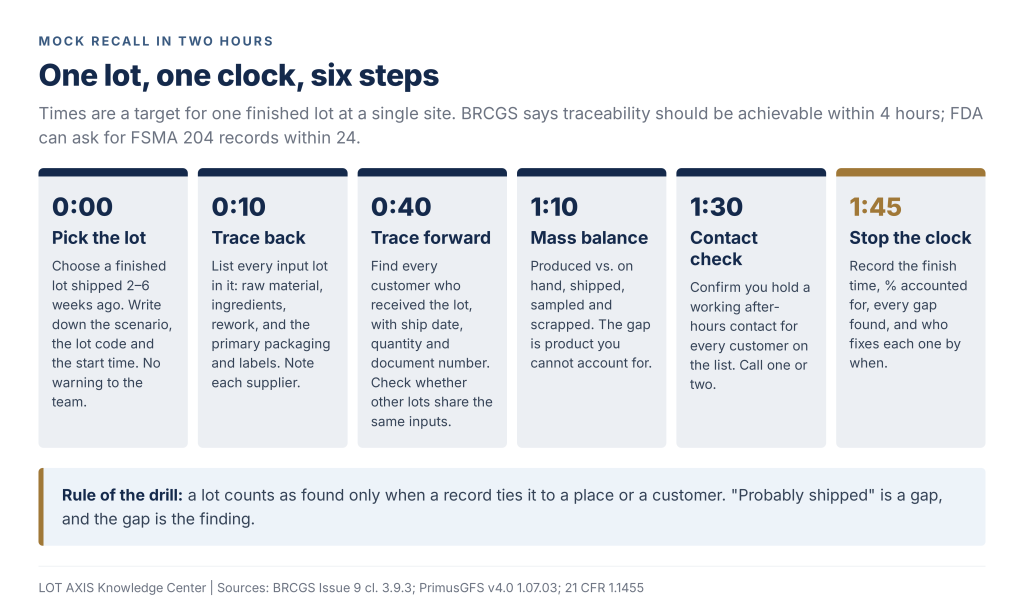
Two hours is a target, not a standard. It is the time one finished lot should take at a single site when the records are in order. If it takes all day, that is the result.
0:00, pick the lot. Choose a finished lot that shipped two to six weeks ago, so some of it is still in the market and some may still be on hand. Don’t choose your simplest product. Choose one with rework, a shared ingredient or a mixed pallet. Write down the scenario (for example, “supplier reports possible Listeria in ingredient lot X”), the lot code and the start time. Do not warn the people who hold the records.
0:10, trace back. List every input lot in that finished lot: raw material, ingredients, processing aids, rework, and the primary packaging and printed labels. Note the supplier and receiving date for each. BRCGS explicitly includes packaging and labels in the test. [10]
0:40, trace forward. Find every customer who received the lot, with ship date, quantity and shipping document number. Then turn the question around: which other finished lots used the same input lots? That list is your real recall scope.
1:10, run the mass balance. Compare what was produced with what you can prove happened to it. The formula is below.
1:30, check the contacts. For every customer on the forward list, confirm you hold a current contact who can act outside office hours. Call one or two, tell them it is an exercise, and ask how much of the lot they still hold. [13][14]
1:45, stop the clock. Write down the finish time, the percentage accounted for, and each gap, with an owner and a date to fix it.
What to Write Down
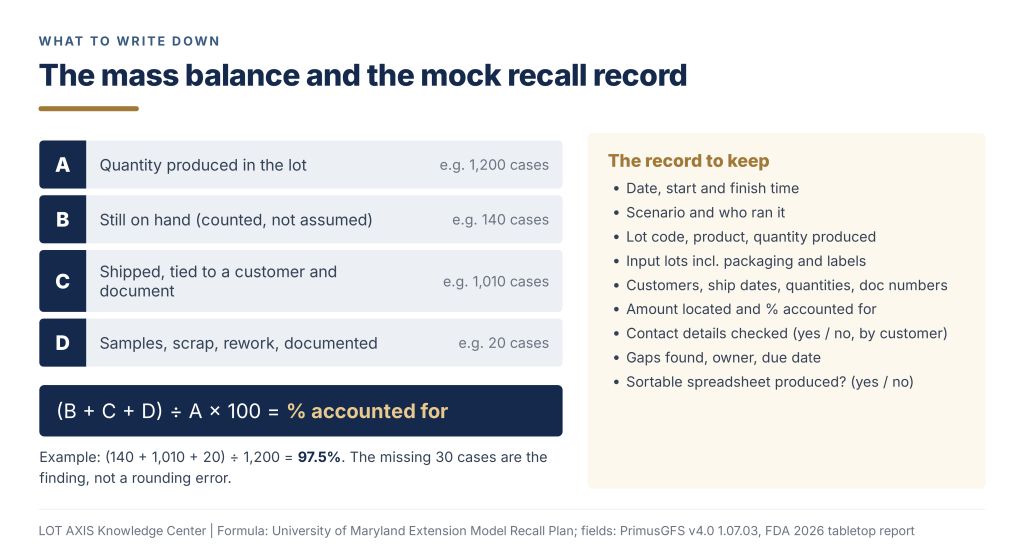
The University of Maryland Extension model recall plan gives the simplest version of the mass balance. [13] Let A be the quantity produced, B the quantity still on hand, C the quantity delivered to customers, and D incidental use such as samples, scrap and rework. Then (B + C + D) ÷ A × 100 is the percentage accounted for.
Count B physically, don’t take it from the system. Count C only where a shipping record ties cases to a named customer. If 1,200 cases were produced and you can prove 1,170, the result is 97.5%, and the 30 missing cases are the finding. Run the same arithmetic on the input side too: raw material received, used in this lot, used elsewhere, and left.
PrimusGFS spells out what the record should hold: the date and time the exercise started, the product chosen, the scenario, the amount produced, the affected lot codes, the amount located, the percent located, copies of the supporting documents, a check that customer contact details exist, and lessons learned. [12] Add one line borrowed from FDA’s drills: could we have produced this as a sortable spreadsheet? Only a small number of FDA’s participants sent a draft traceability plan, and FDA found that those plans made the data far easier to read. [1] Keep the plan beside the drill and note where the two disagree.
Five Ways a Drill Flatters You
The easy lot. A single-ingredient product with one customer proves nothing about the product with rework and twelve customers.
The warned team. If the QA manager pre-pulled the files last week, you have tested their preparation, not the system.
Skipping packaging. Labels and film are inputs. Label mix-ups sit behind a large share of undeclared-allergen recalls, so a wrong label lot needs to be traceable too.
Records counted as product. “The system says it shipped” is not the same as a bill of lading with a lot code on it.
Stopping at your own dock. FDA’s retailers and restaurants moved fastest when suppliers had agreed in advance what data would travel with each load. [1] Ask one customer and one supplier to take part next time.
How Lot Axis Fits
A mock recall is hard when the answers live in a receiving clipboard, a production spreadsheet and the shipping office’s email. Lot Axis captures receiving, production and shipping by barcode scan against one lot record, so the input lots, output lots, quantities and customers are linked as the work happens. The trace back, the trace forward and the mass balance become one screen and an export, not an afternoon of searching. That is what we mean by Lot Intelligence™: lot data you already use to run the plant, ready the moment someone asks where a lot went.
Want to see a real mock recall run in minutes? Schedule a Lot Axis demonstration and bring one of your own shipped lots. We will trace it with you.
This article is general information, not legal or certification advice. Confirm your obligations against the current text of 21 CFR parts 1, 7 and 117, 9 CFR part 418, and the edition of your certification scheme.
Sources
Paste this list at the end of the published post. The full research package below stays internal.
- FDA — Traceability Readiness Tabletop Exercises Final Report (June 2026)
https://www.fda.gov/media/192993/download
- FDA — Guidance: Initiation of Voluntary Recalls Under 21 CFR Part 7, Subpart C
https://www.fda.gov/media/123664/download
- 21 CFR 117.139 — Recall plan
https://www.law.cornell.edu/cfr/text/21/117.139
- 21 CFR 7.42 — Recall strategy (depth of recall and effectiveness checks)
https://www.law.cornell.edu/cfr/text/21/7.42
- 9 CFR 418.3 — Preparation and maintenance of written recall procedures
https://www.law.cornell.edu/cfr/text/9/418.3
- SQFI — SQF Food Safety Code: Food Manufacturing, Edition 10
https://www.sqfi.com/the-sqf-code/choose-your-code/library-of-codes/food-manufacturing
- University of Maryland Extension — Model Recall Plan (with mock recall exercise)
https://extension.umd.edu/sites/extension.umd.edu/files/publications/Model-Recall-Plan-Fillable.pdf
- FDA — Berlin Seeds Recalls Alfalfa Sprouting Seed Because of Possible Health Risk (September 23, 2026)
https://www.fda.gov/safety/recalls-market-withdrawals-safety-alerts/berlin-seeds-recalls-alfalfa-sprouting-seed-because-possible-health-risk