| KEY TAKEAWAYS
• On August 4, 2026 an Orange County Superior Court entered final judgment against California’s Department of Cannabis Control, finding the state track-and-trace system does not flag irregular transactions as state law requires, and giving the department six months to fix it. • Missouri’s State Auditor reported in February 2026 that the statewide system “does not currently have the capability to identify purchases over the legal transaction quantity limits in real time”; the state put track-and-trace out to bid as its vendor contract expired June 30, 2026. • New Mexico switched statewide systems on September 4, 2026 — and told licensees that only the data sitting in the old system at cutover would migrate. • State systems are compliance ledgers. They are not designed to give you yield, cost per gram, cycle time or shrink, and Maine’s own user workgroup said so in writing. |
Two Different Jobs, One Set of Scans
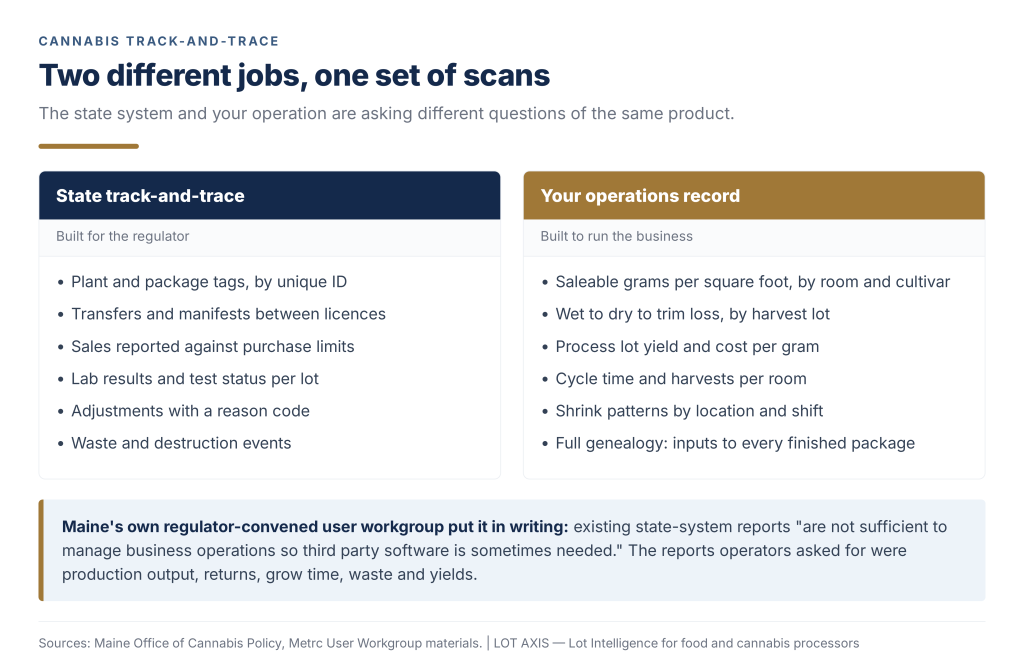
Every licensed cannabis operator in a regulated market types the same numbers into two places: the state’s track-and-trace system, and whatever they actually use to run the business — a POS, a spreadsheet, a whiteboard, an ERP.
That duplication feels like waste, so a lot of operators resolve it by deciding the state system is their system of record. It holds every plant tag, every package, every transfer. Why keep a second copy?
Because the two systems are built to answer different questions. A state system exists to let a regulator see product move through the licensed supply chain and to spot diversion. Your operation needs to know which cultivar returned the most saleable grams per square foot, which process lot lost a third of its weight, which packages are aging on the shelf, and who touched the batch that a lab just flagged. Those are not the same data set, and 2026 made the gap unusually easy to see.
What 2026 Actually Showed
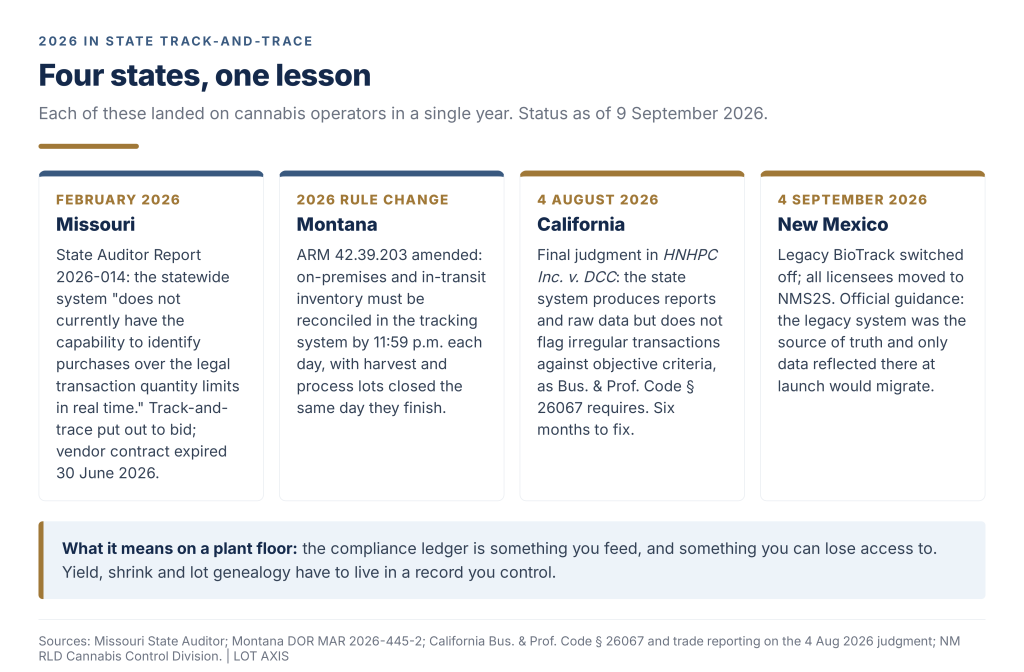
California: the system did not even do the regulator’s job. California Business and Professions Code section 26067 requires the state’s track-and-trace database to be designed to “flag irregularities” for investigation.[1] In HNHPC Inc. v. Department of Cannabis Control, Judge Lee Gabriel entered final judgment on August 4, 2026, finding that the California Cannabis Track-and-Trace system does not do this: it produces large volumes of reports and raw transaction data, but does not automatically identify potentially irregular activity against objective criteria, leaving analysts to review data manually without an established definition of what counts as irregular. The order gives the department six months to establish those criteria; it does not require California to replace the system.[2][3]
Missouri: a state auditor said the same thing about purchase limits. Report No. 2026-014, released in February 2026, found the DCR “performed minimal inventory inspections to ensure cannabis was not being diverted into the black market” and that the statewide system “does not currently have the capability to identify purchases over the legal transaction quantity limits in real time.”[4] Separately, Missouri opened a request for proposal in March 2026 for a fully integrated track-and-trace, licensing and case-management solution as its vendor contract ran to expiry on June 30, 2026, citing functionality gaps, reporting delays and “arduous manual processes.”[5][6]
New Mexico: the ledger changed hands. The Cannabis Control Division moved every licensee from BioTrack to the New Mexico Seed-to-Sale system (NMS2S). Transfers stopped in the legacy system after 5:00 p.m. on August 25, 2026; retailer inventories migrated September 1–2; the old system was switched off at 12:01 a.m. on September 4, 2026.[7][8] The division’s guidance is the part worth pinning to the wall: the legacy system was “the source of truth,” and only the data reflected in it at launch would migrate — so licensees were told to reconcile physical inventory against tracked inventory and close out stale records before the cutoff.[7][9]
Montana: the reconciliation clock is now daily. Montana amended ARM 42.39.203 in 2026 to require that on-premises and in-transit inventories be reconciled in the tracking system by 11:59 p.m. each day, with harvest and process lots recorded as finished the same day they are completed and depleted packages closed the day they reach zero.[10]
Four states, four different stories, one conclusion for an operator: the compliance ledger is something you feed and something you can lose access to. It is not the same as knowing your own business.
The Reconciliation Trap
When the state system is treated as the source of truth, discrepancies get handled backwards. The physical count becomes the thing that must be wrong.
Maryland shows where that ends. In a consent order dated February 2, 2026, the Maryland Cannabis Administration fined a dispensary operator $100,000 after inspections found products listed in the tracking system that were not physically present — and found that a manager had directed staff to ring up “fake purchases” to zero out those lots rather than report the discrepancies. Regulators found no evidence of theft, but the conduct itself was the violation, and the order added mandatory training and 18 months of monthly third-party audits.[11]
The healthy pattern is the opposite. Count physically, reconcile deliberately with a real reason code and a written note, and look at the pattern of adjustments as an operating signal: repeated variances in one product category or one room usually point to a scale, a receiving step or a shrink problem, not to a data-entry problem.
When a Lab Result Moves, Traceability Gets Real
Compliance data is thin in exactly the moment it matters most. Oklahoma’s OMMA ordered a laboratory to cease operations in August 2025 after finding it had miscalculated yeast and mold content, affecting roughly 19,000 samples; the affected products were flipped to “test failed” status in the state system. A year later, compliance inspectors were still finding those products in dispensary inventories, and OMMA issued a mandatory recall in 2026.[12] New York’s Office of Cannabis Management ran a similar sequence, recalling 54 product lots plus one more after determining a permitted lab had reported unreliable results.[13]
In both cases the state had the package records. What it could not do is tell each operator, quickly, which of their finished packages contained material from an affected harvest or process lot, where those packages went, and what remained on hand. That is a genealogy question, and genealogy lives in the system you use to make product — the one that links inputs to outputs at every transformation.
The Numbers a Compliance System Will Not Give You
This is not a criticism of the vendors. It is a design boundary, and Maine’s own regulator documented it. The Office of Cannabis Policy convened a Metrc User Workgroup at the direction of the Legislature and published its findings: existing reports in the system “are not sufficient to manage business operations so third party software is sometimes needed,” and the reports users actually wanted were production output, returns, grow time, waste and yields.[14][15]
Those are the numbers that decide whether a licence survives. Whitney Economics estimated $2.24 billion in excess federal taxes paid by cannabis operators in 2025 under IRC section 280E, and reported that only 27.3% of U.S. operators were profitable in 2024 amid broad price compression.[16][17] In a market like that, grams per square foot by room and cultivar, cost per gram, cycle time, trim and drying loss by harvest lot, and shrink by location are not nice-to-have dashboards. They are the difference between a plan and a guess.
What to Keep in Your Own System
- One record of every lot, from harvest through process lot to finished package, with input-to-output links captured at the moment of the work rather than reconstructed later.
- Weights that come off the scale, not off a keyboard — wet weight, dry weight, trim, waste — so yields are a byproduct of the process.
- Reason codes with meaning. Every adjustment recorded with a cause you would be willing to explain to an inspector and to your own operations meeting.
- Your own history, exported. Assume you will change state systems, vendors or POS providers. Keep a copy of lot history you control.
- A one-hour recall drill. Pick a finished package, walk it back to its harvest lot and forward to every customer who received it. Time it.
- The state system fed from that record, not the other way round.
How Lot Axis Fits
Lot Axis is built for lot-controlled processing: barcode-driven receiving, production and shipping that keep one current record of every lot as it is cut, dried, extracted, blended and packed. Because the lot identity follows the product through every scan, the reporting a state system demands comes out of the same data that tells a production manager what a room actually yielded last cycle and where weight went missing. That is what we mean by Lot Intelligence™: traceability data used every day, not only when a regulator asks.
The operators who came through 2026 calmly were the ones whose own records were good enough that a court order, an audit finding or a statewide cutover was an administrative event rather than an existential one.
Want to see what lot genealogy looks like when the yields fall out of it automatically? Schedule a Lot Axis demonstration and we will walk one of your product flows — harvest, process lot, package, transfer — end to end.
This article is general information about state regulatory programs, not legal advice. Requirements differ by state and change often; confirm your obligations with your state cannabis regulator. Status as of September 9, 2026.
Sources
Paste this list at the end of the published post. Keep it to 6–8 authoritative links — primary law, agency pages and one current-status trade report. The full research package below stays internal.
- California Business and Professions Code § 26067 — track-and-trace program and the requirement to flag irregularities
https://leginfo.legislature.ca.gov/faces/codes_displaySection.xhtml?lawCode=BPC§ionNum=26067
- California Department of Cannabis Control — DCC-2026-02-R Initial Statement of Reasons (CCTT recording and data-accuracy amendments)
https://www.cannabis.ca.gov/cannabis-laws/rulemaking/dcc-2026-02-r/isor/
- Missouri State Auditor — Marijuana Program, Report No. 2026-014 (February 2026)
https://auditor.mo.gov/AuditReport/ViewReport?report=2026014
- New Mexico Regulation and Licensing Department — New Mexico Seed-to-Sale (NMS2S) track-and-trace transition
- Maine Office of Cannabis Policy — Metrc User Workgroup Report to the Maine State Legislature
https://mainelegislature.org/doc/9369
- Montana Department of Revenue — MAR Notice No. 2026-445-2, ARM 42.39.203 seed-to-sale tracking and reconciliation
https://revenue.mt.gov/news/rules-hearing/MAR-Notice-2026-445-2
- Oklahoma Medical Marijuana Authority — Mandatory recall issued for products tested by Greenleaf Labs LLC
https://oklahoma.gov/omma/about/news/2026/mandatory-recall-issued-for-products-tested-by-greenleaf-labs-llc.html
- Cannabis Industry Journal — California Court Orders DCC to Overhaul Cannabis Track-and-Trace System (August 6, 2026)
California Court Orders DCC to Overhaul Cannabis Track-and-Trace System