| KEY TAKEAWAYS
• A food case label has one job downstream: let a customer’s scanner read what it is (GTIN), which lot it came from (batch/lot) and when it was made or packed (a date) without anyone typing. • In a GS1-128 barcode those three are carried by Application Identifiers (01), (10) and (11)/(13)/(15)/(17); the industry treats GTIN plus batch/lot as the FSMA 204 traceability lot code.[1][3][4] • The pallet gets a different label — an SSCC in a GS1-128 barcode — and the data usually travels ahead of the truck in an EDI 856 advance ship notice.[5][13] • Most label failures are physical, not digital: symbols squeezed too small, printed on kraft corrugate, placed too close to an edge, or applied over condensation. GS1 sets a maximum GS1-128 length of 6.5 inches and an edge rule of 0.30 inches minimum, 4 inches maximum.[1] • Sunrise 2027 changes the barcode at retail checkout, not on your cases — but it is a preview of customers expecting lot and date to arrive as data.[7] |
Your Label Is the Only Part of Your System That Leaves the Building
Every processor has some internal way of knowing what a lot is. Production sheets, a whiteboard, a scale printout, an ERP screen. None of that travels. What travels is a label on a case and a label on a pallet, and whatever your customer’s receiving system can read off them.
That is why the case label deserves more attention than it usually gets. If a distributor’s tunnel scanner cannot decode it, someone keys it in — or does not, and the lot link breaks there. If the lot number on the label does not match the lot record behind it, your traceback stops being evidence and becomes an argument.
The good news: the industry settled this long ago, and the data set is small.
The Four Fields That Do the Work
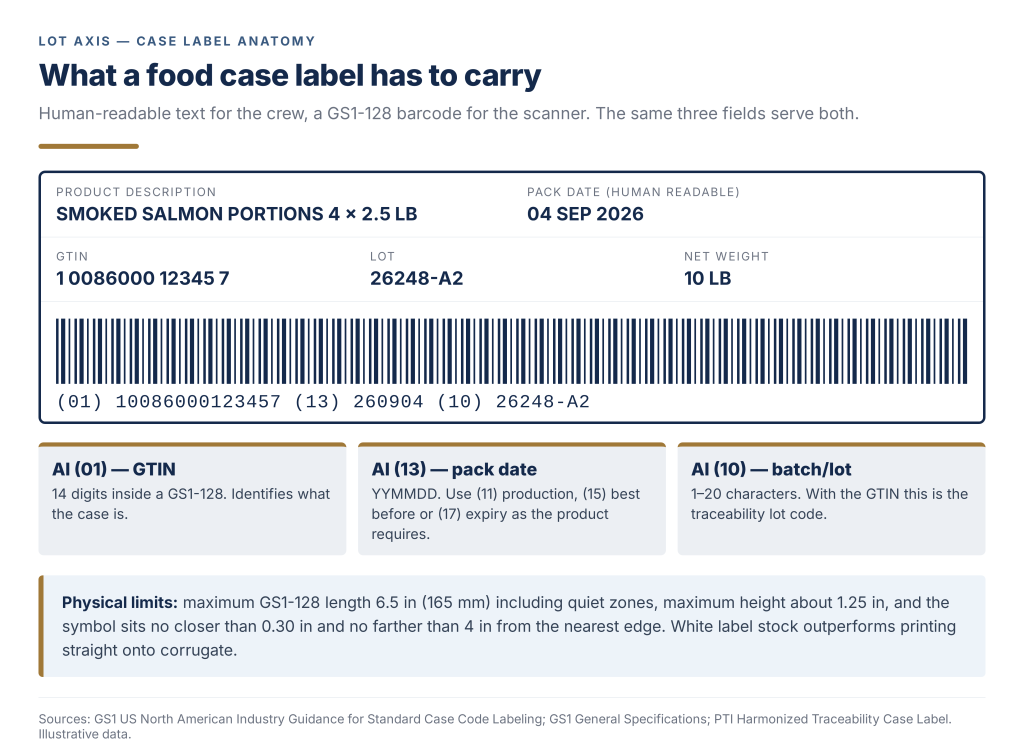
GS1 US’s North American Industry Guidance for Standard Case Code Labeling is the reference document for grocery and foodservice case labels. For manufacturers using GS1-128 barcodes on cases, it recommends a short list of Application Identifiers — the two-digit prefixes that tell a scanner what the next chunk of data means and how long it is.[1][2]
| Data | AI | Format | Notes |
| Global Trade Item Number (GTIN) | (01) | 14 digits | Must be in 14-digit form inside a GS1-128; variable-measure items use indicator digit 9 |
| Batch or lot number | (10) | 1–20 characters | Your production lot, shift, or internal code |
| Production date | (11) | YYMMDD | Age of refrigerated, processed or frozen product |
| Packaging date | (13) | YYMMDD | Unprocessed fresh foods, or where processing changes shelf life |
| Best before date | (15) | YYMMDD | Where the date is meant for the end customer |
| Expiration date | (17) | YYMMDD | Last date the product can be used; for blends, calculate from the oldest input |
Two practical rules sit behind that table. First, the date should also appear in plain human-readable text on the case, because the date is tied to the lot and is what a warehouse crew actually reads; best practice is one date code per product, matching the text on the case.[1] Second, a GS1-128 barcode holds a maximum of 48 characters including the AIs, so you choose the attributes that matter rather than encoding everything, and not every trading partner asks for a GS1-128 at all — it is an agreement, not a universal mandate.[2][17]
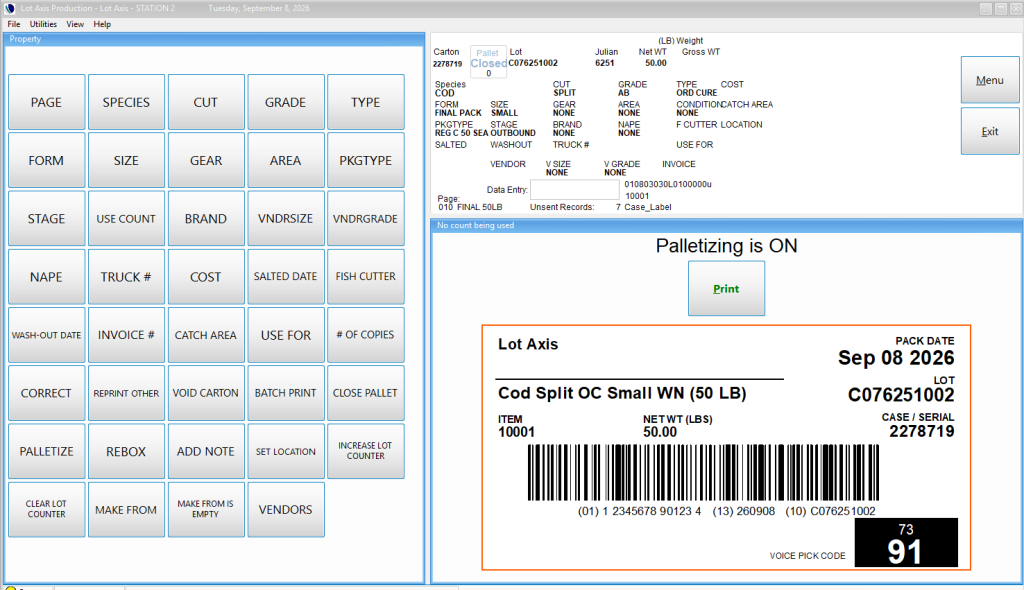
The Produce Traceability Initiative’s harmonized case label is the most concrete example of this in food. It carries a GS1-128 barcode with AI (01) GTIN, a date — AI (13) pack/harvest or AI (15) use-by — and AI (10) batch/lot, plus human-readable product information, the four-digit voice pick code (a digest of GTIN and lot, optionally the pack date) and either a PLU or a retail UPC for the items inside.[3][4]
Why GTIN Plus Lot Is Your Traceability Lot Code
FSMA 204 does not tell you how to build a lot code, and FDA has said the traceability lot code does not have to appear on the product label or packaging at all. What the rule requires is that the code exist, stay unique within your records[11][12], and be provided to the next recipient along with the other shipping data.[3][9]
Industry closed that gap with a convention: the traceability lot code is the combination of the GTIN, AI (01), and the internally assigned batch/lot, AI (10), as printed on the case label.[3][4] It is a good convention because it is already on the carton, already scannable, and already unique — your lot number only has to be unique inside your own numbering, and the GTIN carries your company prefix, which GS1 issues to the brand owner.[6]
So the same label that gets a case put away correctly also produces the shipping records. Under 21 CFR 1.1340 a shipper of a listed food keeps eight data elements per traceability lot and passes seven of them to the immediate subsequent recipient, in electronic, paper or other written form.[9] Scanning a case label is the cheapest way to capture most of them without transcription. Shipping is also not an event where you invent a new code: a new traceability lot code is assigned only at initial packing, first land-based receiving from a fishing vessel, or transformation.[10]
The Pallet Label Is a Different Label
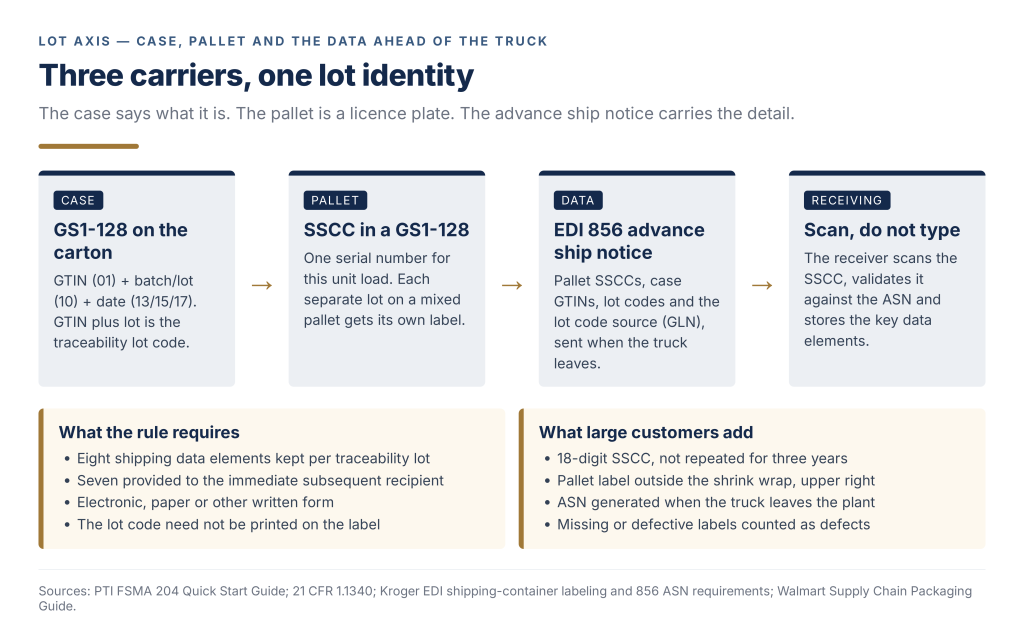
A common mistake is to treat pallet labels as bigger case labels. They are not. The minimum for a pallet is a Serial Shipping Container Code (SSCC) encoded in a GS1-128 barcode — a licence plate for that specific unit load, not a description of the product.[5]
Then the detail travels electronically. The recommended practice is an EDI 856 advance ship notice, with pallet SSCCs, case GTINs, the traceability lot code and the traceability lot code source (typically a GLN); the receiver scans the SSCC and validates the shipment against the ASN rather than typing anything.[5]
Large customers formalise this. Kroger’s manufacturing shipping-container requirements use the 18-digit SSCC, expect the ASN to be generated when the truck leaves the plant, require the label on the outside of the shrink wrap in the upper right corner of the pallet, and require that where more than one lot of an item sits on a pallet, each lot is labeled separately and pre-approved.[13] Walmart’s supply-chain packaging guide sets its own case and pallet label and ASN standards, with measured labeling defects on the supplier scorecard.[14] These are the specifications your label design has to satisfy, and they are stricter than the regulation.
The Physical Rules Everyone Skips
Most label problems are mechanical. GS1’s case-labeling guidance, which sits on top of the General Specifications, is specific:[1][16]
- Maximum GS1-128 length 5 inches (165 mm) including quiet zones, and do not compress the symbol to fit a smaller label when all 48 characters are used.
- Maximum barcode height about 25 inches (31.75 mm); for unattended fixed-position scanners in general distribution, a narrow bar width of 0.0195 inches, versus 0.0104 inches for hand-held scanning.
- Edge rule: not closer than 30 inches (8 mm) nor farther than 4 inches (100 mm) from the nearest edge of the container.
- White labels are proven to work best. Printing case data directly onto kraft corrugate is a known source of readability problems and print-head maintenance.
Print quality is measurable, not a matter of opinion: ISO/IEC 15416 defines how a linear symbol is graded, averaging multiple scan lines across the symbol height.[15] A handheld scanner that reads your label in a warm packing room tells you nothing about how it grades under a customer’s tunnel optics. If your labels matter, a verifier report at press setup and periodic printer checks matter too.
Cold and wet add their own failure mode. An adhesive applied over frost or condensation bonds to the moisture, not the carton, and the label leaves the case later in the cold chain. Match the adhesive to the temperature at which the label is applied, not only the temperature it is stored at, and check whether your labels survive a freeze-thaw cycle before a customer does.
Sunrise 2027 Is About Checkout, Not Your Cases
You will hear more about 2D barcodes over the next year. GS1’s Sunrise 2027 initiative aims for retail point-of-sale systems to be able to scan and process 2D barcodes — QR codes carrying a GTIN, and eventually lot and expiry — by the end of 2027.[7]
That milestone is about consumer units at checkout. GS1-128 on cases and pallets stays exactly where it is. What Sunrise 2027 does signal is the direction: retailers are building the ability to read lot and date at the point of sale, and early testing found that every retailer that tried it hit issues processing GS1 Application Identifier data such as expiration dates.[8] The trading partners who will handle lot data well in 2028 are the ones printing it correctly now.
A One-Hour Audit of Your Own Label
Pull one case from today’s production and one from a customer return or a hold, and check:
- Does the GS1-128 contain AI (01) GTIN-14, AI (10) batch/lot and a date AI? Decode it, do not eyeball it.
- Does the human-readable text agree with the barcode, including the date?
- Does the lot number on the label match the lot in your production record, exactly, no leading-zero games?
- Is the symbol within the length, height and edge limits above, on a white label?
- On a mixed pallet, is each lot labeled separately, with SSCCs that match the ASN you sent?
- Can you take that lot code and produce inputs, quantities, times and destinations in minutes?
Where the Label Stops and the System Starts
A label is a printout. Its value depends on the lot record behind it — and that record is where most processors are thin. If the GTIN and lot come from a template someone edits before each run, the barcode is only as reliable as the person at the keyboard.
Lot Axis exists to make the label a by-product. Lots are created when production happens, inputs are linked to outputs, and case and pallet inventory carries the same lot identity your customer scans at their dock. When a customer or FDA asks about one lot code, the answer comes from one record rather than a reconstruction — which is also how you narrow the recall to the lots actually affected instead of a date range.
See what your label data could tell you. Ask us for a walkthrough using your own product hierarchy and lot numbering — we will show you the case label, the pallet label and the shipping records coming out of one lot record. [Request a demo](#).
This article is general information, not legal or regulatory advice. Trading-partner labeling requirements vary; confirm current specifications with each customer and with the applicable GS1 and FDA documents.
Sources
- GS1 US — [North American Industry Guidance for Standard Case Code Labeling](https://gs1us.org/content/dam/gs1us/documents/industries-insights/by-industry/food/North-American-Guidance-for-Case-Code-Labeling.pdf)
- GS1 US — [What is a GS1-128 barcode?](https://www.gs1us.org/upcs-barcodes-prefixes/gs1-128)
- GS1 — [General Specifications](https://ref.gs1.org/standards/genspecs/)
- Produce Traceability Initiative — [Harmonized Traceability Case Label](https://producetraceability.org/wp-content/uploads/2025/03/FINAL_PTI_Harmonized_Traceabilty_Case_Label_November_2024.pdf)
- Produce Traceability Initiative — [FSMA 204 Implementation Guidance](https://producetraceability.org/wp-content/uploads/2024/02/PTI-FSMA-204-Implementation-Guidance-FINAL-2.12.24-1.pdf)
- Produce Traceability Initiative — [FSMA 204 Quick Start Guide](https://producetraceability.org/wp-content/uploads/2025/01/FSMA-204-Quick-Start-Guide.pdf)
- eCFR — [21 CFR 1.1340: records required when shipping a food on the Food Traceability List](https://www.law.cornell.edu/cfr/text/21/1.1340)
- GS1 US — [Sunrise 2027](https://www.gs1us.org/industries-and-insights/by-topic/sunrise-2027)