| KEY TAKEAWAYS
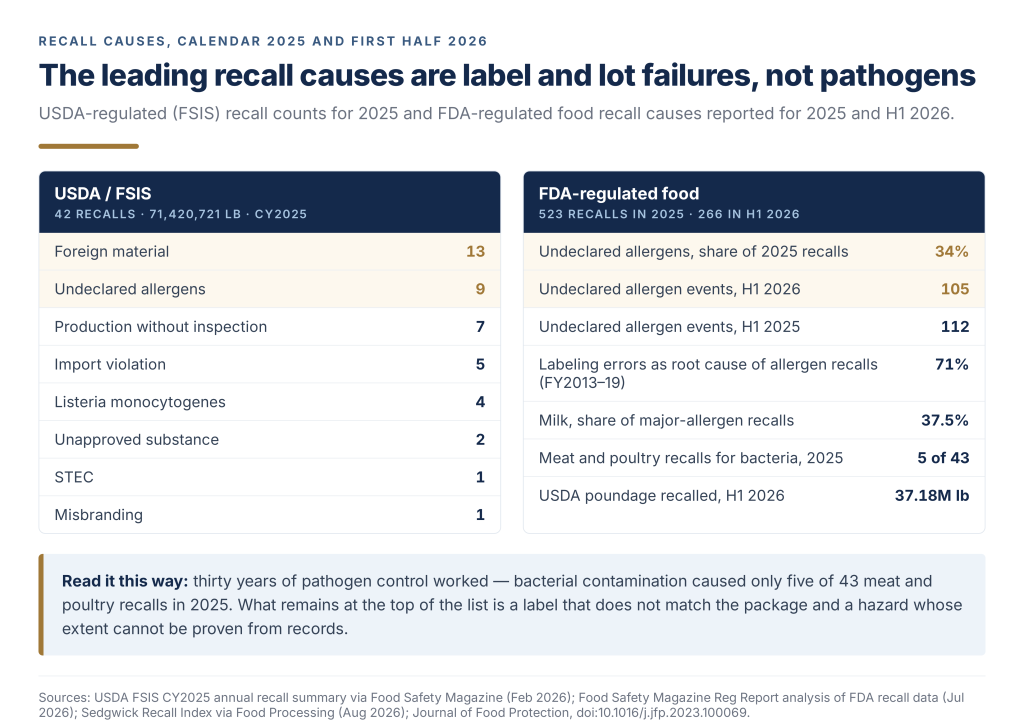
– Foreign material caused more USDA-regulated recalls than anything else in 2025 (13 of 42), and undeclared allergens were second; undeclared allergens led FDA-regulated food recalls at 34 percent of the year’s total [1][2]. – Bacterial contamination accounted for just five of 43 meat and poultry recalls in 2025 — the lowest total in two decades of available data [3]. – In FDA’s own analysis of allergen recalls, labeling-associated errors were the root cause of 71 percent of major-food-allergen recalls where a root cause was known [4]. – Recall size is usually set by records, not by hazard. Hillshire recalled 58 million pounds in September 2025 for wood in the batter, covering everything packaged over a six-month window [5][6]. – The regulations ask for four specific facts within 24 hours: type, amount, origin and destination of the affected product [7]. |
Pathogens get the headlines, the hospitalizations and the litigation. But if you look at what actually triggers recalls in a normal year, two causes sit at the top, and neither of them is microbiology. One is a label that does not match what is in the package. The other is something that should never have been in the food, where the hard part is proving how much product it touched.
Both are lot-record problems. And in both cases, the quality of your records — not the seriousness of the hazard — usually decides how much product you pull off the market.
What the Numbers Actually Say
USDA’s Food Safety and Inspection Service published 42 recalls in calendar year 2025, covering 71,420,721 pounds of product. Thirty-eight of those recalls, and more than 71 million of those pounds, were Class I. The leading cause was foreign material with 13 recalls, followed by undeclared allergens with nine, production without inspection with seven, import violations with five and Listeria monocytogenes with four [1].
On the FDA side, 2025 produced 523 food recalls, up from 431 in 2024 — a change squarely inside normal year-to-year variation. Undeclared allergens led again, at 34 percent of recalls, with pathogens close behind [2].
The pattern held into 2026. Through the first half of the year, undeclared allergens were still the leading cause of FDA food recalls with 105 events, and USDA recall volume hit its highest first-half level in a decade — 37.18 million pounds — driven largely by foreign material, including a single 36.99-million-pound recall of fried rice products contaminated with glass [8].
The contrast is worth sitting with. In 2025, only five of 43 meat and poultry recalls were for bacterial contamination — the lowest figure in two decades of available data, excluding 2020 [3]. The industry has spent thirty years building pathogen controls, and it shows. The failures that remain are mostly failures of labels and records.
Undeclared Allergens Are a Label-Control Failure
The standard mental image of an allergen recall is cross-contact: peanut residue on a shared line. That happens, but it is not the main event.
FDA researchers who analyzed 1,471 allergen and gluten recalls in FDA-regulated foods across fiscal years 2013 to 2019 found that labeling-associated errors accounted for 71.1 percent of major-food-allergen recalls with a known root cause — 914 out of 1,286. Milk was the most commonly involved allergen at 37.5 percent, followed by soy at 22.5 percent and tree nuts at 21.6 percent, and bakery products were the single largest product category [4]. An earlier FDA root-cause review found that applying the wrong label or the wrong package to a food accounted for 82 of 281 undeclared-allergen recalls, often because labels for similar products were stored together and grabbed in the middle of a run [9].
Recent cases read exactly that way:
- In June 2026, FSIS issued a public health alert for 21-ounce packages of honey Dijon chicken breasts after a store employee noticed that the correct label was on the front of the pack and the wrong back label — the one carrying the ingredient statement — was on the reverse. The affected product was identified by a best-by date of June 28, 2026 and lot code 15326A [10].
- In May 2026, a shellfish alert went out because ravioli labeled beef and burrata actually contained shrimp filling in lobster sauce; the mismatch was found by two consumer complaints [11].
- In May 2026, a recall of 71,603 pounds of frozen soup dumplings was traced to a formulation change: the product was reformulated with peanut oil and the finished label was never updated. FSIS caught it during a routine allergen verification task [12].
None of those were sanitation events. Each one was a break in the link between a production lot and the label artwork approved for it. Under FDA’s preventive controls rule, that link is a required control in its own right: §117.135(c)(2) requires food allergen controls covering both cross-contact and “labeling the finished food, including ensuring that the finished food is not misbranded” [13].
Foreign Material Is a Scope Problem
Foreign material recalls behave differently. The hazard is usually discovered fast — a consumer complaint, an injury, a metal detector reject — and it is often confined to a narrow slice of production. The problem is proving which slice.
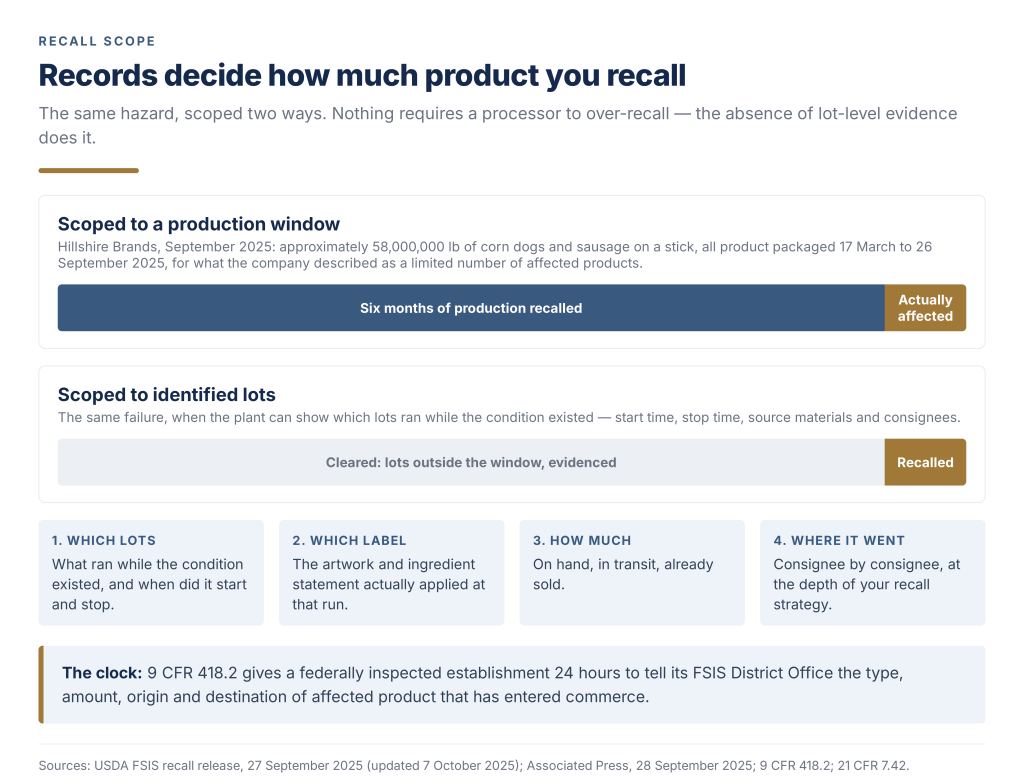
On September 27, 2025, Hillshire Brands recalled approximately 58,000,000 pounds of corn dog and sausage-on-a-stick products because pieces of wood could be embedded in the batter. The company’s investigation determined that wooden sticks were entering the process before battering, and the problem surfaced through multiple consumer complaints, five involving injuries [5]. The recall covered product packaged between March 17, 2025 and September 26, 2025 — roughly six months of output — while the company itself described a “limited number” of products as actually containing wood fragments [6].
That gap between “a limited number” and “58 million pounds” is the whole lesson. When you cannot demonstrate which production lots ran while the failure condition existed, the defensible answer is to recall everything that might have. Regulators do not require you to over-recall; the absence of lot-level evidence does.
What a Recall Decision Actually Requires
The rules are specific about what you must be able to say, and how fast.
If you run a federally inspected meat or poultry establishment, 9 CFR 418.2 requires you to notify your FSIS District Office within 24 hours of learning that adulterated or misbranded product has entered commerce, and to tell them the type, amount, origin and destination of that product [7]. Section 418.3 requires written procedures stating how you will decide whether to recall and how you will carry it out [14].
Under FDA, §117.139 requires a written recall plan for any food with a hazard requiring a preventive control, including procedures to notify direct consignees, warn the public where needed, conduct effectiveness checks and dispose of recalled food [15]. The recall strategy itself — depth of recall to wholesale, retail or consumer level, and the extent of effectiveness checks — is set out in 21 CFR 7.42 [16], and classification into Class I, II or III turns on the probability of serious health consequences under 21 CFR 7.3 [17].
Every one of those obligations rests on the same four facts, and every one is a lot question:
- Which lots are affected — what ran while the condition existed, and when did it start and stop.
- Which label went on which lot — the artwork and ingredient statement actually applied at that run.
- How much of it there is — on hand, in transit, already sold.
- Where the product went — consignee by consignee, at the depth your strategy specifies.
Outside pressure on this is rising, not falling. The U.S. PIRG Education Fund’s Food for Thought 2026 report examined 28 outbreak investigations and around 320 recall announcements from 2025 and found that 60 percent of outbreak investigations produced no product recall at all, with lags of months to years between first illness and recall [18][19]. The response to slow recalls is not usually looser expectations; it is more pressure to identify affected product quickly and precisely.
A Drill Worth Running This Week
Take the last case of finished product you shipped. Then answer, on the clock, using only records:
- Which production lot is it, and what raw material lots went into it?
- What label version was approved for that item, and what evidence shows that version was the one applied to that run?
- If you had to stop at a point in time, which lots ran before and after it?
- Which customers received that lot, in what quantities, and on what dates?
If any answer requires walking to a filing cabinet, calling a supervisor, or comparing a paper run sheet against a shipping binder, you have found the reason recalls grow. Write down what was missing and fix that one gap. That is a more useful exercise than a policy review.
How Lot Axis Fits
Lot Axis was built for lot-controlled food processing: barcode-driven receiving, production and shipping, with one current record of every lot from raw material through transformation to the customer. Because the traceability lot code follows the product through every scan, the answers to those four questions are already assembled — which inputs went into a lot, which item and label it was produced as, how much exists, and which customers hold it.
That is what we mean by Lot Intelligence™: the same records that let you narrow a recall to the lots that ran during a two-hour window are the records that tell your supervisors what is on hand and what is aging. Nobody keeps a system alive for an event that happens once every five years. Records that earn their keep every day are the ones that are accurate when a recall decision lands.
Want to see what a recall decision looks like with lot-level records behind it? Schedule a Lot Axis demonstration and we will trace one of your product flows — receiving, production, shipping — end to end.
This article is general information about federal food regulations, not legal advice. Confirm your obligations against the current text of 9 CFR part 418 and 21 CFR parts 7 and 117, and against your inspection program’s current directives.
Sources
Paste this list at the end of the published post. Keep it to 6–8 authoritative links — primary law, agency pages, peer-reviewed research and one current-status trade report. The full research package below stays internal.
- USDA FSIS — Annual Recall Summaries
https://www.fsis.usda.gov/food-safety/recalls-public-health-alerts/annual-recall-summaries
- Food Safety Magazine — Foreign Material, Undeclared Allergens Caused Most USDA Food Recalls in 2025 (February 23, 2026)
https://www.food-safety.com/articles/11166-foreign-material-undeclared-allergens-caused-most-usda-food-recalls-in-2025
- Journal of Food Protection — Recalls Associated with Food Allergens and Gluten in FDA-Regulated Foods from Fiscal Years 2013 to 2019
https://doi.org/10.1016/j.jfp.2023.100069
- 9 CFR 418.2 — Notification (24-hour reporting of adulterated or misbranded product)
https://www.law.cornell.edu/cfr/text/9/418.2
- 21 CFR 117.139 — Recall plan
https://www.law.cornell.edu/cfr/text/21/117.139
- 21 CFR 7.42 — Recall strategy (depth of recall and effectiveness checks)
https://www.law.cornell.edu/cfr/text/21/7.42
- USDA FSIS — The Hillshire Brands Company Recalls Corn Dog and Sausage On A Stick Products Due To Possible Extraneous Matter Contamination (September 27, 2025)
https://www.fsis.usda.gov/recalls-alerts/hillshire-brands-company-recalls-corn-dog-and-sausage-a-stick-products-due-possible
- S. PIRG Education Fund — Food for Thought 2026